


The multifamily sector produces more operational data per property than nearly any other commercial real estate segment. Rent rolls, maintenance requests, utility usage, lease renewals, amenity tracking, and prospect activity create a constant stream of information. Despite this, many organizations find it challenging to turn these numbers into meaningful insights.
Effective AI data analysis offers portfolio managers, asset managers, and operators a powerful approach to make sense of this complexity, transforming raw data into actionable strategies that enhance decision-making and operational performance across multifamily portfolios.
Why Traditional Analytics Fall Short in Multifamily Operations
While property management software has advanced over the past decade, most platforms remain limited to descriptive analytics. They report on past performance but provide little guidance for proactive decision-making. The real challenge lies not in technology, but in how insights are generated and applied. Key limitations include:
1. Historical Focus Only
Platforms primarily answer what happened last month, quarter, or year, such as occupancy changes, rent growth lag, or budget overruns, providing hindsight rather than foresight.
2. Limited Predictive Capability
Most systems lack the ability to forecast trends or identify early warning signals, relying instead on static reports that require manual interpretation.
3. Time-Intensive Analysis
Generating actionable insights across large portfolios, like 5,000 units spanning multiple markets, requires extensive effort, often delaying decisions and leaving potential NOI on the table.

The Signal-to-Noise Problem
Multifamily portfolios generate thousands of data points daily. Lease applications, maintenance requests, utility readings, competitive rate shops, prospect interactions, renewal offers. Each represents a potential signal about asset health, market positioning, or operational efficiency. Most organizations capture this data but lack the analytical framework to distinguish meaningful patterns from statistical noise.
Consider renewal season at a 300-unit community. Traditional analytics might show an 85% renewal rate. Acceptable performance. But ai data analysis can segment that figure by:
-
Unit type and floor plan efficiency
-
Lease term and original move-in concessions
-
Resident tenure and payment history
-
Proximity to specific amenities or building features
-
Market rent spread versus in-place rents
This granular segmentation reveals that renewal rates vary by 20 percentage points depending on these factors. That intelligence directly informs retention strategies, pricing decisions, and capital allocation priorities.
Predictive Capabilities That Actually Matter
The Artificial Intelligence Index Report 2024 documents substantial improvements in AI performance across various analytical tasks, particularly in pattern recognition and predictive modeling. For multifamily operators, these advancements translate into specific operational advantages.
Revenue management provides the clearest example. Dynamic pricing algorithms have existed for years, but early versions relied on relatively simple inputs such as occupancy thresholds and competitive surveys. Modern ai data analysis incorporates dozens of variables simultaneously:
Revenue Optimization Inputs:
-
Historical absorption rates by season, unit type, and price point
-
Competitive supply additions and lease-up velocity
-
Local employment trends and wage growth
-
Resident retention patterns and renewal propensity
-
Concession effectiveness across different prospect segments
-
Traffic conversion rates by lead source and tour timing
These systems don’t just recommend rent increases or decreases. They identify specific inventory segments where pricing power exists, quantify the revenue impact of various concession structures, and predict absorption rates under different scenarios. The result is measurably higher revenue per available unit without sacrificing occupancy stability.
|
Analytical Approach |
Time Horizon |
Accuracy Range |
Operational Value |
|---|---|---|---|
|
Historical Trending |
Backward-looking |
High (95%+) |
Limited to context |
|
Manual Forecasting |
30-90 days |
Moderate (70-80%) |
Dependent on analyst skill |
|
AI Predictive Models |
90-365 days |
High (85-92%) |
Proactive decision support |
|
Integrated AI Analysis |
Real-time to 12 months |
Very High (88-94%) |
Strategic and tactical guidance |
Operational Efficiency Through Pattern Recognition
Maintenance operations represent another domain where ai data analysis delivers measurable returns. Every work order contains structured data (category, priority, response time, resolution time) and unstructured information (resident descriptions, technician notes, follow-up requests). Traditional systems track completion metrics. AI models identify failure patterns.
A portfolio might experience elevated HVAC service requests during summer months. Expected seasonal variation. But ai data analysis might reveal that specific unit lines in buildings constructed between 2008-2010 with a particular HVAC manufacturer show failure rates 40% higher than portfolio average. That insight triggers preventive replacement programs rather than reactive repair cycles, reducing resident disruption and long-term maintenance costs.
The World Bank’s perspective on AI-ready data emphasizes the importance of properly structured datasets for analytical accuracy. For multifamily organizations, this means establishing data governance frameworks that ensure consistency across properties, markets, and management platforms.
Portfolio-Level Intelligence and Benchmarking
Individual asset analysis matters, but portfolio-level insights drive strategic decisions. Which markets show the strongest fundamentals for capital deployment? Where should organizational resources concentrate? Which property managers consistently outperform on key metrics? These questions require analytical frameworks that can normalize performance across different market conditions, asset vintages, and competitive positions.
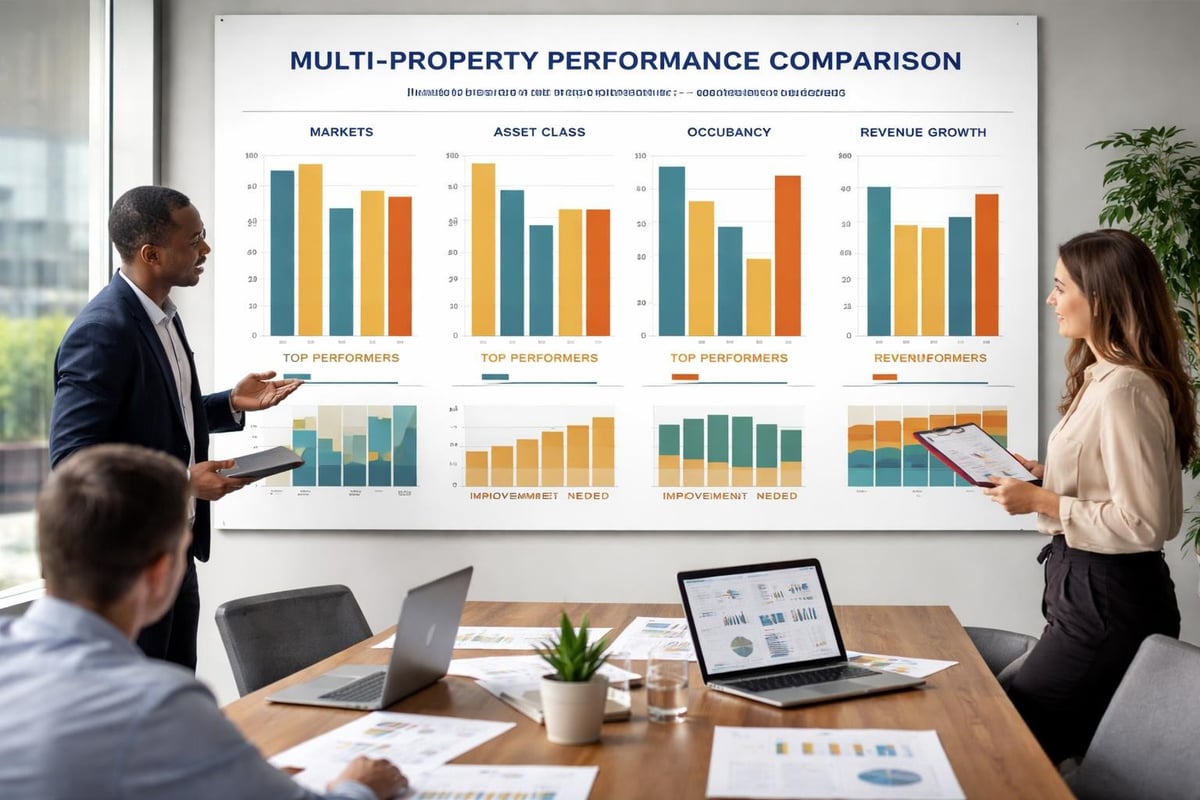
Traditional benchmarking relies heavily on third-party data sources and broad peer comparisons. Useful for context, limited for actionable insight. AI data analysis enables dynamic internal benchmarking that accounts for property-specific variables while identifying genuine performance gaps.
Normalized Performance Metrics
Consider two communities in different submarkets. Property A shows 5% year-over-year rent growth. Property B shows 3%. Superficially, Property A outperforms. But ai data analysis adjusts for:
-
Market fundamentals: Submarket A experienced 4% overall rent growth; Submarket B saw 1%
-
Competitive positioning: Property A faces limited direct competition; Property B competes against three newer developments
-
Capital investment: Property A received $2 million in renovations; Property B operated with routine maintenance only
-
Concession environment: Property A maintained 4 weeks free on average; Property B held to 2 weeks
After normalization, Property B’s performance significantly exceeds Property A despite lower absolute growth. This level of analytical nuance requires processing dozens of variables simultaneously, something human analysts struggle to accomplish consistently across large portfolios.
Automated Insight Generation and Reporting
The multifamily industry has long suffered from reporting fatigue. Asset managers receive monthly packages containing 40 pages of metrics, charts, and variance explanations. Most critical insights hide within the volume. Busy professionals scan for red flags and move to the next property.
Modern AI report generation fundamentally reimagines this process. Rather than presenting every available metric, intelligent systems identify statistically significant variances, emerging patterns, and actionable opportunities. Reports become shorter, more focused, and actually readable.
Key Elements of Intelligent Reporting:
-
Exception-based flagging of performance outliers
-
Natural language summaries of complex metric relationships
-
Predictive alerts for emerging risks (renewal exposure, occupancy softening, expense acceleration)
-
Competitive intelligence integration showing market positioning shifts
-
Recommended actions with quantified revenue or cost impact
This approach doesn’t eliminate human judgment. It amplifies analytical capacity by handling routine pattern detection, allowing asset managers to focus on strategy rather than spreadsheet manipulation.
Integration with Organizational Structures
One persistent challenge in multifamily analytics involves aligning reporting with organizational hierarchies and responsibility structures. A regional manager needs different insights than an asset manager, who requires different information than a property manager. Traditional systems force users to navigate complex reporting structures or wait for custom report development.
AI data analysis platforms increasingly incorporate organizational awareness. They understand reporting relationships, responsibility boundaries, and decision-making authority. A regional VP reviewing performance across 15 properties receives portfolio-level insights with drill-down capability. The property manager at a specific community sees unit-level detail with competitive context. Both access the same underlying data, but the analytical presentation aligns with their decision-making scope.
Private portfolio management particularly benefits from this organizational flexibility. Institutional owners often manage complex structures involving multiple funds, vintage years, and investment strategies. AI systems can segment performance across these dimensions while maintaining consolidated views for executive leadership.
Data Quality and Model Reliability
The OpenDataLab research on standardized datasets highlights a critical challenge in real-world ai data analysis: input quality determines output reliability. Multifamily organizations often operate multiple property management systems, various vintage data structures, and inconsistent coding practices across properties.
Successful AI implementation requires addressing these data quality issues systematically:
|
Data Quality Dimension |
Common Issues |
Impact on AI Accuracy |
Remediation Approach |
|---|---|---|---|
|
Completeness |
Missing fields, partial records |
15-25% accuracy reduction |
Automated validation, required field enforcement |
|
Consistency |
Varying coding standards, duplicate entries |
10-20% accuracy reduction |
Standardized taxonomies, deduplication algorithms |
|
Timeliness |
Delayed data entry, batch processing lag |
5-15% accuracy reduction |
Real-time integration, automated workflows |
|
Accuracy |
Data entry errors, miscategorization |
20-30% accuracy reduction |
Validation rules, anomaly detection |
Organizations that invest in data infrastructure see measurably better results from ai data analysis implementations. The relationship is direct: better inputs generate better insights.

Operational Applications Across the Portfolio Lifecycle
The practical value of ai data analysis extends across the entire multifamily operational spectrum. Acquisition underwriting, asset management, disposition strategy. Each phase generates unique analytical requirements and opportunities.
Acquisition and Underwriting
Traditional underwriting relies heavily on historical operating statements, market studies, and cap rate analysis. These inputs remain essential, but ai data analysis adds predictive depth. Machine learning models can analyze hundreds of comparable transactions, adjusting for property-specific characteristics, market timing, and competitive dynamics to generate more accurate value ranges.
Revenue projections particularly benefit from analytical sophistication. Rather than applying flat growth assumptions, AI models can forecast rent trajectories based on:
-
Historical market cycles and correlation patterns
-
Supply pipeline absorption modeling
-
Demographic trend analysis and household formation rates
-
Employment sector composition and wage growth forecasts
-
Competitive property performance during similar market conditions
The result is underwriting that incorporates probabilistic scenarios rather than point estimates. Acquisition committees can evaluate downside protection, base case expectations, and upside potential with greater confidence.
Active Asset Management
Once acquired, properties require constant performance optimization. Multifamily revenue management represents the most visible application, but operational efficiency, capital allocation, and resident experience all benefit from analytical rigor.
Resident retention provides a concrete example. Most organizations track renewal rates and implement retention programs. But which residents should receive retention incentives? Offering everyone a concession reduces NOI unnecessarily. AI models can predict renewal propensity at the individual resident level based on payment history, service request patterns, lease terms, and market rent spreads.
This precision enables targeted retention spending that maximizes return on investment. A resident showing 30% renewal probability might justify a meaningful concession. One showing 85% probability probably renews without incentive. The analytical framework quantifies the revenue impact of various approaches.
Market Intelligence and Competitive Positioning
Multifamily performance never exists in isolation. Every asset competes within a specific submarket context. Understanding competitive positioning requires constant market intelligence gathering and analysis. Traditional approaches involve periodic surveys, rate shops, and competitor website monitoring. Labor-intensive and frequently outdated.
Modern ai data analysis incorporates competitive intelligence systematically. Automated data collection tracks competitor pricing, concessions, availability, and amenity offerings. But data collection alone doesn’t create advantage. The analytical layer identifies meaningful patterns:
-
How competitors adjust pricing relative to occupancy thresholds
-
Concession program effectiveness across different seasons
-
Amenity investments that drive measurable rate premiums
-
Lead time between competitor rent changes and occupancy impacts
These insights inform both defensive and offensive strategies. Property teams can respond to competitive threats quickly while identifying opportunities to capture market share through strategic pricing or positioning adjustments.
Risk Identification and Mitigation
Portfolio management fundamentally involves risk management. Market risk, operational risk, financial risk, regulatory risk. Traditional approaches rely on periodic reviews, covenant compliance monitoring, and reactive problem-solving. AI data analysis enables proactive risk identification through continuous monitoring and pattern recognition.
Delinquency patterns illustrate this capability. Most organizations track aging reports and implement collection procedures. But ai models can identify early warning indicators that precede payment defaults:
-
Partial payments becoming more frequent
-
Payment timing shifting later in the month
-
Increased service requests suggesting financial stress
-
Employment verification data showing industry sector challenges
Identifying at-risk residents early creates intervention opportunities before delinquency becomes severe. Whether through payment plans, social service referrals, or proactive communication, early action preserves resident relationships and reduces bad debt expense.
Strategic Planning and Capital Allocation
Executive leadership teams face constant capital allocation decisions. Which properties justify renovation investment? Where should organizational resources concentrate? What acquisition opportunities align with portfolio strategy? These decisions benefit enormously from analytical rigor that traditional approaches struggle to provide.
AI data analysis enables scenario modeling that quantifies trade-offs across different strategic paths. A renovation program might generate 8% rent premiums but require 18 months to achieve stabilized occupancy. How does that compare to modest cosmetic updates generating 3% premiums with minimal disruption? The models can project cash flow impacts, return hurdles, and risk-adjusted returns across multiple scenarios.
This analytical capability becomes particularly valuable when evaluating LP positions in private equity structures or assessing fund-level performance against investment theses. Sophisticated investors increasingly expect this level of analytical transparency from their operating partners.
Integration Challenges and Implementation Considerations
Despite clear benefits, ai data analysis implementation encounters predictable obstacles. Legacy technology infrastructure, organizational resistance, data privacy concerns, and skill gaps all create friction. Successful deployments address these challenges systematically rather than assuming technology alone solves problems.
Common Implementation Barriers:
-
Data fragmentation: Information scattered across property management, accounting, CRM, and maintenance platforms
-
Change management: Team members comfortable with existing reporting resist new analytical approaches
-
Skill development: Interpreting AI-generated insights requires different capabilities than traditional reporting
-
Trust building: Decision-makers need confidence in model accuracy before relying on recommendations
-
Cost justification: Demonstrating ROI requires baseline performance metrics many organizations lack
Organizations that succeed with AI implementation typically follow phased approaches. Start with high-impact use cases where data quality is strong and analytical value is obvious. Build credibility through demonstrated results before expanding scope. Invest in training and change management alongside technology deployment.
The multifamily sector stands at an analytical inflection point where data volume, computational capability, and operational complexity converge to make ai data analysis not just beneficial but essential for competitive performance. Organizations that develop sophisticated analytical capabilities will identify opportunities, mitigate risks, and optimize operations in ways that traditional approaches simply cannot match. Leni specializes in bringing AI-powered portfolio intelligence to multifamily owners and asset managers, delivering the analytical depth and operational insights that drive measurable performance improvement across entire portfolios.

Leni is an AI analyst with a background in real estate.
Born in 2022, Leni works alongside asset managers, asset owners, and limited partners, helping teams stay oriented across systems like Yardi and Entrata. With an understanding of both operations and financials, Leni helps teams spot risk early and actively steps in by surfacing insights, creating alerts, and keeping work moving, decisions aligned, and momentum intact.
Get Portfolio Insights With Leni Analytics


