AI Tool for Reporting in Real Estate: Full Guide 2026

AI Tool for Reporting in Real Estate: Full Guide 2026
Reporting never stops in commercial real estate. Every Monday brings occupancy updates. Every month-end demands NOI summaries. Every quarter requires investor packages assembled from scratch. Asset managers and portfolio operators find themselves in an endless cycle, pulling identical data from Yardi, RealPage, or Entrata into the same spreadsheets, reformatting the same tables, and calculating the same metrics. The data sources remain constant. The questions rarely change. Yet the manual work repeats itself week after week, consuming hours that should be spent analyzing performance, not assembling reports. The emergence of an ai tool for reporting in real estate represents a fundamental shift in how commercial real estate teams approach this challenge, moving from reactive manual compilation to automated, proactive intelligence.
The Reporting Calendar That Runs Itself
Asset management teams operate on rigid reporting schedules dictated by investor requirements, internal reviews, and portfolio oversight needs. Weekly leasing activity reports. Monthly variance analyses. Quarterly performance packages. Annual budget comparisons. Each deliverable follows a predictable pattern: extract data from property management systems, clean inconsistencies, calculate standard metrics, format presentations, and distribute to stakeholders.
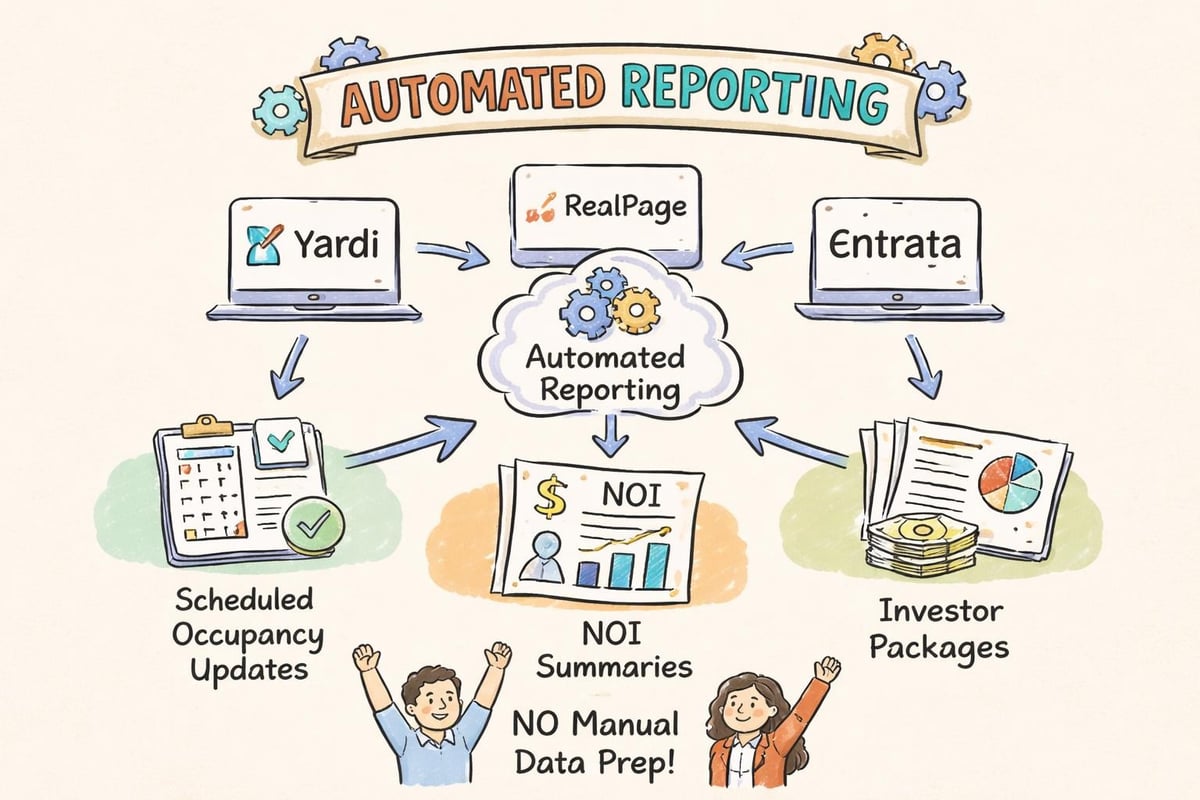
An ai tool for reporting in real estate eliminates this repetitive cycle by automating the entire recurring report workflow. The system connects directly to your existing property management platforms and generates reports on predetermined schedules without manual intervention.
Direct Integration with Property Management Systems
The critical difference between general-purpose reporting tools and purpose-built commercial real estate platforms lies in native integration capabilities. Platforms designed specifically for CRE asset management connect directly to:
Yardi Voyager for lease data, rent rolls, and financial actuals
RealPage for property operations and accounting information
Entrata for multifamily portfolio metrics and resident data
AppFolio for smaller portfolio management workflows
These integrations eliminate the export-import-clean-format sequence that consumes hours of analyst time. When an ai tool for reporting in real estate pulls data directly from source systems, it maintains referential integrity, preserves data lineage, and provides verifiable outputs with direct links back to originating records.
Consider a standard monthly reporting package for a 25-property multifamily portfolio. Traditional workflow requires:
Export rent rolls from each property management system
Consolidate across properties in Excel
Calculate occupancy, effective rent, collections
Compare against budget and prior periods
Create variance analyses and commentary
Format charts and tables for presentation
Distribute to stakeholders
This process typically consumes 12-16 hours of senior analyst time each month. An automated system completes the identical workflow in minutes, scheduled to run on the last business day of each month, with reports delivered to specified recipients without human intervention.
Recurring Report Templates That Adapt
Static templates fail when portfolio composition changes, properties are acquired or sold, or reporting requirements evolve. Advanced reporting tools for property managers incorporate dynamic templates that adjust automatically to portfolio changes.
When you acquire a new property, the system detects the addition, incorporates it into relevant reports, and adjusts historical comparisons appropriately. When investors request new metrics or formats, template modifications propagate across all scheduled reports without rebuilding individual deliverables.
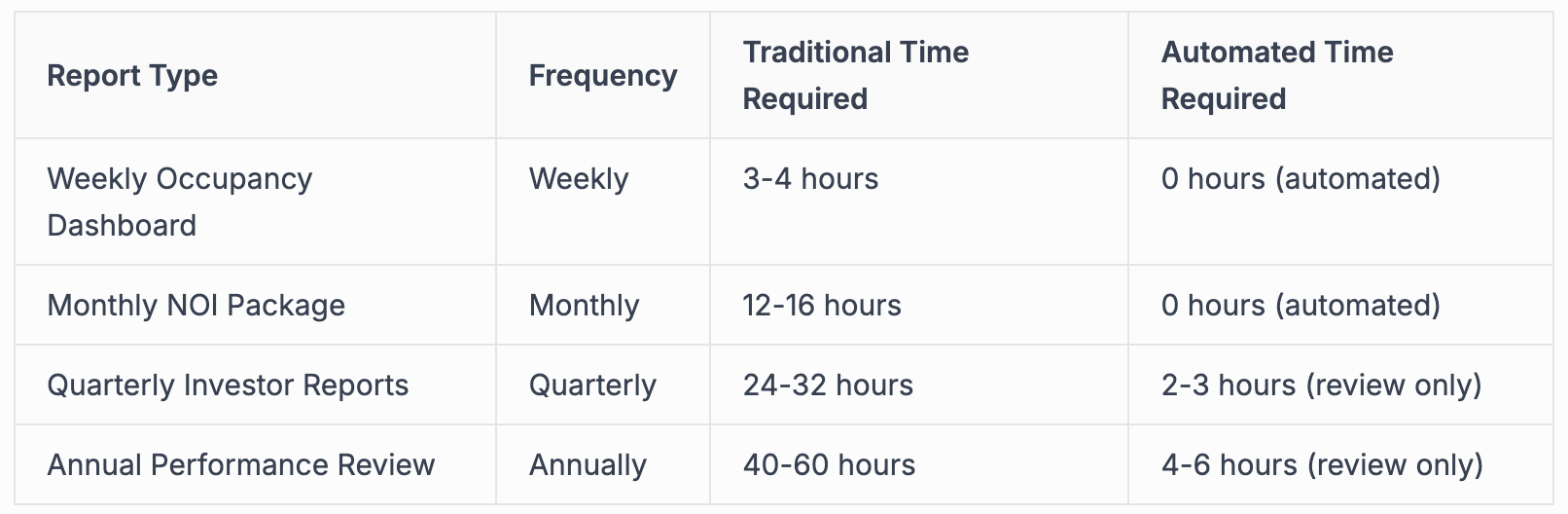
The time savings compound across reporting cycles. A team producing these four standard deliverables reclaims approximately 800-1,000 hours annually when using an ai tool for reporting in real estate with full automation capabilities.
From Backward-Looking Summaries to Proactive Intelligence
Traditional reporting operates on a rearview mirror principle. You discover what happened last week, last month, or last quarter. By the time a metric appears in a monthly report showing occupancy declined 3%, the issue has existed for weeks. Collection shortfalls become visible in reports long after delinquencies began trending upward.
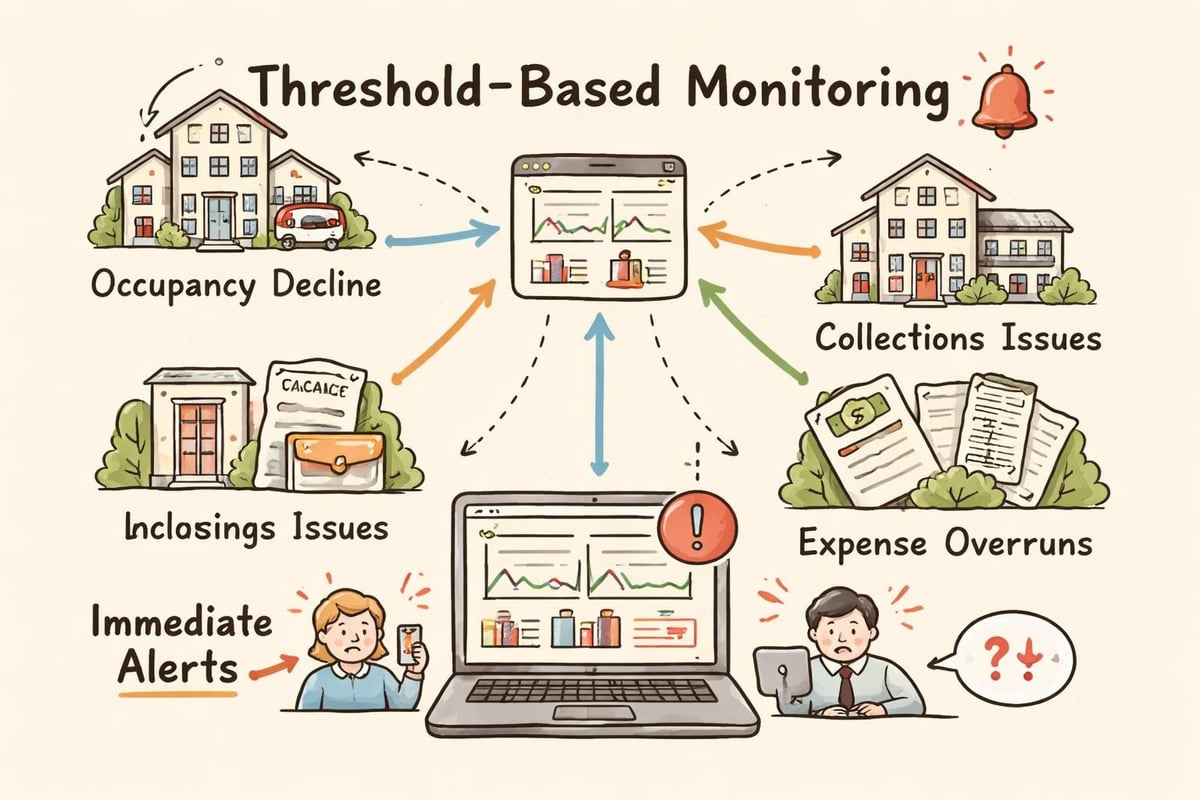
The second fundamental shift an ai tool for reporting in real estate enables involves moving from periodic summaries to continuous monitoring with threshold-based alerts. Rather than waiting for scheduled reports to reveal problems, the system monitors portfolio key asset management metrics in real-time and notifies teams the moment conditions breach established parameters.
Threshold-Based Monitoring Across Portfolio KPIs
Effective proactive reporting begins with defining acceptable ranges for critical performance indicators. Asset managers establish these thresholds based on underwriting assumptions, budget projections, debt covenant requirements, and operational experience.
For a Class A multifamily portfolio, monitoring thresholds might include:
Occupancy below 92% triggers immediate alert
Collections below 98% for two consecutive weeks requires review
Effective rent variance exceeding 5% from budget demands analysis
Operating expense overruns above 10% initiates cost investigation
NOI margin compression beyond 2% prompts operational assessment
Rather than discovering these conditions in next month's report, threshold-based systems notify relevant team members within hours of the breach. This compression of response time transforms how teams address portfolio challenges, as explored in detail by Surface's analysis of AI in real estate operations.
Multi-Property Portfolio Surveillance
Managing twenty, fifty, or one hundred properties simultaneously creates information overload. No team can manually monitor dozens of metrics across an extensive portfolio in real-time. Anomalies hide in the volume. Problems at individual properties escape notice until they're severe enough to affect portfolio-level aggregates.
An ai tool for reporting in real estate designed for portfolio intelligence monitors every property continuously, comparing current performance against historical patterns, peer properties, and established benchmarks. The system identifies outliers automatically and escalates based on severity and persistence.
A practical example: One property in a 40-asset portfolio shows occupancy declining from 95% to 91% over three weeks while peer properties remain stable at 93-96%. Traditional monthly reporting would flag this in the next cycle, 2-4 weeks after the trend began. Continuous monitoring alerts the asset management team within days, enabling immediate investigation into local market conditions, competitive supply, operational issues, or pricing strategies.
Source-Linked Verification and Audit Trails
Automated alerts without verifiable sourcing create as many problems as they solve. Teams waste time investigating false positives or questioning data accuracy. The distinguishing characteristic of purpose-built platforms versus general AI tools lies in maintaining direct links between alerts and source documentation.
When the system flags a collections issue, it should provide:
Specific properties and units affected
Dollar amounts and percentages involved
Historical comparison showing trend severity
Direct links to source records in property management systems
Suggested remediation actions based on similar historical situations
This level of detail, combined with data analysis tools that validate information accuracy, enables teams to move immediately from alert to action without intermediate verification steps.
Implementing AI Reporting Across Real Operations
Understanding the theoretical benefits of automated reporting differs significantly from successful implementation across an operating portfolio. Asset managers evaluating an ai tool for reporting in real estate should consider practical deployment requirements, integration complexity, and change management processes.
Data Integration and System Connectivity
The foundation of effective automated reporting lies in clean, consistent data flows from property management systems. Implementation begins with:
Audit existing data quality across all connected systems. Inconsistent property codes, duplicate entries, missing fields, and formatting variations create downstream complications. Address these issues before automation amplifies them.
Establish standardized property hierarchies that reflect how you actually manage the portfolio. Region, asset class, vintage, and ownership structure taxonomies must align between operational systems and reporting platforms.
Configure integration parameters including data refresh frequencies, field mappings, and calculation methodologies. These technical specifications determine whether automated reports match manual versions exactly or introduce unexplained variances.
Test with parallel runs where automated and manual reports run simultaneously for 2-3 cycles. Compare outputs line-by-line to validate accuracy before retiring manual processes, as detailed in automated real estate reporting best practices.
Template Development and Stakeholder Requirements
Different audiences require different information presented in specific formats. Investors want risk-adjusted returns and capital account summaries. Operating partners need granular property-level operational metrics. Executive teams require portfolio-level strategic dashboards.
An effective implementation of an ai tool for reporting in real estate involves:
Cataloging all current reports produced across the organization
Identifying overlap and redundancy where identical data appears in multiple formats
Consolidating stakeholder requirements into standardized templates
Building approval workflows that route reports to appropriate reviewers before distribution
Establishing version control so template modifications don't break historical comparisons
The goal isn't simply automating existing reports. It's rethinking what information stakeholders actually need and how it should be presented, then building automated workflows that deliver that intelligence consistently.
Training Teams on Proactive Response Workflows
Transitioning from periodic reporting to continuous monitoring requires operational changes beyond technology deployment. Teams accustomed to month-end reporting rhythms must adapt to real-time alert responses.
Successful implementations establish:
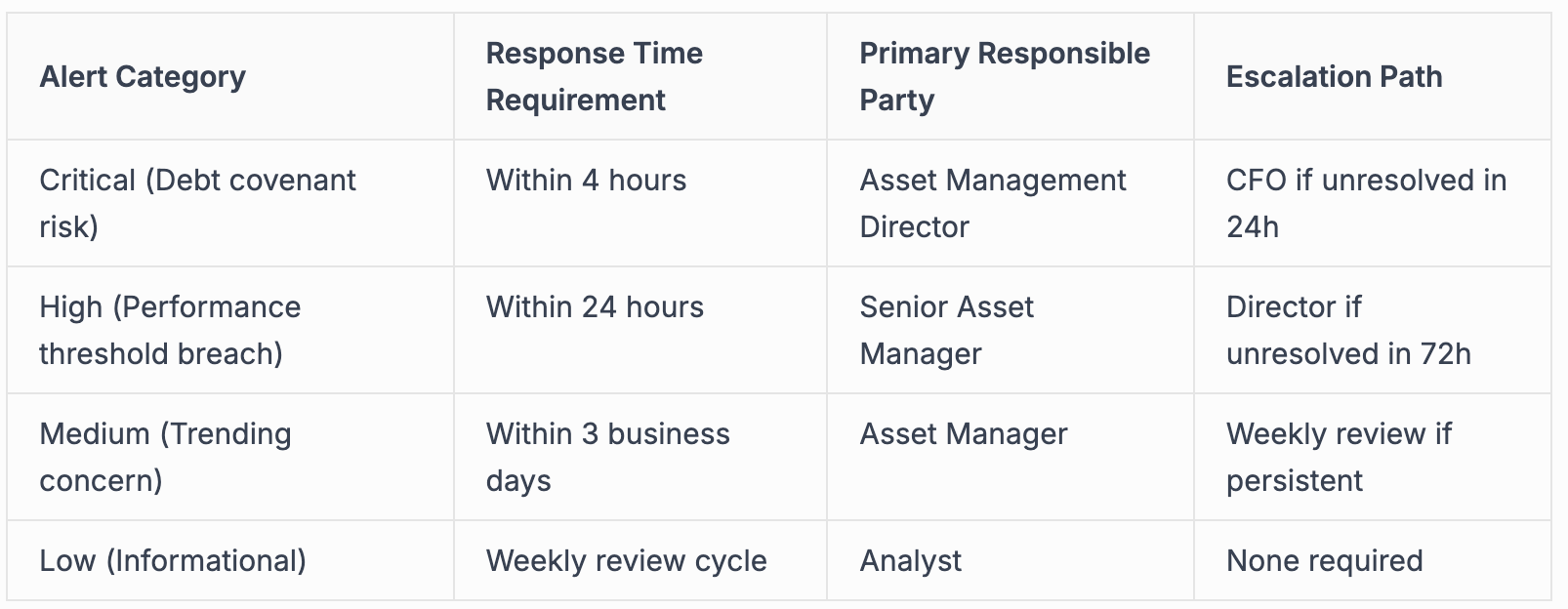
Clear protocols prevent alert fatigue while ensuring serious issues receive immediate attention. The system should allow threshold customization so teams can tune sensitivity based on experience rather than fighting constant false positives.
Measuring Impact and ROI
Quantifying the value delivered by an ai tool for reporting in real estate extends beyond simple time savings calculations. Comprehensive ROI assessment considers multiple dimensions of impact.
Direct Time Recovery
The most obvious benefit involves hours reclaimed from manual reporting tasks. For a typical institutional asset management team:
Analyst time previously spent on data compilation redirects to actual analysis
Senior manager review time decreases when automated quality controls catch errors before distribution
Executive preparation time reduces when dashboards update automatically rather than requiring meeting prep
A three-person asset management team managing $500M AUM typically spends 25-30% of their collective time on reporting activities. Automation can reduce this to 5-10%, freeing 60-80 hours per month for higher-value activities like market research and strategic planning.
Earlier Problem Detection and Resolution
The value of identifying issues weeks earlier than traditional reporting cycles compounds over time. Consider collection problems: detecting a 2% decline immediately versus discovering it in next month's report often represents the difference between quickly resolving a few problem units versus addressing a systemic issue affecting property performance.
Research from Kolena on AI tools driving real estate efficiency demonstrates that early intervention on operational issues can improve NOI margins by 1-3% annually across portfolios. On a $500M portfolio with 6% average NOI margin, that improvement translates to $300,000-$900,000 in additional annual operating income.
Improved Stakeholder Confidence
Investors and lenders value consistency, accuracy, and timeliness in reporting. Teams that deliver reports on predictable schedules with verifiable data sources and clear audit trails build credibility that translates into tangible benefits during refinancing, capital raises, and performance reviews.
Automated reporting systems also eliminate the explanatory conversations that follow manual errors: "Why does this month's occupancy not reconcile with last month?" or "Where did this property disappear from the portfolio summary?" These credibility issues, while seemingly minor, accumulate into material relationship challenges over time.
Security, Compliance, and Data Governance
Deploying an ai tool for reporting in real estate across mission-critical portfolio data requires rigorous security and compliance standards. Asset managers handle confidential financial information, proprietary investment strategies, and personally identifiable tenant data subject to various regulatory requirements.
SOC 2 Type 2 Certification Requirements
Any platform accessing property management systems and investor data should maintain SOC 2 Type 2 certification at minimum. This independent verification confirms:
Security controls protect data from unauthorized access
Availability commitments ensure systems remain operational
Processing integrity maintains data accuracy throughout workflows
Confidentiality prevents unauthorized disclosure
Privacy protects personally identifiable information appropriately
The distinction between Type 1 (design assessment) and Type 2 (operating effectiveness over time) matters significantly. Type 2 certification requires sustained compliance over months of audited operation, not just theoretical policy documentation, as discussed in Matterport's overview of AI applications in real estate.
Role-Based Access and Data Segregation
Not everyone on an asset management team requires access to all portfolio data. Analysts need property-level operational metrics. Senior managers require consolidated portfolio views. Executives want strategic dashboards. Investors see only their specific funds or properties.
Sophisticated platforms implement granular role-based access controls that:
Restrict data visibility to appropriate organizational levels
Limit report distribution to authorized recipients
Maintain audit logs of who accessed what information when
Enable data segregation across funds, partners, or business units
These controls become critical when a single team manages multiple funds with different investor groups or operates joint ventures with distinct information rights.
Data Retention and Historical Integrity
Commercial real estate operates on long time horizons. Asset hold periods span 5-10 years. Investors require historical performance data extending across acquisition, operation, and disposition. Lenders need historical financials for refinancing. Regulators may request documentation years after events occurred.
An ai tool for reporting in real estate must preserve historical data integrity even as properties are bought, sold, or refinanced. The platform should maintain:
Immutable historical records that can't be altered retroactively
Point-in-time reporting that recreates exactly what was known when previous decisions were made
Calculation methodology versioning that documents how metrics were computed across different periods
Source document retention linking reports to underlying evidence
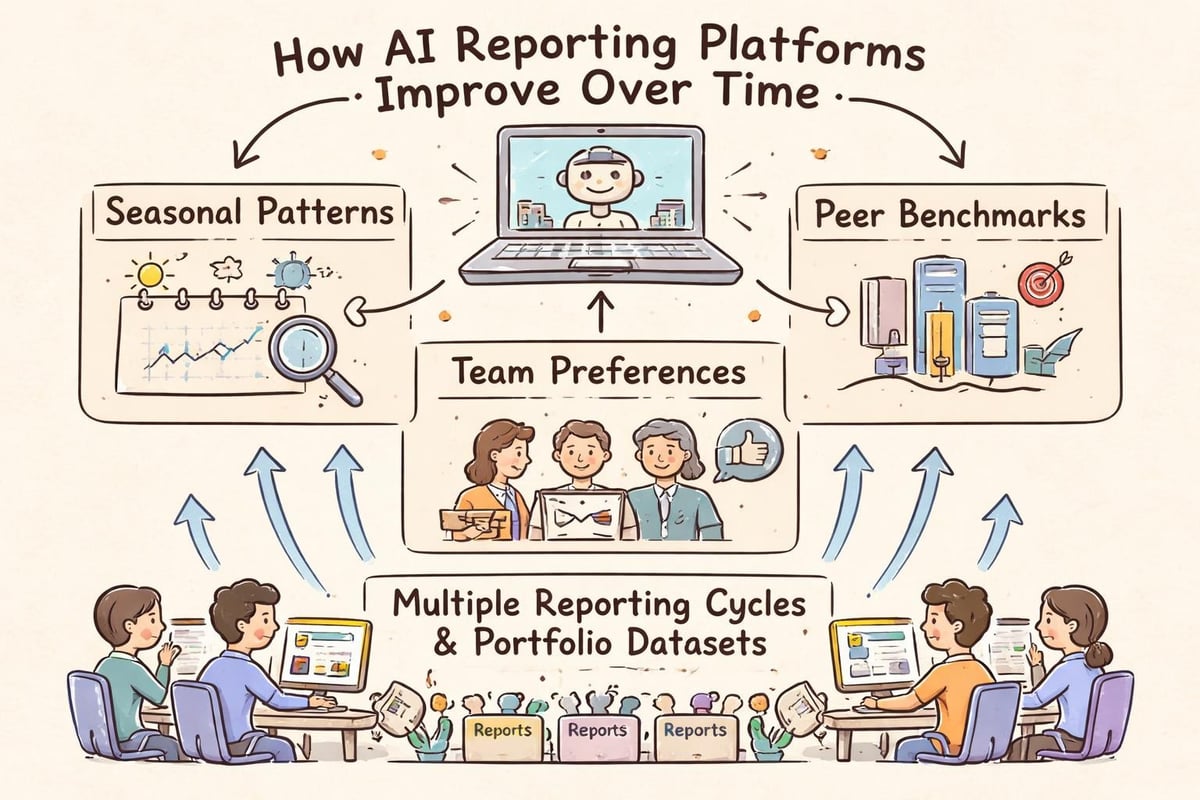
Building Adaptive Intelligence Over Time
The most advanced implementations of AI reporting platforms don't just automate existing processes. They improve continuously as they ingest more data and learn from team interactions. This adaptive capability distinguishes purpose-built AI analyst platforms from static reporting tools.
Pattern Recognition Across Historical Performance
As the system processes more reporting cycles across more properties, it builds sophisticated models of normal versus anomalous performance. A property showing 2% occupancy decline might be concerning in isolation but entirely normal given seasonal patterns the AI has identified across three years of historical data.
The platform learns:
Seasonal variations specific to different markets and asset classes
Peer group benchmarks derived from actual portfolio performance rather than third-party surveys
Leading indicators that historically preceded significant performance changes
Correlation patterns between different metrics that humans might miss
This learning capability means the ai tool for reporting in real estate becomes more valuable over time rather than remaining static. Alerts become more accurate. Reports become more insightful. Analysis becomes more predictive.
Customization Based on Team Preferences
Different asset management teams have different analytical approaches, risk tolerances, and reporting preferences. Advanced platforms adapt to these preferences through:
Template evolution based on which sections of reports stakeholders actually read and reference
Alert threshold refinement as teams indicate which notifications proved actionable versus which were false positives
Calculation methodology preferences when teams consistently override default formulas with custom approaches
Distribution list optimization as the system learns which stakeholders engage with which report types
This adaptation occurs without explicit programming. The AI observes how teams interact with outputs and adjusts accordingly, as detailed in research on AI applications transforming real estate.
Integration with Broader Analytical Workflows
Reporting doesn't exist in isolation. Asset managers use the same underlying data for financial modeling and underwriting, acquisition analysis, budget planning, and strategic decision-making. The most powerful implementations connect reporting outputs to these adjacent workflows.
When a monthly report shows NOI variance, the platform should enable immediate scenario analysis: "If this trend continues for six months, how does it affect refinancing capacity?" or "What rent growth would be required to return to budgeted performance?"
This integration transforms reporting from a compliance exercise into an analytical foundation that supports broader portfolio management decisions, connecting to capabilities like real estate portfolio intelligence and strategic planning tools.
What the Automated Reporting Workflow Actually Looks Like
Understanding how these capabilities combine in practice helps visualize what asset management operations look like when an ai tool for reporting in real estate runs the reporting calendar autonomously.
Monday morning, 7:00 AM: Your executive dashboard updates automatically with weekend leasing activity across all properties. Occupancy changes, new leases signed, renewals executed, and move-outs processed populate without manual data entry. The system has already compared performance against weekly targets and flagged two properties trending below expectations.
Monday morning, 8:30 AM: You receive a threshold alert indicating collections at one property dropped to 96.2%, below your 98% floor. The notification includes specific units involved, historical payment patterns for those residents, and a link directly to the delinquency records in Yardi. You forward it to the property manager with a request for immediate outreach before the situation worsens.
Month-end, last business day, 5:00 PM: The system generates complete monthly reporting packages for all stakeholders. Investor reports, internal performance reviews, lender compliance packages, and executive summaries distribute automatically to predetermined recipients. Each report draws from the same verified data sources, ensuring consistency across all deliverables.
Month-end +1 business day, 9:00 AM: Rather than spending the first week of the new month assembling last month's reports, you review the automated outputs for accuracy and spend your time analyzing the variances the system has highlighted. The AI has already identified that rising maintenance expenses at three properties correlate with HVAC system age and suggests a proactive replacement analysis.
Quarterly, first week: Investor presentation decks generate automatically, incorporating quarterly performance data, market research updates, and portfolio-level analytics. You spend your time refining commentary and strategic recommendations rather than building slides and populating tables.
This workflow represents the fundamental transformation an ai tool for reporting in real estate enables. The calendar runs itself. Data flows automatically. Teams shift from compilation to analysis, from reactive problem discovery to proactive intervention.
Asset managers and portfolio operators who automate their reporting infrastructure reclaim hundreds of hours annually while simultaneously improving the timeliness and accuracy of portfolio intelligence. The combination of automated recurring reports and threshold-based proactive alerts transforms reporting from a periodic backward-looking compliance exercise into a continuous forward-looking analytical foundation. Leni delivers both capabilities through direct integration with Yardi, RealPage, Entrata, and AppFolio, automating the reporting calendar while monitoring portfolio KPIs with Pulse alerts that notify teams the moment performance moves outside established parameters. The result is a reporting workflow that runs itself, freeing asset management teams to focus on the analytical and strategic work that actually drives portfolio value.

Johanna Gruber
Johanna has spent the last 8 years helping marketing teams connect with audiences through content. Specializing in B2B SaaS and real estate.

Curious About AI?
Join the largest AI community for real estate online. Get bite-sized, real-world use case videos, plus practical tips and proven strategies from top industry experts on adopting AI effectively.
MEET LENI
AI SuperAgent Purpose Built for Investors and Operators.
Experience how professionals and teams in your domain are getting the edge using AI.
