


Multifamily investment teams closed more than $290 billion in deals across 2025, yet asset managers consistently report that 60 percent of analyst hours still go to formatting Excel tabs, cross-checking rent rolls against offering memorandums, and copy-pasting data into investment committee templates. That friction vanishes when ai for real estate investment shifts from passive chatbot to active analyst-one that builds complete financial models, drafts IC memos, and performs live market research with verifiable source citations.
Why Traditional Deal Workflows Leak Speed and Precision
Investment professionals face a straightforward problem: every property acquisition or disposition generates dozens of documents, hundreds of line items, and multiple layers of stakeholder review. Underwriting a value-add multifamily asset means reconciling the seller's OM projections against in-place rent rolls, building a discounted cash flow model with multiple exit scenarios, stress-testing interest rate sensitivities, and translating those findings into executive-ready memos and investor decks.
Historically, junior analysts spend 12 to 18 hours per deal on mechanical tasks. They toggle between PDFs, spreadsheets, and presentation software, transcribing data by hand and hoping no formula breaks when columns shift. AI in real estate has been discussed for years, yet most tools remain read-only summarizers-they generate bullet points but cannot produce the structured deliverables investment committees actually need.
The Gap Between Summary and Deliverable
A chat interface that answers "What's the projected IRR?" still leaves the analyst building the waterfall model from scratch. Teams need tools that go end-to-end: extract rent roll data, map unit types to pro forma assumptions, construct formulas for NOI and levered cash flows, and export a working Excel file ready for stress tests. That shift from Q&A to executable output defines the next generation of ai for real estate investment.
- Full financial model generation with formulas intact, not static screenshots
- Verifiable source linking so every assumption traces back to an OM paragraph or market comp
- Multi-scenario analysis built directly into sensitivity tabs
When platforms produce deliverables rather than summaries, deal teams compress review cycles from days to hours.

How AI Builds Investment-Grade Financial Models
Modern ai for real estate investment platforms parse offering memorandums and rent rolls in native formats-PDFs, scanned images, spreadsheets-then construct Excel workbooks with formulas that mirror institutional underwriting standards. Leni, purpose-built for multifamily asset and portfolio management, reads seller projections, identifies unit counts by floor plan, and builds cash flow waterfalls that calculate NOI, debt service, and equity distributions across hold periods.
The workflow begins when a team uploads an OM and rent roll. The AI extracts lease data, vacancy assumptions, operating expense ratios, and capex reserves. It then populates an Excel template with dynamic formulas: revenue growth tied to market rent escalators, expense inflation by category, and sensitivity tables that adjust exit cap rates or reversion proceeds. The output is a live model, not a static PDF summary, so analysts can immediately test alternative financing structures or value-add timelines.
What Real Underwriting Requires
Investment committees expect specific analytics: internal rate of return, equity multiple, debt yield, and cash-on-cash returns across base, upside, and downside cases. They also need to see how 50-basis-point moves in the cap rate or a six-month lease-up delay impact returns. Commercial real estate deal analysis demands formulas that reference actual cell ranges, so auditors and lenders can trace every number.
| Model Component | AI-Generated Output | Manual Analyst Effort |
|---|---|---|
| Rent roll import | Parsed by unit, lease term, escalators | 2-3 hours of data entry |
| Pro forma revenue | Formulas for turnover, renewals, concessions | 4-5 hours building assumptions |
| OpEx & capex schedules | Line-by-line with inflation factors | 3-4 hours reconciling OM footnotes |
| Cash flow waterfall | IRR, equity multiple, sensitivity grids | 5-6 hours linking tabs |
| Total time saved | Model delivered in minutes | 14-18 hours per deal |
Because the AI understands real estate semantics-distinguishing between economic and physical occupancy, recognizing replacement reserves versus TI allowances-it maps data correctly the first time. Teams still apply judgment to assumptions and strategy, but they no longer spend half a week on spreadsheet mechanics.
Automating Investment Committee Memos and Investor Presentations
Once underwriting models exist, the next bottleneck is documentation. Investment committees and capital partners require narrative memos that synthesize market context, asset positioning, financial returns, and risk factors. Drafting those memos historically meant re-reading the OM, pulling highlights from the model, and formatting slides or Word documents-another eight to ten hours per deal.
AI for real estate investment now translates deal materials into structured IC memo drafts. Leni ingests the OM, the underwriting model, and any supplementary market reports, then produces a memo outline covering executive summary, property overview, market analysis, financial projections, and risk considerations. Each section references specific data points: unit mix from the rent roll, comparable sales from the OM, cap rate assumptions from the model.
From Raw Data to Executive Narrative
The AI identifies key selling points-like a recent property management transition that should lift NOI by 200 basis points, or a submarket where absorption has tightened 15 percent year-over-year. It writes those observations in professional language, inserts relevant tables, and flags areas where the team should add strategic commentary. The output is not a final document-it is a high-quality first draft that saves senior associates and principals from starting with a blank page.
- Executive summary with deal thesis, target returns, hold period
- Property and market sections drawing OM descriptions and demographic data
- Financial highlights table with IRR, equity multiple, debt metrics
- Risk factors list referencing lease rollover, capex timing, rate exposure
- Appendix exhibits pulled directly from the Excel model
Investment teams review, refine, and approve the memo in a fraction of the usual time. AI for portfolio management extends the same logic across multiple assets, generating consolidated reports that compare performance metrics and flag outliers.

Live Market Research with Verifiable Source Links
Beyond internal documents, deal evaluation requires external market intelligence: employment trends, new supply pipelines, rent growth forecasts, demographic shifts. Traditionally, analysts Google topics, skim articles, and paste URLs into footnotes. That process is slow and often produces stale or anecdotal data.
AI for real estate investment now performs on-demand, live web research and returns findings with direct source citations. When a team asks, "What is the three-year rent growth forecast for Phoenix multifamily?" the AI searches current reports from brokerage firms, REIT earnings calls, and economic development agencies, then synthesizes the findings and links each claim to its original source. That transparency means investment committees can verify every statistic and assess source credibility.
Why Source Verification Matters
Capital allocators distrust black-box answers. They need to see that a quoted absorption rate came from a Q4 2025 CBRE report, not an uncited blog post. Live market research capabilities let AI deliver the same rigor a junior analyst would-except in minutes rather than hours-by pulling data from reputable publishers and linking directly to PDFs or press releases.
- Query submission: Team asks for submarket demographics, competitive supply, or economic indicators.
- Live web search: AI scans recent publications, filtering by date and source authority.
- Synthesis with citations: It compiles a summary paragraph and appends URLs for each data point.
- Integration into memos: Research findings flow directly into IC memo market sections or investor presentations.
This approach eliminates the risk of relying on outdated assumptions buried in old spreadsheets. When a deal hinges on whether a submarket can absorb 800 new units over 24 months, verifiable absorption data from the local planning commission or brokerage Q&A becomes critical.
Scaling Deal Velocity Without Compromising Diligence
Investment firms evaluating 50 to 100 opportunities per quarter face a capacity problem. Each deal requires the same rigorous underwriting, yet analyst headcount remains fixed. AI for real estate investment solves that constraint by running long, multi-step tasks end-to-end: extract data, build models, draft memos, research markets, all while the team focuses on strategic decisions like financing negotiations or partnership structures.
Leni's design reflects that philosophy. It does not claim to replace judgment-portfolio strategy, asset positioning, and capital allocation remain human decisions. Instead, it automates the repetitive, formula-driven work that delays decisions. A firm that once underwrote two deals per week per analyst can now handle four or five, because the AI completes the first 80 percent of each deliverable overnight.
Real-World Adoption Patterns
Early adopters report measurable gains. A multifamily owner reviewing acquisition pipelines uses AI-generated models to quickly triage which assets merit deeper diligence. An asset management team preparing quarterly board decks lets the AI draft performance summaries for 30 properties, then spends its time analyzing variance drivers and recommending strategic pivots. Private portfolio management workflows benefit especially, because AI can track KPIs across hundreds of units and flag outliers automatically.
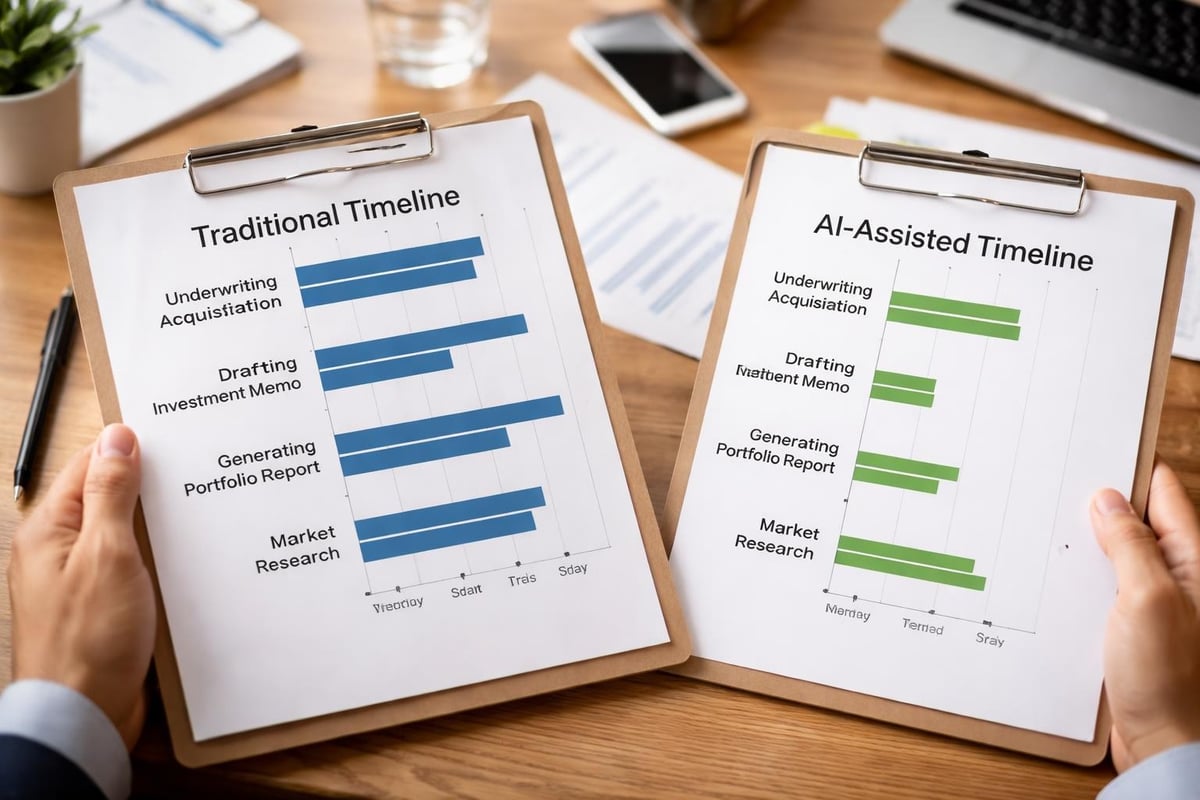
| Use Case | Traditional Timeline | AI-Assisted Timeline | Time Saved |
|---|---|---|---|
| Underwriting one acquisition | 14-18 hours | 2-3 hours | 80-85% |
| Drafting IC memo | 8-10 hours | 1-2 hours | 80-85% |
| Quarterly portfolio report | 20-24 hours | 4-5 hours | 75-80% |
| Market research deep dive | 6-8 hours | 1 hour | 85-90% |
Those time savings compound. A team that reclaims 100 analyst hours per month can redeploy that capacity toward sourcing new deals, optimizing asset business plans, or conducting sensitivity analyses that improve risk-adjusted returns.
Limitations and the Importance of Human Oversight
No AI for real estate investment platform operates flawlessly in every scenario. Models occasionally misinterpret unusual lease structures-like master leases or percentage rents-and require manual correction. Memo drafts sometimes emphasize boilerplate market context over asset-specific value drivers, necessitating editorial refinement. Market research can surface outdated links if the web contains stale reports that have not been updated.
Responsible teams treat AI outputs as high-quality first drafts, not final work products. They review formulas, verify assumptions against original documents, and cross-check research citations. The value proposition is not perfection-it is velocity and consistency. An analyst who once spent two days building a model from scratch now spends two hours validating and refining an AI-generated version, freeing 14 hours for strategic analysis.
Setting Realistic Expectations
Vendors that claim their tools "ingest everything forever" or "match templates 100 percent" often disappoint users when edge cases arise. Real estate AI tools perform best when scoped to well-defined tasks: extract rent rolls, build DCF models, draft memo sections. They struggle with ambiguous requests like "optimize the entire portfolio" without clear parameters. Teams succeed by defining specific workflows-acquisition underwriting, disposition modeling, quarterly reporting-and measuring AI performance against those discrete milestones.
- Model validation: Always spot-check formula links and assumption cells.
- Memo editing: Add deal-specific strategy commentary and risk nuances.
- Source verification: Confirm that research citations are current and authoritative.
- Feedback loops: Note where AI outputs miss the mark, so platforms can improve.
This collaborative approach positions AI as a force multiplier, not a replacement. Senior professionals focus on judgment, negotiation, and capital relationships, while AI handles the mechanical work that scales linearly with deal volume.
Integrating AI into Existing Investment Workflows
Adoption does not require rebuilding entire tech stacks. Most teams already use Excel for underwriting, PowerPoint or Word for memos, and email for sharing documents. AI for real estate investment platforms slot into those workflows by accepting common file formats-PDFs, .xlsx, .csv-and exporting deliverables in familiar templates.
Leni integrates with existing processes by letting users upload OMs and rent rolls via web interface or email, then returning Excel models and memo drafts that open in standard applications. There is no proprietary file format or mandatory migration to a new database. Analysts download the model, adjust assumptions, and share it with colleagues exactly as they would a manually built file. Best asset management software evaluations increasingly prioritize this interoperability, recognizing that friction-free adoption drives faster ROI.
Change Management and Training
Successful rollouts involve a phased approach:
- Pilot with one deal type: Start by automating underwriting for garden-style multifamily acquisitions, where data structures are consistent.
- Validate outputs rigorously: Compare AI-generated models against manually built versions to confirm accuracy.
- Expand to adjacent tasks: Add IC memo drafting and market research once underwriting proves reliable.
- Document best practices: Create internal guides on how to frame requests, validate outputs, and handle exceptions.
- Measure impact: Track hours saved, deal cycle times, and error rates to quantify value.
Teams that treat AI as a tool to augment, rather than replace, analyst expertise see the fastest productivity gains. Analysts freed from data entry can focus on sensitivity scenarios, debt structuring, and strategic positioning-higher-value activities that directly improve returns.
The Competitive Edge for Multifamily Investors
Multifamily markets in 2026 remain competitive, with institutional capital chasing stabilized assets and value-add opportunities in growth markets. Winning bids often come down to speed and conviction: the ability to submit a refined LOI within 48 hours, backed by credible underwriting and a clear investment thesis. AI for real estate investment accelerates that timeline without sacrificing rigor.
A team using AI can generate a full underwriting package-model, memo, market summary-over a weekend, while competitors are still reconciling rent rolls manually on Monday morning. That speed advantage translates to better deal flow, stronger broker relationships, and higher close rates. Real estate assets become easier to evaluate at scale, allowing firms to compare multiple opportunities in parallel and allocate capital to the highest risk-adjusted returns.
Operational Efficiency Beyond Acquisitions
The same capabilities apply to asset management and dispositions. Portfolio managers monitoring 20 properties can task AI with generating monthly variance reports, flagging properties where NOI trails budget by more than five percent, and drafting action plans for leasing or expense optimization. When preparing to sell, teams export disposition models that mirror buyer underwriting standards, streamlining due diligence and reducing time to close.
AI data analyst guides for commercial real estate emphasize this versatility: the technology adapts to acquisition, hold, and exit phases, providing consistent analytics and documentation throughout the investment lifecycle. Firms that embed AI into every phase of ownership compound efficiency gains across hundreds of deals and thousands of units.
Industry Trends Driving Adoption
Broader market forces accelerate the shift toward ai for real estate investment. Rising interest rates and tighter lending standards increase the importance of precise underwriting-lenders scrutinize debt service coverage and stress tests more closely, demanding detailed sensitivity analyses. Simultaneously, labor markets remain tight, making it harder to hire experienced analysts at competitive salaries. AI offers a path to scale capacity without proportional headcount growth.
Institutional investors and family offices also demand faster reporting cycles. Quarterly board meetings now expect real-time portfolio dashboards and variance explanations, not static PDFs emailed days after period close. Platforms integrating AI in real estate by 2025 position firms to meet those expectations, automating data aggregation and narrative reporting so asset managers spend time on strategy rather than spreadsheet formatting.
Academic and Industry Validation
Research into AI-based property valuation using self-supervised vision transformers demonstrates that machine learning can parse complex datasets-images, lease terms, market indicators-to estimate values with institutional-grade accuracy. While those models focus on valuation, the underlying principle applies broadly: AI excels at pattern recognition and structured output generation, making it ideal for repetitive, rules-based tasks like financial modeling and memo drafting.
Even companies like Revaluate leverage AI to predict propensity to move, helping marketers target prospects more efficiently. Real estate investment platforms extend that logic to deal evaluation, using data signals to identify opportunities and automate follow-on analysis. Firms that adopt these tools position themselves ahead of peers still relying on manual workflows.
Measuring Return on AI Investment
Finance teams evaluating ai for real estate investment platforms ask straightforward questions: What does this cost, and what do we gain? Typical pricing models charge per seat or per task, with monthly subscriptions ranging from a few hundred to a few thousand dollars per user. Return on investment comes from hours saved, faster deal cycles, and reduced error rates.
A simple calculation: if an analyst earning $120,000 annually (roughly $60 per hour) saves 100 hours per month using AI, the firm gains $6,000 in reclaimed capacity. Over a year, that totals $72,000 per analyst-many multiples of the platform subscription cost. Beyond direct labor savings, faster deal velocity means capturing more opportunities in competitive bidding situations, where a 24-hour head start can determine who wins the LOI.
| Metric | Manual Process | AI-Assisted Process | Value Gain |
|---|---|---|---|
| Deals underwritten/month | 8-10 | 15-20 | +50-100% deal flow |
| Hours per underwriting | 16 | 3 | 81% time savings |
| Error rate (formula/data) | 5-8% | 1-2% | 60-75% fewer errors |
| Days to IC memo draft | 3-4 | <1 | 70-80% faster approval |
Firms also measure qualitative benefits: improved analyst morale (less time on tedious tasks), higher retention (more engaging work), and better capital deployment (more deals evaluated means more selective acquisitions).
Future Directions and Platform Evolution
AI for real estate investment will continue evolving toward greater automation and integration. Next-generation platforms will combine financial modeling with property-level IoT data, automatically adjusting pro forma assumptions when smart thermostats or access logs signal occupancy changes. They will interface directly with lender portals, pulling rate sheets and sizing debt tranches based on underwriting outputs. Market research will incorporate real-time economic indicators-employment reports, housing starts, migration data-refreshing projections as conditions shift.
Leni and similar platforms will expand task orchestration, allowing teams to define multi-step workflows: "When a new OM arrives, extract data, build a model, draft a memo, research the submarket, and email the package to the IC." That level of automation transforms AI from tool to team member, handling routine deal evaluation so professionals focus on strategic decisions and relationship management.
Interoperability will also improve. Platforms will export models in formats compatible with third-party valuation tools, lender underwriting systems, and investor reporting dashboards. API integrations will let firms pull data from property management software, feed it into AI analysts, and push insights back to executive dashboards-all without manual file transfers.
The multifamily investment landscape rewards speed, precision, and scalability. AI for real estate investment delivers all three by automating financial modeling, memo drafting, and market research, freeing teams to focus on strategic decision-making and capital relationships. Platforms like Leni provide purpose-built tools that understand real estate semantics, produce verifiable deliverables, and integrate seamlessly into existing workflows, positioning firms to compete at higher deal velocity without sacrificing diligence.

Leni is an AI analyst with a background in real estate.
Born in 2022, Leni works alongside asset managers, asset owners, and limited partners, helping teams stay oriented across systems like Yardi and Entrata. With an understanding of both operations and financials, Leni helps teams spot risk early and actively steps in by surfacing insights, creating alerts, and keeping work moving, decisions aligned, and momentum intact.
Get Portfolio Insights With Leni Analytics


