What Is Propwire? Meaning, Real Estate Data, and Investor Use Cases

What Is Propwire? Meaning, Real Estate Data, and Investor Use Cases
Most real estate investors do not struggle because there is no data. They struggle because the useful data is scattered, slow to organize, or hard to turn into action.
That is where Propwire usually enters the conversation. People searching for it are often trying to understand whether it is a data source, a lead-generation tool, a research platform, or some combination of all three.
In practical terms, Propwire is generally understood as a real estate data platform that helps investors, agents, wholesalers, and other operators search property records, identify potential opportunities, and analyze ownership or market information more efficiently. Rather than relying only on manual county searches or fragmented listing sources, users turn to a platform like Propwire to organize property-level data into a more actionable workflow.
If you want the simplest definition, it is this: Propwire is a real estate data and prospecting platform used to find properties, research owners, and support investment outreach.
What Propwire Does
At a high level, Propwire helps users search, filter, and evaluate property information for acquisition, outreach, and market research purposes.
Property search: helps users look up homes, parcels, and ownership records across targeted markets.
Lead generation: supports prospecting by surfacing owner and property signals that may indicate opportunity.
Market filtering: allows investors to narrow opportunities by geography, property type, distress indicators, equity, or other criteria.
Ownership research: helps users identify who owns a property and how that ownership fits into a broader investment strategy.
Deal screening: gives users a faster way to sort through properties before moving into deeper underwriting or outreach.
Export and workflow support: makes it easier to move property lists into marketing, sales, or investment pipelines.
Why Propwire Matters in Real Estate
Interesting insight: in many investment workflows, finding the deal is harder than analyzing the deal.
That is why data platforms like Propwire matter. Before underwriting begins, many investors need a repeatable way to identify properties, screen them quickly, and build prospect lists without jumping across multiple disconnected systems.
For users focused on direct-to-owner outreach, off-market sourcing, or local market coverage, a platform like this can reduce manual research time and improve how quickly an operator moves from raw data to a usable target list.

What People Usually Use Propwire For
While use cases vary, Propwire is commonly associated with a few core real estate workflows.
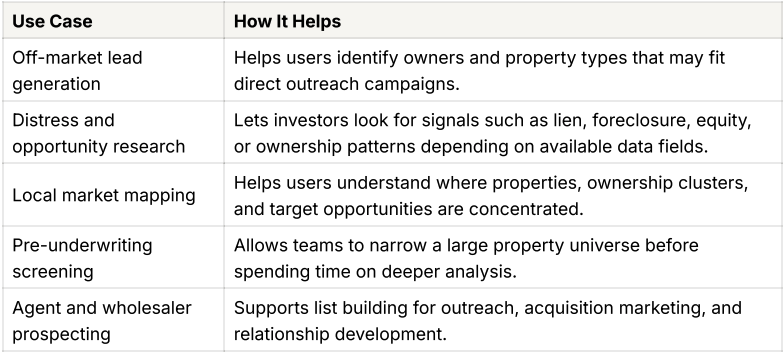
Key Features Commonly Associated with Propwire
Features can change over time, but platforms in this category are usually valued for the same practical capabilities.
Property Record Search
Users typically want a fast way to search properties by address, market, owner status, or investment criteria. That makes the platform useful for both targeted lookups and broader list-building.
Owner and Property Filters
Filtering is one of the main reasons investors use tools like this. A large property database only becomes useful when users can narrow it to the exact ownership profiles, distress patterns, or geographic pockets that matter.
Lead List Creation
Many users are not just researching. They are preparing to contact owners, evaluate opportunities, or hand prospects to an acquisitions or sales team. A structured list-building workflow matters because it moves the platform closer to execution.
Market Research Support
Beyond individual properties, the broader value often comes from understanding a market more quickly. That includes seeing where inventory clusters, how ownership is distributed, and where opportunity may be concentrated.
Data Export and Workflow Handoff
The best data platforms do not stop at search. They support the next step by making it easier to export, review, and move prospects into outreach, analysis, or CRM workflows.
Who Typically Uses Propwire
Propwire is usually most relevant for people trying to find or evaluate real estate opportunities at scale.
Real estate investors looking for acquisition opportunities
Wholesalers building off-market prospect lists
Agents and brokers researching ownership and prospecting targets
Direct-to-seller marketers running outbound campaigns
Small acquisition teams trying to screen opportunities faster
Operators mapping neighborhoods or ownership concentrations
Why a Platform Like Propwire Is Useful
The value of a property data tool is rarely the raw database alone. It is the speed and structure it creates around decision-making.
Faster research: reduces the time spent piecing together public records manually.
Better targeting: helps users focus only on the property profiles they actually want.
More scalable prospecting: supports repeatable lead generation rather than one-off searches.
Cleaner workflow handoff: makes it easier to move from search to outreach or underwriting.
Improved market visibility: helps users understand patterns beyond a single property.
Propwire vs MLS and Other Real Estate Data Tools
This is one of the most useful distinctions for readers. Propwire is usually discussed more as a property data and prospecting platform than as a traditional MLS replacement.
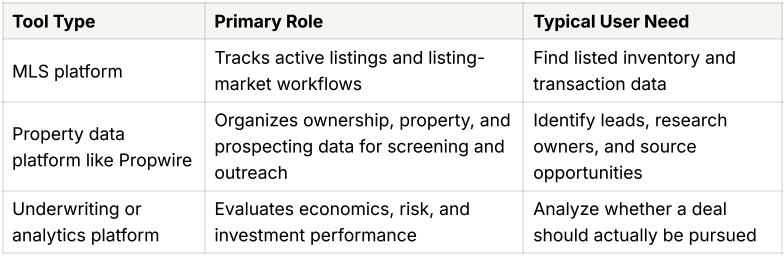
A useful shorthand is this: Propwire can help you find and organize potential deals, but deeper underwriting tools help you decide whether those deals are worth pursuing.
How Propwire Fits into a Broader Real Estate Workflow
In a typical workflow, Propwire would sit near the front end of the acquisition funnel. It helps teams identify properties, build lead lists, and screen opportunities before a property moves into deeper underwriting, market research, or investment committee work.
That means a data platform like Propwire and an analytical platform like Leni usually solve different parts of the workflow. Propwire helps source and organize opportunities. Leni helps with the analytical side after that, such as underwriting, market research, memo drafting, and reporting automation.
.png)
What Propwire Does Not Replace
It is also useful to be clear about what a property data platform does not automatically solve.
It does not replace underwriting discipline.
It does not verify that every lead is a good deal.
It does not remove the need for local market judgment.
It does not replace a CRM, acquisitions process, or full investment workflow on its own.
You might want to explore this further: data platforms create opportunity volume, but analysis is what turns volume into real decision quality.
Frequently Asked Questions
What is Propwire?
Propwire is generally understood as a real estate data platform used to search property records, identify owners, and support lead generation or opportunity screening.
Who uses Propwire?
Typical users include investors, wholesalers, agents, brokers, and acquisition teams looking for property-level research and prospecting support.
Is Propwire an MLS?
Not in the traditional sense. It is more commonly discussed as a property data and prospecting platform rather than a direct MLS replacement.
Can Propwire help with off-market deals?
Yes, that is one of the main reasons people use platforms in this category. They help users identify and organize properties that may fit direct outreach or lead-generation strategies.
Does Propwire replace underwriting?
No. It can help surface and organize opportunities, but deeper analysis is still required to evaluate pricing, risk, and investment quality.
Final Takeaway
Propwire matters because it helps solve an early problem in real estate: finding and organizing potential opportunities before they disappear into scattered lists, notes, and searches. That makes it useful at the top of the workflow, where speed and visibility often matter most. A larger lead list only helps, though, if what comes out of it can actually be trusted once a team starts underwriting against it.
But finding an opportunity is only the beginning. The real advantage comes from what you do next: evaluating it, comparing it, and deciding whether it is worth pursuing. That is where a platform like Leni fits more naturally, helping real estate teams turn property information into underwriting, research, and clearer next-step analysis without changing the basic role Propwire plays. The part that matters most at this stage is not just speed, but whether each number in that underwriting can be traced back to the rent roll, offering memo, or market data it came from.


AI in Real Estate Community
Connect with asset managers, operators, and investors navigating AI adoption in real estate.

Latest Help Articles
Learn about how AI is changing the investment world with in-depth research and industry voices.


MEET LENI
Purpose Built Agentic Platform for Investors
Designed for people who want to do serious work using AI.
We Work with Leaders Shaping the Industry
From automating portfolio reporting to market research, learn how leaders are integrating AI in their businesses.
