What Is Roofr? Meaning, Roofing Software, and Property Operations Use Cases

What Is Roofr? Meaning, Roofing Software, and Property Operations Use Cases
When people search for Roofr, they are usually not looking for a generic real estate term. They are trying to understand a specific software platform used in the roofing industry.
That matters because Roofr is not a property management system, investment platform, or real estate analytics tool. It is generally understood as a software platform built for roofing contractors that helps manage estimating, proposals, measurements, CRM workflows, material ordering, invoicing, and job execution.
In practical terms, Roofr is a vertical software platform for residential roofing businesses. It helps contractors move from lead capture to roof measurement, proposal, job management, and payment collection in a more centralized workflow.
If you want the simplest definition, it is this: Roofr is a roofing contractor software platform designed to streamline sales, estimating, operations, and job workflows.
What Roofr Does
At a high level, Roofr is built to help roofing companies run more of their business in one system rather than across spreadsheets, disconnected tools, and manual paperwork.
Lead capture: helps contractors collect and qualify inbound opportunities.
Roof measurement: provides aerial roof measurement reports to speed up estimating.
Proposal generation: allows contractors to build and send professional proposals with e-signatures.
CRM workflow: helps teams manage prospects, jobs, communication, and sales pipeline activity.
Material ordering: supports ordering workflows and supplier-related coordination.
Invoicing and payments: helps contractors bill customers and collect payment digitally.
Production handoff: supports work orders, crew workflows, and execution after the sale closes.
What Type of Software Roofr Is
Roofr is best understood as a vertical SaaS platform for roofing contractors. In other words, it is industry-specific operating software rather than broad horizontal software used by every type of business.
This trend stands out because vertical software usually wins by understanding the real workflow of a specific industry. In Roofr’s case, that means quoting roofs, measuring roof geometry, managing contractor sales activity, and moving jobs from estimate to completion.
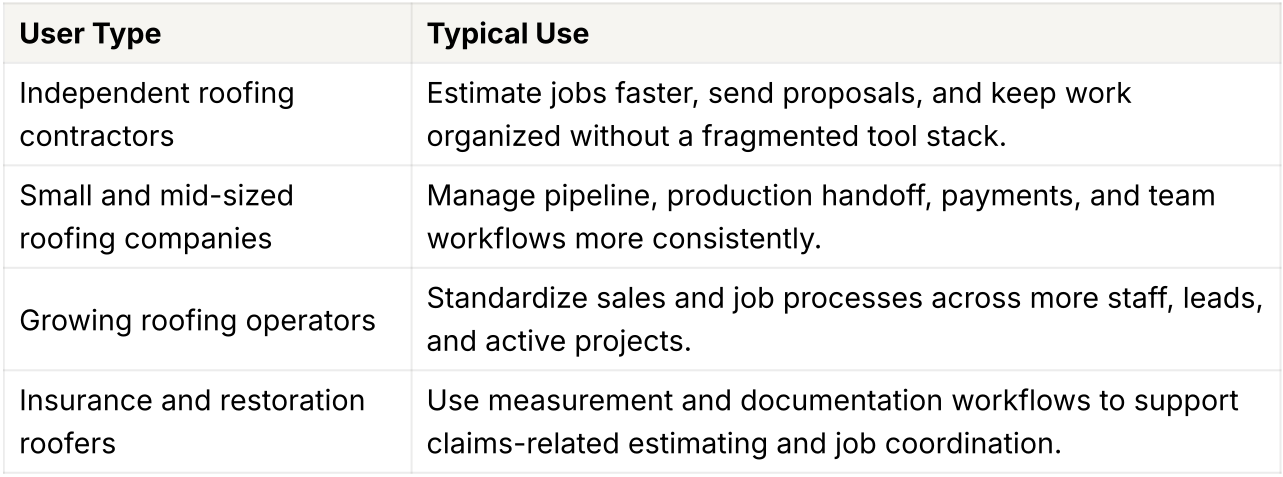
Who Uses Roofr
Roofr is generally most relevant for businesses that sell and execute roofing jobs, especially in residential roofing.
.jpeg)
Key Features Commonly Associated with Roofr
Roof Measurement Reports
One of Roofr’s best-known functions is aerial roof measurement. That helps contractors avoid climbing every roof for early-stage quoting and gives them faster geometry inputs for estimates and proposals.
Instant Estimator and Lead Capture
Roofr also offers tools designed to capture demand earlier in the process. This matters because contractors often lose time before a job even reaches the proposal stage. Faster lead capture can improve response time and conversion.
Proposal and E-Signature Workflows
Professional proposals are not just about presentation. They affect close rates. A structured proposal workflow helps contractors move from estimate to approval with less friction and fewer manual follow-ups.
CRM and Pipeline Management
Roofing businesses often run on high-velocity lead flow and local reputation. A CRM layer matters because sales opportunities can easily stall when teams rely on memory, text messages, or disconnected notes.
Material Ordering and Production Coordination
After a sale closes, operational complexity starts to increase. Ordering materials, coordinating work orders, and handing jobs from sales to production are some of the most important points where execution can break down.
Invoicing and Payments
Collecting payment quickly is as important as winning the job. Digital invoicing and payment workflows help reduce delays and improve cash flow management.
Why Roofr Matters
Interesting insight: for many contractors, the real problem is not just winning more work. It is keeping the workflow organized after work starts coming in.
That is why platforms like Roofr matter. They reduce operational drag across the full sales-to-job cycle. Instead of using one tool for measurements, another for proposals, another for invoicing, and another for customer tracking, a contractor can centralize more of the workflow.
Faster estimating: reduces delay between lead and quote.
Cleaner sales process: improves consistency in proposals and follow-up.
Better operational handoff: helps sales and production stay aligned.
Stronger visibility: gives teams a better view of job status and pipeline.
Less manual work: replaces fragmented admin processes with a more structured system.
How Roofr Relates to Real Estate
Roofr is not a real estate software platform in the usual sense. It is not built for landlords, REITs, asset managers, or property management teams.
Its connection to real estate is more indirect. Roofing work happens on real properties, and that means Roofr can sit adjacent to property operations when a contractor is working on residential homes or other buildings. But the end user is typically the roofing contractor, not the property owner or investor.
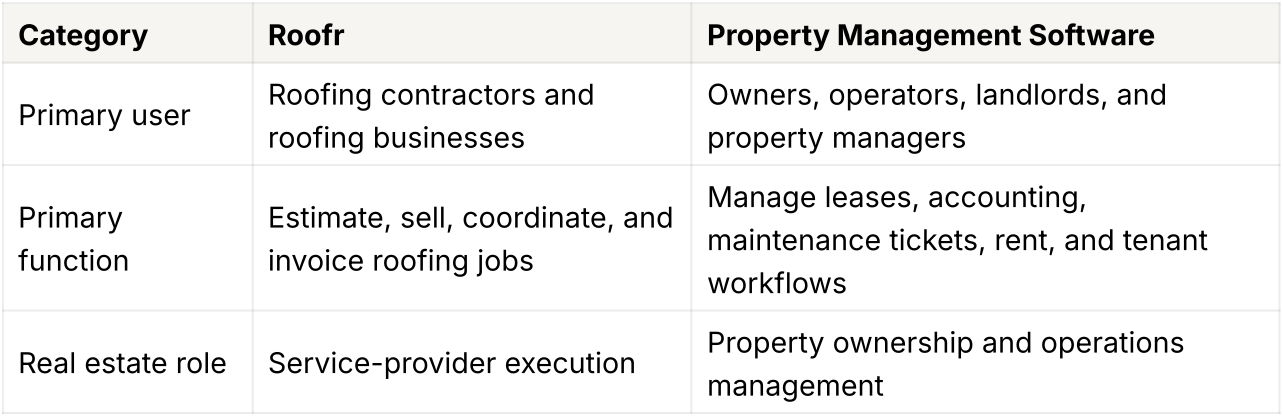
A useful way to think about it is this: Roofr helps service providers execute roofing work, while real estate operations platforms help owners and operators manage the property itself.
Roofr vs Property Management Software
This is one of the most useful distinctions for readers coming from a real estate background.
.jpeg)
What People Usually Mean When They Search for Roofr
Search intent around Roofr usually falls into a few categories:
They want to know whether Roofr is a roofing CRM or broader business operating platform.
They are comparing Roofr to other contractor software.
They want to understand whether it includes aerial measurements, proposals, invoicing, or job management.
They are evaluating whether it fits a small roofing company or a scaling contractor operation.
They are trying to understand whether Roofr is a real estate tool or a contractor tool.
The most important clarification is simple: Roofr is primarily a contractor operations platform for the roofing trade.
How Roofr Fits into a Broader Workflow
In a typical workflow, Roofr sits close to the front-line execution layer of a roofing business. It helps teams capture leads, produce estimates, win jobs, and move those jobs into operations.
That is different from the role of analytical platforms. For example, a platform like Leni is built for research, underwriting, document work, and reporting across real estate and investment workflows. Roofr and Leni solve different problems. Roofr helps a roofing contractor run jobs. Leni helps investors and operators analyze decisions and produce higher-level outputs.
Frequently Asked Questions
What is Roofr?
Roofr is a software platform built for roofing contractors to manage estimating, proposals, CRM activity, material ordering, invoicing, and job workflows.
Is Roofr a real estate platform?
No. It is better understood as a roofing contractor software platform, not a property management or real estate investment tool.
Who uses Roofr?
Typical users include independent roofers, residential roofing businesses, and growing contractor teams that need more structured sales and operations workflows.
What is Roofr known for?
It is especially known for aerial roof measurement reports, proposal workflows, CRM functionality, and contractor-oriented operating tools.
Does Roofr replace underwriting or property analytics?
No. It helps contractors execute roofing jobs. It does not replace real estate underwriting, asset management, or portfolio analysis tools.
Final Takeaway
Roofr is best understood as a specialized software platform for roofing contractors rather than a general real estate or property management tool. The reason it matters is simple: roofing businesses often lose time and margin through fragmented workflows.
A platform like Roofr helps centralize estimating, proposals, CRM activity, production handoff, and payments into one operating system. The useful way to think about it is this: Roofr helps roofing contractors run the work, while other platforms, like Leni, may help owners, operators, or investors evaluate what that work means at the property or portfolio level.

AI in Real Estate Community
Connect with asset managers, operators, and investors navigating AI adoption in real estate.

Latest Help Articles
Learn about how AI is changing the investment world with in-depth research and industry voices.


MEET LENI
Purpose Built Agentic Platform for Investors
Designed for people who want to do serious work using AI.
We Work with Leaders Shaping the Industry
From automating portfolio reporting to market research, learn how leaders are integrating AI in their businesses.
