What is Workforce Housing?

In simple terms, workforce housing refers to housing that is priced for middle income households who earn too much to qualify for many traditional affordable housing programs but still cannot comfortably afford market rate housing in high cost areas. In real estate, it matters because it sits between subsidized affordable housing and higher priced conventional housing, helping essential workers live closer to where they work.
In an urban environment that is evolving quickly, increasing housing prices have made it difficult for many middle-income and essential workers to afford to live near the places where they work. Workforce housing is becoming a critical answer, intended to be affordable home options for those who enable our communities to work, teachers, firefighters, healthcare professionals and much more. In this blog we explore the definition of workforce housing, the economic and social benefits it provides, current policies and challenges, recommendations for a sustainable future.
What makes workforce housing important is that many communities depend on workers who are essential to daily life, yet those same workers are often priced out of living near their jobs. That gap affects not only households, but also local employers, municipalities, commuting patterns, and long term community stability.
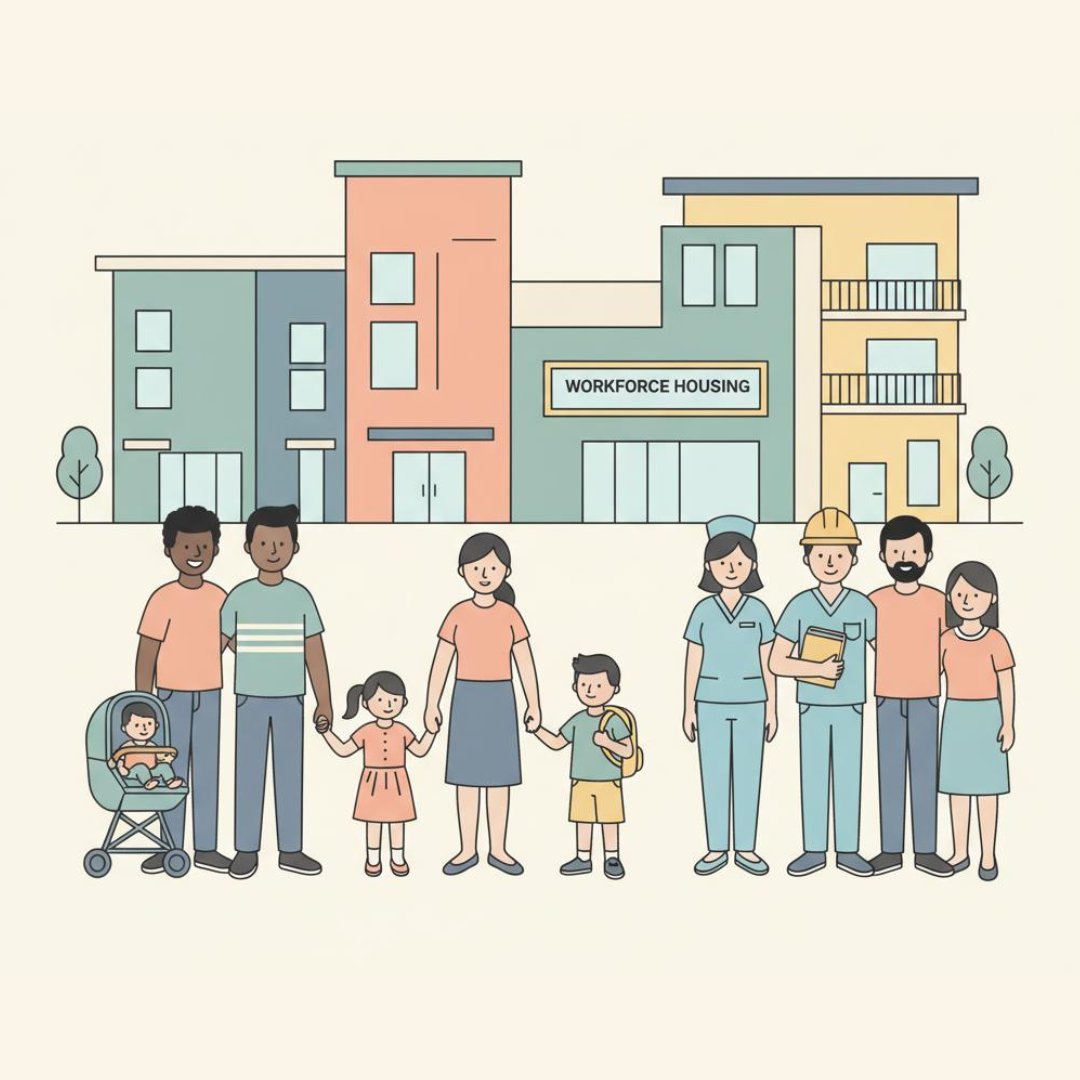
Workforce Housing: Bridging the Gap for Essential Workers
According to the Urban Land Institute (ULI), workforce housing is defined as housing that remains affordable for households earning between 60% and 120% of the area median income (AMI). Essentially, it targets families positioned between the deeply affordable and luxury market segments. While different models exist, workforce housing generally caters to families earning between 80% and 120% of the median income, with the specific range varying based on local market conditions, county, and state factors.
A useful way to think about workforce housing is this: it is designed for households that are still fully participating in the labor market, but whose incomes have not kept pace with rent growth and home prices in supply constrained markets.
Key Characteristics:
Income Eligibility: Individuals earning too much to qualify for traditional affordable housing, but not enough to enter supply-constricted, high-cost markets.
Proximity to Employment: Usually situated near job centers, to decrease long commutes.
Public and Private Support: Typically built with a mix of government incentives, tax credits, and public-private partnerships.
Why Workforce Housing Matters in Real Estate
It supports labor force stability: Employers and cities rely on workers being able to live within a reasonable distance of their jobs.
It helps preserve community function: Teachers, nurses, municipal workers, and service employees are critical to how neighborhoods operate.
It creates a distinct investment segment: Workforce housing often attracts demand because it serves a large renter base that may be underserved by both subsidized housing and luxury product.
It connects housing policy with property operations: Affordability pressure, zoning, land use, and development economics all affect how workforce housing gets built and preserved.
Why Is Workforce Housing Required?
Economic Strains in Urban Areas: The USA’s biggest cities like New York, San Francisco and Los Angeles are struggling with sky high housing prices. Despite creating ample economic opportunity, these cities have numerous workers performing essential but low paid labor who have been priced out of the neighborhoods they work in. The gap between wages and housing costs is not only a financial burden but also impacts overall quality of life.
Impact on Communities: When essential workers are pushed to live far from their jobs, communities suffer. Longer commutes can result in lower productivity, worse congestion and larger environmental consequences. Furthermore, the separation of where we live from where we work risks damaging the social fabric of the neighborhoods in which we live and work, and is one of the big challenges to building strong communities.
Supporting Data: Recent studies indicate that the lack of workforce housing contributes to labor shortages in key sectors. For example, data from various urban studies have shown that affordable, conveniently located housing correlates with better employee retention in essential public services. These trends highlight the urgent need to expand workforce housing initiatives to support a sustainable workforce.
This trend stands out in high cost markets because housing affordability is no longer only a low income issue. In many metros, even fully employed middle income households can struggle to access housing near strong job centers, which is why workforce housing has become such a central development and policy conversation.
Economic and Social Benefits
Community and Economic Stability: Affordable housing options for essential workers stabilize local economies. They also create a more efficient work-life schedule with shorter commuting times that enables workers to invest more time and energy in their work and their families, positively impacting community productivity. Local businesses also heed increased customer and economic activity so long as workers live near their places of employment.
Enhanced Quality of Life: Workforce housing can result in better work-life balance. And when workers spend less time on the road, they have more time for leisure and can participate more actively in community life. Being close to one another in our communities not only helps build community ties, but also gives a sense of belonging and communal ownership.
Environmental Impact: Workforce housing lowers carbon emissions by minimizing long commutes. That transition helps cities lower their environmental footprints overall, aligning with larger sustainability goals.
Practical Implications for Owners, Developers, and Communities
Developers often see workforce housing as a way to address strong demand in the middle of the market, especially where luxury product is oversupplied and affordability gaps are widening.
Investors may view workforce housing as a resilient segment because it serves a broad tenant base with recurring need.
Local governments often support workforce housing through zoning changes, incentives, density allowances, or public private partnerships.
Communities benefit when workers can live closer to schools, hospitals, transportation, and employment centers.
Workforce vs. Section 8 vs. Affordable Housing
Terms such as “workforce,” “Section 8,” “affordable housing” and “workforce housing” are frequently perplexing and appear to overlap. Communities use the terms broadly, and it’s helpful to understand the differences, no matter where you are — in New Hampshire or a big city like New York.
With that, expensive housing is often focused on in many cities, according to Brookings Institution. However, public employees and households with two or more workers can rarely afford that with their income options.
Quick Comparison
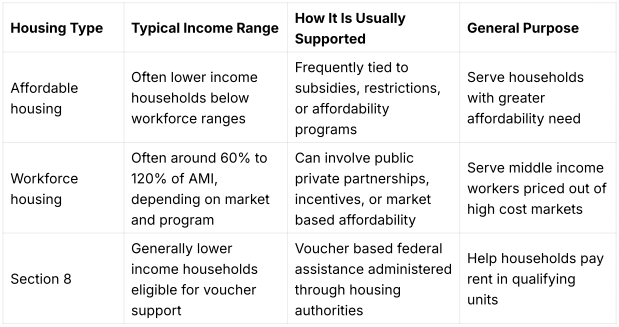
Affordable Housing
Affordable housing would be any home serving households at/above 60 percent of the median income. This is what local governments say that they get in exchange for affordable rental housing for families. Typically, the household income of returning veterans, the young, and the old, is much less than this. When you factor in traffic congestion and the fact that people must pay bills, affordability for homes is a crucial factor.
Workforce Housing and AMI
Workforce housing is 61 percent and higher. In particular, these workers earn a middle income and aren’t reliant on government-subsidized rents. The area median income (AMI) is even higher for something like a workforce housing unit, New York, for example. Prices there are much higher for everything.
Household size does not matter, but some people believe that it should. You can almost classify people roughly: about 80 to 120 percent of people are typically In most cases, 80 to - 120 percent of the people fall in either category. This is typical in most cases. So, in most cases, there are about 80 to 120 percent of people who fall in the category of middle-income households. They tend to live in close proximity to others.
The important distinction is that workforce housing usually refers to households that are still earning regular wages and are not primarily dependent on vouchers, but who still face affordability pressure because market rents and home prices have moved ahead of income growth.
Section 8
Section 8 focuses on both workforce housing and affordable housing units. This program is often called public housing and gives a voucher to the family like most local governments do through their programs. There are tons of families on the waiting lists that must be helped by the local governments in those areas.
Generally, the HUD program allocates vouchers through a local housing authority and the market for that project.
A Section 8 tenant can visit any unit that accepts vouchers. In California, a law was passed claiming that landlords can’t bar Section 8 tenants because of the voucher. However, employment and income concerns are loopholes.
With that, other criteria landlords can check include rental history and credit history.
The way it currently works is that the voucher gets issued by the area’s housing authority and is given to the family. They find a housing unit that accepts the voucher. Rent is consistent with the standard for that area and can be changed based on what’s appropriate.
Though it’s important to check published figures defining the Fair Market Rent, HUD can determine the FMR rent value based on what it thinks a tenant should pay for a unit with a voucher. Then, the tenant moves in. The voucher covers what the tenant can’t pay from their income.
Workforce Housing Investments
Workforce housing is aimed at a larger part of the market than the other types. In practice, and in fairness, it refers to market affordable housing, which costs less than the average rent but does not depend on government subsidies. This housing is what bridges the gap between the free market and government housing systems to provide middle income workers with a decent place to live.
But for most people, such housing assistance from a workforce housing program is a perfect solution homeownership is impossible for thousands or millions of working Americans. And workforce housing units should be in continued demand.
They are less regulated than government sponsored options when others develop in this space. So, being a developer with a larger tenant base has its own advantages. This is because affordable housing tenants are quite limited by the government assistance available at any given time. Alternatively, workforce housing means that you’re constrained by market demand alone.
Why Investors and Operators Pay Attention to Workforce Housing
Demand can be durable: Middle income renter demand often remains strong in markets where ownership is unaffordable.
The segment can be broad: Workforce housing may serve a larger renter pool than more tightly restricted affordable programs.
Execution still matters: Affordability alone does not guarantee success. Operators still need strong location, maintenance, resident retention, and cost control.
Policy risk and opportunity both matter: Incentives, zoning, and local housing policy can materially shape development feasibility and long term returns.
Conclusion:
Workforce housing is not only building affordable homes it’s a matter of protecting the backbone of our communities. Fulfilling the housing needs of essential workers will repair cities’ economic stability, employment reduces carbon footprints, and foster vibrant, connected communities. Simultaneously, cutting edge technology platforms like Leni are revolutionizing the management and optimization of multifamily properties. Leni helps multifamily owners and operators in consolidating data for benchmarking performance and reporting processes using AI powered intelligence and reporting capabilities.
As policymakers, community leaders, and technology innovators collaborate, these advanced tools will play a pivotal role in creating a future where every worker truly has a place to call home.
Faq’s
What is workforce housing?
Workforce housing refers to affordable housing designed for middle income workers such as teachers, healthcare providers, and first responders who earn too much to qualify for traditional affordable housing yet still struggle with high market rents and home prices.
Who qualifies for workforce housing?
Eligibility typically targets households earning between 60% and 120% of the Area Median Income (AMI). The exact criteria may vary by region and program, but it generally aims to support essential workers and middle-income families.
How does workforce housing differ from other affordable housing programs?
Unlike programs for extremely low-income households, workforce housing is tailored for those who fall into a “middle-income” category. It emphasizes proximity to employment centers and often involves mixed-income developments and public-private partnerships.
What are the economic and community benefits of workforce housing?
Workforce housing helps reduce long commutes, supports local economies, and stabilizes communities by ensuring essential workers live near their jobs. This accessibility improves work-life balance and contributes to lower environmental impacts.
What challenges are associated with developing workforce housing?
Key hurdles include high land costs, restrictive zoning laws, funding limitations, and community resistance. Overcoming these challenges often requires policy reforms, innovative planning, and collaborative efforts between public agencies and private developers.
Why is workforce housing especially important in high cost metros?
Because the gap between wages and housing costs is often widest in high cost markets, even middle income workers can struggle to live near their jobs. That makes workforce housing especially relevant in supply constrained urban areas.
Is workforce housing the same as subsidized housing?
Not necessarily. Some workforce housing developments involve public support or incentives, but the category often refers more broadly to housing that is affordable to middle income households without relying entirely on deep subsidy structures.
Why does workforce housing matter to real estate investors?
Because it serves a large and often persistent renter base, especially in markets where homeownership is out of reach and higher cost rental product is unaffordable for many working households.


AI in Real Estate Community
Connect with asset managers, operators, and investors navigating AI adoption in real estate.

Latest Help Articles
Learn about how AI is changing the investment world with in-depth research and industry voices.


MEET LENI
Purpose Built Agentic Platform for Investors
Designed for people who want to do serious work using AI.
We Work with Leaders Shaping the Industry
From automating portfolio reporting to market research, learn how leaders are integrating AI in their businesses.
