The Best Apartment Amenities to Maximize NOI

The Best Apartment Amenities to Maximize NOI
Every amenity decision is really a capital allocation decision. The right feature can increase lease velocity, support renewals, and create pricing power. The wrong one can quietly add operating cost, maintenance burden, and resident expectations without producing meaningful NOI lift.
Apartment amenities aren’t just shiny add-ons, they’re profit boosters…so long as they fit your market, bolster retention, and justify premium rents. But with hundreds of possible features from cold-plunge pools to concierge bots deciding what to add or skip has never been trickier.
This data-backed guide is for multifamily owners, developers, and asset managers who want to maximize net operating income (NOI) while avoiding the amenity arms race trap.
We’re covering:
Examples of apartment amenities
Whether you should charge apartment amenity fees
The 5 best apartment amenities in terms of ROI
How to choose amenities for your property
What’s in store for amenities in the future
What are apartment amenities?
Apartment amenities are the extra perks that elevate the resident experience and, ideally, generate outsized returns for owners.
Think of them as levers: pull the right ones and you boost lease velocity, retention, and ancillary income. Pull the wrong ones and you’re saddled with high upkeep and zero rent pop.
In the NMHC/Grace Hill 2024 Renter Preferences Survey, 85% of renters said amenity packages influence where they live and how long they stay, but the “must-haves” vary sharply by market segment.
In-unit vs. community amenities
There are two types of apartment amenities: in-unit and community amenities.
In-unit amenities are used by residents in their own units. They’re not designed to be shared by other residents, but to enhance the living experience in a resident’s individual unit.
That distinction matters financially. In-unit amenities tend to support the clearest rent premium because the resident experiences the value privately and daily. If an amenity removes friction inside the unit, it is usually easier to defend in pricing and renewal conversations.
Examples of in-unit amenities:
Keyless smart locks
High-speed WiFi
In-unit laundry
Built-in storage
Smart thermostats
Community amenities are add-ons shared by the entire community (or by residents who pay the required amenity fee). They can be found outside the unit or in common areas and are designed to shape how residents experience the property as a whole.
Brief explanation of the difference between in-unit and community/shared amenities
Benefits of each
Examples of each
Community amenities usually influence leasing and retention differently than in-unit features. Rather than driving direct daily convenience inside the apartment, they strengthen the property’s overall identity, encourage social connection, and can help differentiate the asset in a crowded submarket. The tradeoff is that they often carry more ongoing maintenance and operating complexity.
Examples of community amenities:
Package lockers
Fitness studios
Coworking spaces
Dog parks
Swimming pools
Once you know which type of amenity you’re evaluating, the next question is how to pay for it and whether residents will accept a separate charge.
.png)
Apartment amenity fees: Should you charge them?
Amenity fees are recurring or one-time charges that offset installation and O&M (operation and maintenance) costs. They’re common in luxury buildings and high-capex amenities (think golf simulators or concierge services).
Nationally, general-use fees average $30/month or a $200-$500 one-time charge. Premium services (valet trash, package management) run another $5-$20 monthly.
When to consider charging an amenity fee:
You offer high-touch features with measurable overhead (like staffed fitness centers, 24/7 package rooms).
Your market positioning warrants à-la-carte pricing (ultra-luxury, student housing).
You offer niche amenities that not everyone will want to use
When to fold fees into rent:
You’re in a competitive submarket where hidden charges feel like “junk” fees and hurt leasing velocity
You only offer essential utilities that residents can’t opt out of (like baseline Wi-Fi and trash).
It is also worth thinking about fee transparency early. As scrutiny around hidden fees increases, operators should document what the fee covers, whether it is optional, and how it compares with the local competitive set. A fee that makes sense operationally can still hurt conversions if residents experience it as unclear or unfair.
The ultimate apartment amenities list
Below is a curated, ROI-oriented apartment amenities list you can adapt to Class A, B, or value-add projects. Categories help you budget and stack features logically.
Core convenience
In-unit washer/dryer
Secure package lockers with cold storage
Bike rooms & EV charging stations
Smart access control
Health & wellness
Fitness center/yoga studio
Outdoor fitness court or walking trail
Air-quality monitoring + ERV system
Meditation or quiet room
Community & social
Rooftop lounge
Coworking space
Resident experience programming (mixology, coding bootcamps)
Pet run
Kids’ play room or playground
Gaming den
Ping pong table
Outdoor kitchen with grills
Sustainability
Solar panels or community solar subscriptions
Grey-water irrigation
Composting stations + rebates
Car-share partnerships
Technology
High-speed internet
Smart home bundles (thermostats, lighting, leak sensors)
App-based amenity reservations
Luxury apartment amenities
For Class A towers or trophy assets, these luxury apartment amenities can command double-digit rent premiums:
Sky-deck pools with cabanas and towel service
On-site spa suites (IV drips, cryotherapy)
Private dining rooms with celebrity-chef partnerships
Golf/VR sports simulators
Car elevators or private garages
Laundry wash and fold service
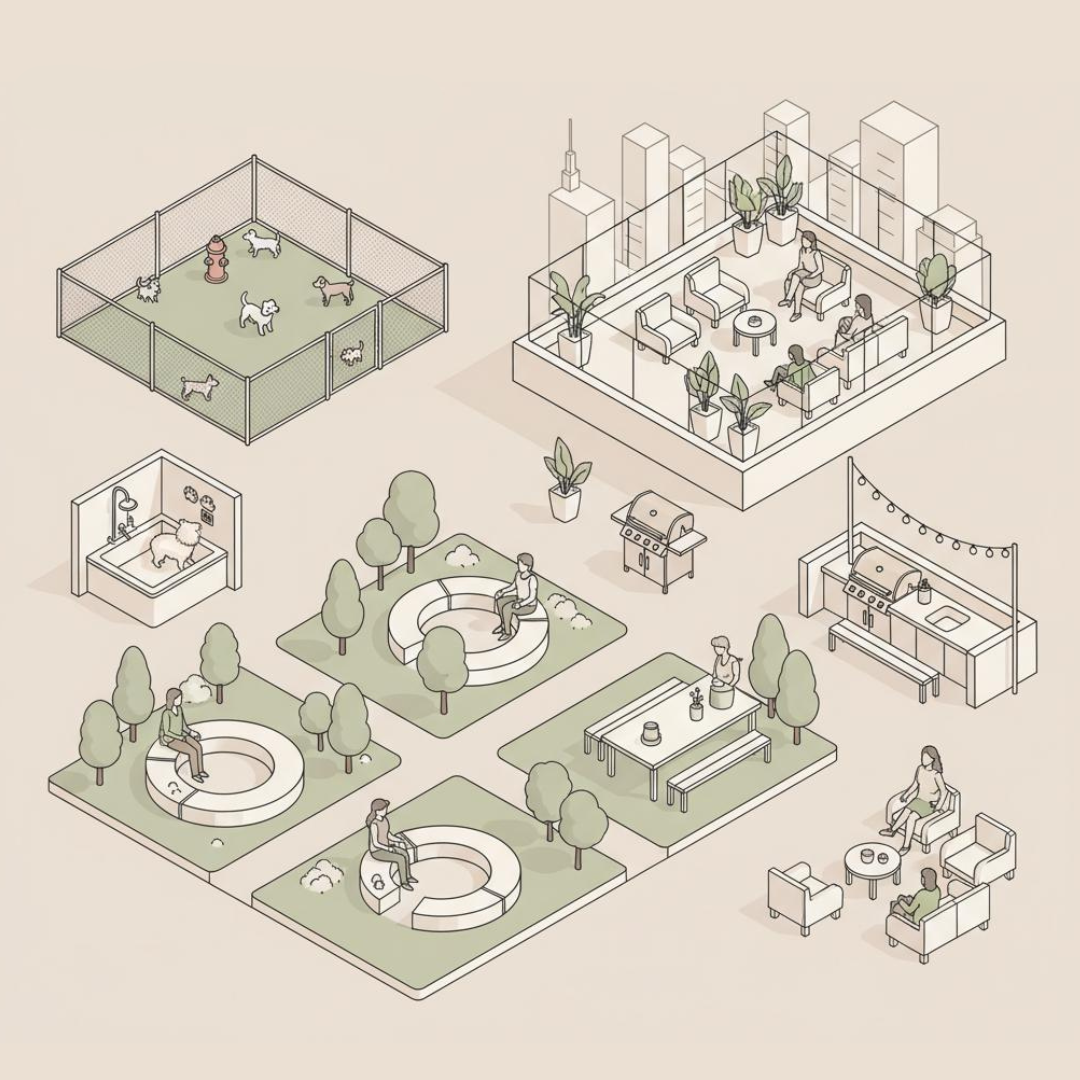
What are the best apartment building amenities?
If you’re looking for amenities that reliably increase lease velocity and renewals without burning through your operating budget start here.
1. Pet-friendly policy
Pet-friendly policies top the list because they pull double duty: they widen your resident pool and extend average length of stay.
Renters with pets move 18% less frequently, and they’re glad to pay a modest premium or pet rent as long as Fido gets the green light. Well-marked pet relief areas and a dog-wash station turn that policy into a loyalty engine rather than a line item.
2. Gym
A thoughtfully equipped gym follows close behind. In the hybrid-work era, residents crave convenient ways to break a sweat between Slack pings. You don’t need a cavernous, hotel-style fitness center just quality machines, space for functional training, and reliable ventilation.
The payoff shows up in higher perceived value and fewer concessions during lease-up.
3. In-unit laundry
In-unit laundry is the ultimate friction remover. The time savings alone justify a rent bump, but the real gain is psychological: when residents don’t have to haul hampers through the lobby, the apartment feels like a long-term home, not a temporary place.
Developers often balk at utility rough-ins, but the ROI usually eclipses flashier add-ons within the first renewal cycle.
4. On-site storage
On-site storage sounds unglamorous, but it solves a chronic pain point for urban renters: where do you keep all your extra stuff!?
Secure, rentable lockers monetize unused basement or parking-garage corners while keeping hallways clutter-free it’s a win for residents and managers alike.
5. Communal space
Purposefully designed communal space turns isolated neighbors into a community. This could be a rooftop lounge, a courtyard with Wi-Fi, or a game room any space where people can get out of their units and gather.
The result is a stronger social fabric, higher resident satisfaction scores, and fewer turnover-inducing noise complaints. Curate the experience with periodic events, and the amenity evolves from cost center to brand signature.
Those best-performing amenities share a pattern: they solve recurring resident pain points, support pricing power without extreme capex, and remain usable across multiple demographic profiles. That is usually a stronger formula than chasing novelty for its own sake.
The next step is translating that idea into property-level decision criteria, because an amenity that works in one submarket or asset class may underperform badly in another.
What to consider when choosing apartment amenities
Selecting the right apartment amenities requires a strategic, balanced approach. Remember that what moves the needle in one property won’t necessarily have an impact in another. Amenities should be tailored on a property-by-property basis.
When evaluating potential amenities for your properties, consider these critical factors:
1. Demographic alignment
Different resident profiles value amenities differently. Young professionals might prioritize coworking spaces and social areas, while families value pet friendliness and outdoor recreation spaces. Analyze your current and target resident demographics before making significant amenity investments.
2. Space utilization efficiency
Every square foot dedicated to amenities represents space that could otherwise generate direct rental income. As such, you have to ask yourself: Does the amenity create enough value to justify the space allocation?
High-performing amenities enhance the property’s overall value proposition rather than just taking up valuable real estate.
3. Implementation costs
Beyond initial construction or installation expenses, calculate the amenity’s total lifecycle costs.
These will include:
Ongoing maintenance requirements
Staffing needs
Utility consumption
Insurance implications
Future replacement schedules
4. Operational complexity
Some amenities create operational burdens think increased liability, management requirements, or specialized maintenance needs. Evaluate whether your team has the capacity and expertise to take on these new challenges to support each amenity.
5. Competitive differentiation
The most valuable amenities should address gaps in the local market. Unique apartmentamenities that solve specific resident pain points typically deliver stronger returns than simply matching competitor offerings. This might mean focusing on high-quality versions of standard amenities rather than introducing entirely new concepts.
6. Data
Advanced asset management platforms like Leni provide crucial insights into amenity performance across your portfolio and the broader market. By analyzing utilization patterns, resident feedback, and amenity-specific financial impacts, you can make empirically sound decisions rather than following industry trends.
Quick evaluation checklist
Will this amenity support a measurable rent premium, occupancy gain, or retention benefit?
Does the target resident actually value it enough to change leasing behavior?
Can the property operate and maintain it reliably without creating service issues?
Is the feature differentiated for the submarket, or are you simply matching everyone else?
Do you have a way to track utilization, resident response, and financial impact after launch?
That last question matters more than it seems. Amenities often get approved based on concept, but NOI improves only when teams measure whether the feature actually changed leasing, concessions, retention, or ancillary income.
Once current amenity choices are grounded in economics, it becomes easier to evaluate what is actually changing in the resident experience and what is just trend noise.
.png)
The future of apartment amenities
Resident preferences and technology are always evolving. That’s why asset managers need to stay one step ahead, always positioning their properties for what’s coming down the pipeline. We’ve noticed a few emerging trends that shed some light on where multifamily amenities are headed next:
Flexible, programmable spaces
Rather than dedicated single-purpose amenities, apartments are increasingly creating adaptable spaces that can transform based on resident needs and usage patterns.
Wellness integration
Beyond basic fitness centers, comprehensive wellness amenities are gaining traction including meditation rooms, air quality monitoring, circadian lighting systems, and spaces designed according to biophilic principles.
Technology as a service
Smart apartment tech is moving past flashiness and focusing on everyday ease. Sensors warn you before something breaks, thermostats learn your routine and adjust on their own, lights respond to simple voice commands, and one dashboard lets you control every system in the unit.
Will amenities matter in the future?
For years, multifamily has been engaged in what people are calling the “amenities arms race” – competing with increasingly lavish offerings from rooftop pools to pet spas. This approach has dominated multifamily strategy as properties sought to outdo each other with distinctive perks and luxury features.
But recent research reveals that this might not be the smartest method anymore. Market saturation, economic pressures, and changing resident priorities are reshaping how amenities impact your bottom line.
Maintenance quality now outweighs amenity offerings in determining resident satisfaction and renewal decisions. According to NMHC/Grace Hill’s 2024 survey, more than 80% of residents note maintenance service quality as a top factor in their decision to renew especially in secondary markets where practical reliability trumps flashy features.
This sentiment appears across multiple industry studies. When ranking their priorities, nearly half of renters in the Zego 2024 report identified repair and maintenance response as crucial to their living experience – more than double the percentage that prioritizes luxury amenities. What’s striking is how this contrasts with property managers’ perceptions, where only about one-fifth recognized maintenance as residents’ top concern. Clearly, there’s a disconnect between industry assumptions and resident realities.
Source: Zego – Resident Experience Management Report (2024)
This shift doesn’t erase the importance of amenities, but does reframe it. The data suggests residents evaluate amenities only after their fundamental expectations for responsive, reliable operations are satisfied. When AppFolio examined retention patterns, they discovered properties with strong maintenance satisfaction had significantly higher renewal rates and referrals.
For owners and operators, this presents an opportunity to leverage data to find that sweet spot between maintenance investments and amenity development. Data from AppFolio shows that renters satisfied with maintenance were 25% less likely to move and three times more likely to recommend their property manager than those who weren’t.
Recap: The strategic value of amenities with intention
At the end of the day, you can’t view amenities as merely marketing points they’re strategic investments that directly impact NOI. However, the industry is experiencing a fundamental shift. What was once back-of-house is now front and center. Maintenance excellence has become the new competitive advantage.
The bottom line: A property’s competitive advantage comes not from having the most features but from delivering the most reliable experiences. By leveraging analytics platforms like Leni to optimize amenity investments and operations, you can make data-driven decisions that maximize returns while meeting residents’ ever-changing expectations.
Don’t abandon amenities just make sure they’re chosen to meet residents where they’re at.
The strongest amenity strategies are rarely the most extravagant. They are the most intentional. Winning properties choose features that match resident needs, operate them well, communicate their value clearly, and measure whether they actually move leasing, retention, and revenue. That is how amenities stop being decorative and start compounding into NOI.
Want to start leveraging data to improve your bottom line? Leni can help. Try Now

Johanna Gruber
Johanna has spent the last 8 years helping marketing teams connect with audiences through content. Specializing in B2B SaaS and real estate.

Curious About AI?
Join the largest AI community for real estate online. Get bite-sized, real-world use case videos, plus practical tips and proven strategies from top industry experts on adopting AI effectively.
MEET LENI
AI SuperAgent Purpose Built for Investors and Operators.
Experience how professionals and teams in your domain are getting the edge using AI.
