Context Layer for Real Estate AI | Leni
Context Layer for Real Estate AI | Leni
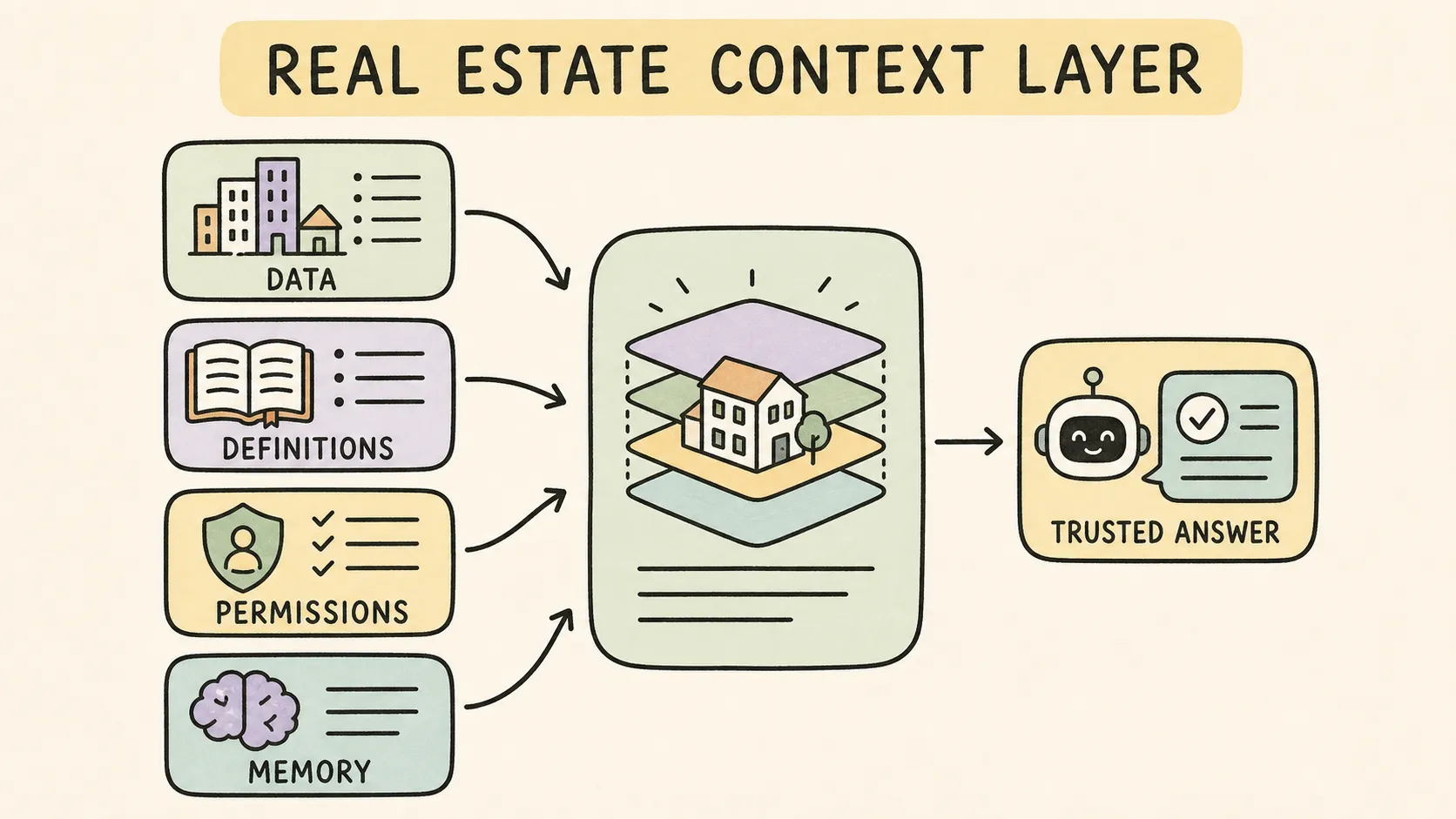
Almost every AI tool can read a document or summarize a number. The harder part is knowing which definition your firm uses, which properties are relevant, which source should prevail, and how the final answer should be presented. Leni’s context layer gives approved AI workflows that operating context while keeping access tied to the authenticated user, organization, and properties.
Why general AI loses the thread
A model can summarize a document or draft an answer, but it does not automatically know:
Which definition of occupancy your firm uses
Which property set is relevant to the request
Which source is authoritative
What format a recurring report should follow
Which exception needs escalation
What a user explicitly asked the system to remember
Which information the user is permitted to access
That knowledge is distributed across systems, documents, decisions, and people. Without a governed way to retrieve it, a plausible response can still be wrong for the organization.
What Leni’s context layer brings together
Semantic context
The semantic layer provides governed real-estate definitions so data can be interpreted consistently. It helps distinguish business meaning from a raw field name or isolated number.
Organizational context
When the customer’s plan and permissions allow, Leni can consult relevant organization-level context for the authenticated user and active organization. This can include the operating knowledge needed to complete an approved workflow in the firm’s way.
Personal context
Leni can consult relevant personal context for the authenticated user, helping approved workflows reflect useful preferences and prior context without giving the user access to someone else’s information.
Live, permission-aware evidence
The systems and files remain the source of truth. The context layer is designed to retrieve relevant evidence under the customer’s permissions rather than treating an old, ungoverned copy as authoritative.
Explicit memory controls
Consulting context is different from changing durable memory. Leni creates, updates, or deletes durable memory only when the user explicitly requests the action and the authorization grant permits it.
Context is part of the system
Authorized source systems provide evidence.
The Universal Data Model creates a consistent data contract.
The semantic layer explains the meaning of supported data.
Personal and organizational context supplies the relevant operating frame.
The runtime coordinates the permitted workflow.
The application or compatible AI assistant receives a governed result through the HTTP API or remote MCP.
The model can change. The customer’s permissions, definitions, evidence, and workflow controls remain part of the Leni system.
Useful context for real-estate workflows
With an approved implementation, context can help an AI workflow:
Apply the firm’s reporting structure to a recurring portfolio update
Use the correct property group and comparison period
Explain a metric using the organization’s governed definition
Carry a user’s requested output preference into later work
Surface the evidence behind an analysis
Preserve a correction only when the user asks to remember it
Keep one organization’s context isolated from another
Exact behavior depends on the connected data, plan, permissions, and configured workflow.
Context without uncontrolled access
Leni derives the authenticated user and organization from the authorized session. Organization and property scope is enforced by Leni. A client cannot broaden access simply by asking for a different organization or property in a prompt.
The public MCP boundary terminates the host’s OAuth token and uses scoped internal identity for downstream work. The current implementation is designed around tenant isolation, explicit grants, and server-owned access boundaries.
Memory should be intentional
Consult: retrieve relevant context for the current task
Create: save new memory only when the user asks
Update: change existing memory only when requested
Delete: remove memory only through an authorized, explicit action
This makes durable context a governed product capability instead of a side effect of every conversation.
Frequently asked questions
What does a context layer improve for my team?
It gives AI the definitions, evidence, permissions, and organizational know-how needed to interpret a task the way your team does. That helps a general model work with the right properties, metrics, documents, and business rules instead of relying only on a prompt and public knowledge.
What information can Leni use as context?
Depending on your plan, permissions, and implementation, Leni can use approved source data, governed definitions, documents, reporting practices, organization context, and user context. We select the relevant information for the task rather than treating every piece of company data as equally useful.
Does Leni copy all our company data into an AI model?
No. We use permission-aware access to relevant evidence and governed context, while your source systems remain authoritative. The model receives only what the approved workflow and authorized tool call make available.
Does Leni remember everything automatically?
No. We separate temporary task context from durable memory. Saving or changing durable memory requires an explicit user action and the appropriate authorization, so your team stays in control of what becomes reusable context.
How does Leni keep one organization’s context separate from another’s?
We bind access to the authenticated user and active organization, then enforce organization and property boundaries on every permitted tool call. A user cannot simply prompt their way into another tenant’s context.
Can ChatGPT or Claude use Leni’s context layer?
Yes, when the assistant environment supports Leni’s remote MCP connection. The user signs in with Leni OAuth, and the assistant can use only the Leni tools and context that user is entitled to access.
Give AI the context your work requires
Read the Leni developer documentation or talk to Leni about a governed context layer for your real-estate workflows.

Leni
Purpose-built AI analyst for investment finance and real estate. Leni runs persistent workflows across underwriting, market research, memos, and reporting so teams can move faster with higher confidence.

Curious About AI?
Join the largest AI community for real estate online. Get bite-sized, real-world use case videos, plus practical tips and proven strategies from top industry experts on adopting AI effectively.
MEET LENI
AI SuperAgent Purpose Built for Investors and Operators.
Experience how professionals and teams in your domain are getting the edge using AI.
