How AI Is Changing Multifamily Asset Management in 2026

How AI Is Changing Multifamily Asset Management in 2026
Multifamily asset managers are being asked to oversee larger portfolios while dealing with more data and higher investor expectations. Yet much of the work still happens across a messy mix of spreadsheets, property management system exports, browser tabs, and reports assembled by hand.
The rent roll is in Yardi. The underwriting model is buried in Excel. Market data is sitting in a browser tab someone can no longer find. And the quarterly report that was emailed at 11 p.m. on Friday may already have disappeared into someone's inbox.
Plenty of tools solve one piece of this problem. Some store data. Others create dashboards or automate a specific task. But modern multifamily asset management software should do more than improve one isolated part of the process. It should connect the pieces.
The platforms worth evaluating in 2026 can extract information from documents, support financial modeling, conduct research, generate reports, and automate multistep workflows. The goal is simple: help teams spend less time gathering information and more time making good decisions.
What Multifamily Asset Management Software Means in 2026
"Asset management software" is a broad label, and the products that fall under it can serve very different purposes. Understanding those differences early can save months of implementation work, and prevent a company from spending six figures on software that never solves the original problem.
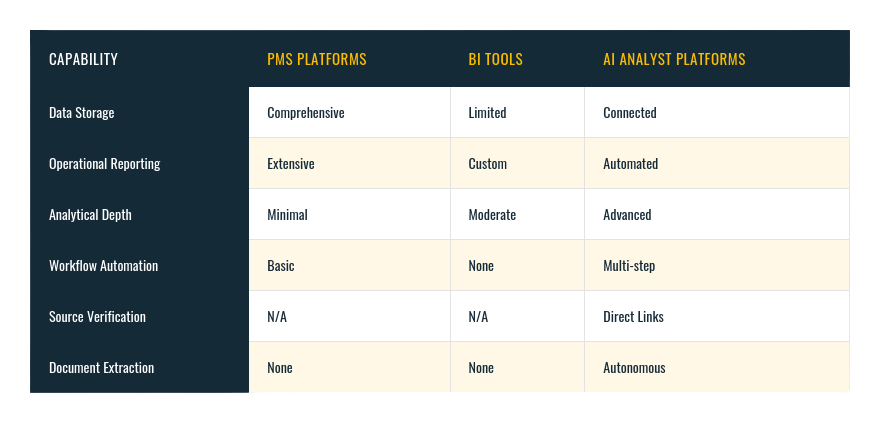
Property management systems such as Yardi, RealPage, and Entrata handle the operational side of the business. They manage leases, rent collection, maintenance requests, resident communication, and accounting. These systems are essential because they provide a reliable record of what happened across a property or portfolio.
What they generally do not do is carry out deeper analysis.
Comparing rental income across several properties may still require working through complicated report builders. Evaluating an acquisition often means exporting data to Excel and rebuilding formulas manually. Even basic asset management metrics may need to be calculated and monitored outside the system.
Business intelligence tools such as Tableau, Power BI, and Looker add another layer. They turn existing data into charts and dashboards, which can be helpful for reporting and portfolio reviews. But a dashboard still needs someone to interpret it.
It can show that occupancy is declining, but not necessarily explain why. It can display an increase in expenses without identifying the underlying operational issue. And it may not flag an unusual result unless someone has already built the right rule or report.
For teams overseeing hundreds or thousands of units, maintaining those dashboards can become another job in itself.
A newer category of purpose-built AI platforms is beginning to fill the gap. These tools connect with property management systems, read documents in different formats, and complete analytical workflows that asset management teams have traditionally handled by hand.
Instead of simply storing or displaying information, they can help with financial modeling, document review, market research, portfolio monitoring, and investor reporting.
How the three software categories compare
Financial Analysis and Multifamily Acquisition Modeling
Acquisition underwriting is one of the most time-consuming and consequential parts of multifamily asset management.
Evaluating a typical 250-unit opportunity may involve extracting rent-roll information from a broker's PDF, entering it into an Excel model, researching market rents and comparable sales, running sensitivity scenarios, and turning the findings into an investment committee presentation.
Completed manually, that process can take 15 to 25 hours for a single opportunity. That becomes difficult to sustain when several deals arrive in the same week.
Purpose-built platforms can shorten much of this process. A team can upload an offering memorandum and have the software identify relevant information such as:
Unit mix
Current and market rents
Operating expenses
Debt terms
Seller assumptions
Historical property performance
The platform can then use that information to create an underwriting workbook with standard Excel formulas, cash-flow projections, IRR calculations, debt schedules, and sensitivity tables.
A useful system should also recognize when information is missing. Rather than quietly filling the gap with an unsupported assumption, it should flag the issue and ask a specific follow-up question.
The final result should be a structured workbook that analysts can review, challenge, and adjust, not a recommendation produced inside a black box.
A complete underwriting package might include:
An Excel model covering assumptions, sources and uses, projected cash flows, debt, and sensitivity analysis
A list of missing inputs and clear questions for the deal team
Return scenarios based on different holding periods and exit cap rates
An executive summary for investment committee review
References connecting key assumptions to the offering memorandum or outside market data
The real benefit extends beyond saving time on a single deal.
An acquisitions team reviewing 30 to 50 opportunities per year could reduce preliminary analysis from several hours to less than one hour per property. That gives the team more time to consider the questions that require genuine judgment: Is the property positioned correctly? Are the seller's assumptions realistic? Where does the team have negotiating leverage? Is this the best use of capital?
Reviewing more opportunities is valuable, but the larger goal is to make better investment decisions.
Document Extraction That Understands Multifamily Context
Multifamily documents rarely follow a consistent format.
One broker's rent roll may look completely different from another's. Important assumptions can be buried inside an 80-page offering memorandum. Leases often include property-specific language that affects valuation but takes hours to identify. T12 statements arrive in custom spreadsheets that can break as soon as someone tries to consolidate them.
A general AI tool may be able to pull text from these files. That is not the same as understanding what the information means in a real estate context.
Software designed specifically for the industry should recognize, for example, that "base rent" and "minimum rent" may refer to the same concept. It should be able to interpret escalation language, concession structures, expense recoveries, renewal options, and tenant improvement obligations.
It should also call attention to unusual provisions. A right of first refusal on page 47 or a clause that could reduce future rental income should not disappear inside a general summary.
For multifamily teams, useful document-review capabilities include:
Reading long or inconsistently formatted documents, including scanned PDFs
Extracting rent increases, renewal options, concessions, expense recoveries, and other material terms
Identifying nonstandard or potentially risky provisions
Suggesting follow-up questions and negotiation points
Producing structured summaries, risk alerts, and due diligence checklists
Linking extracted information back to the original document
This can reduce hours of manual review to minutes. More importantly, it lowers the risk of overlooking a detail that could materially affect the investment.
For acquisitions teams handling several opportunities at once, that consistency matters. A busy week should not determine how carefully a deal gets reviewed.
Automated Portfolio Reporting and Performance Monitoring
Quarterly investor reporting remains one of the biggest drains on asset management teams.
Someone has to retrieve data from the property management system, calculate performance metrics, write updates for each property, check the numbers, and format everything into a professional report. Across a growing portfolio, the process can take days every reporting period.
That is time analysts could otherwise spend reviewing property performance, planning renovations, addressing leasing issues, or working with operating teams.
AI-enabled asset management platforms can automate much of this workflow. Through direct connections with systems such as Yardi, RealPage, or Entrata, the platform can retrieve current data without requiring a fresh manual export each time.
It can then calculate the appropriate metrics, identify notable changes, draft explanations of what is driving performance, and produce formatted reports with links to the underlying data.
Typical time savings from automated reporting
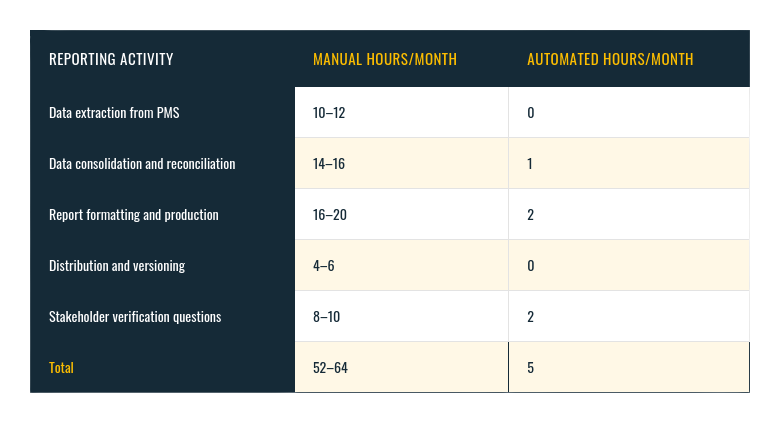
Reclaiming 50+ hours per month represents approximately 1.5 full-time employees worth of capacity redirected from manual report production to strategic activities: lease negotiations, renovation planning, and portfolio growth.
Depending on the team's needs, the output could include:
Excel and PDF reports
Portfolio-performance slides
Property-level updates
Narrative investor summaries
Recurring internal management reports
Recovering more than 50 hours of work each month would provide roughly the capacity of one and a half full-time employees. Instead of spending that time assembling reports, the team could redirect it toward lease negotiations, renovation planning, operational improvements, and portfolio strategy.
Real-Time Monitoring and Proactive Alerts
Monthly reports explain what already happened. Asset managers also need to know what is happening now.
The strongest platforms go beyond scheduled reporting by continuously monitoring important portfolio metrics. Teams can set thresholds for occupancy, expenses, collections, revenue, leasing velocity, and maintenance performance.
If a property moves outside an acceptable range, the system can alert the appropriate person and provide enough context to support an immediate response.
For example:
Occupancy falls below the property's target, prompting a review of leasing activity
Delinquency rises above an acceptable level, creating a potential cash-flow concern
An expense category exceeds its budget by a defined percentage, triggering a vendor or budget review
Leasing velocity slows, suggesting that pricing or marketing may need to change
Maintenance resolution times increase, signaling a possible operational problem
The alert itself is only part of the value. It should arrive with the information needed to understand what may be happening, such as upcoming lease expirations, outstanding applications, recent pricing changes, or relevant operating trends.
This changes asset management from a largely reactive process into a more proactive one. Teams can respond while an issue is still developing instead of discovering it after it has already affected financial performance.
Market Research With Source Attribution
Teams need to understand new supply, rent growth, demographics, employment trends, regulations, comparable properties, and capital market conditions. That information helps determine whether to acquire, hold, renovate, refinance, or sell an asset.
Traditional market research often involves several data subscriptions, manual searches through CoStar or similar services, and hours of work to turn disconnected findings into a useful report. Standard BI tools do not solve the problem because they generally work only with information the company already has.
Purpose-built platforms can conduct focused market research on demand.
A team might request an analysis of Class B apartment properties in a particular submarket. The platform could identify relevant sources, collect current data, compare it with historical trends, and organize the findings into a structured report.
That report could cover:
Local economic conditions
Demographic trends
Current and planned supply
Rent and occupancy trends
Publicly advertised concessions
Relevant regulations and incentives
Comparable sales
Capital market conditions
Every material claim should include a link to its source and, where appropriate, the date on which the information was observed.
Typical deliverables may include:
A comprehensive market report with cited references
Competitive analysis based on advertised rents, concessions, and availability
Comparable-sales analysis adjusted for differences between properties
Submarket-level rent-growth and supply-demand analysis
Source links that allow the team to verify the findings
There is an important distinction here. This is focused, on-demand research, not an attempt to collect everything on the internet continuously.
The team asks a question, the platform investigates that specific issue, and the results include direct links for verification. That makes it easier to evaluate unfamiliar markets without asking the investment committee to accept unsupported claims.
Investment Committee Memos and Investor Presentations
Even after the analysis is complete, significant work remains. Teams still have to turn underwriting results into a clear investment committee memorandum or investor presentation. That means organizing the investment thesis, explaining the market, presenting comparable transactions, summarizing assumptions, describing risks, and making sure the entire document tells a coherent story.
Much of this work falls to senior employees because it requires judgment and an understanding of the investment. Yet a large portion of the process, formatting slides, transferring numbers, applying templates, and assembling standard sections, is mechanical.
AI-powered platforms can use the underlying deal documents and completed underwriting to produce a first draft of the investment committee materials.
The output might cover:
The investment thesis
Market and submarket conditions
Comparable properties and transactions
Key underwriting assumptions
Major risks and possible mitigants
The value-creation plan
Outstanding due diligence items
Teams can define their preferred structure, mandatory slides, narrative sections, and formatting conventions. The system can then follow that framework, leaving the investment professionals to review the reasoning and make the final adjustments.
A typical workflow could look like this:
Upload the offering memorandum, rent roll, T12, and existing financial model.
Request a summary of the opportunity, key risks, and missing information.
Generate an underwriting package and sensitivity analysis.
Create the investment committee memo and investor presentation.
Review the work, adjust the assumptions, and share the final materials.
A process that once took more than 20 hours across several team members becomes one in which human expertise is focused on strategy and judgment, not copying numbers between files.
Connecting With Existing Property Management Systems
The most effective asset management platforms do not try to replace the property management system. They add an analytical layer on top of it.
Yardi can continue managing leases and accounting. RealPage can continue processing rent payments. Entrata can continue handling resident communication. The AI platform connects with those systems and uses their data to support analysis and decision-making.
This layered approach has several practical advantages:
Property managers can continue using familiar systems for their daily work
Information stays in the system where it was created
Teams avoid maintaining duplicate records that eventually fall out of sync
Automated data flows reduce the errors and delays caused by manual exports
Changes to rent rolls or property performance can appear in the analysis without waiting for another reporting cycle
Structured PMS data can be evaluated alongside unstructured documents such as leases, work orders, and financial statements
Modern API connections can provide access to current information without requiring someone to download and upload new files every month. This makes automated recurring reports possible and ensures that portfolio monitoring reflects current performance, not last month's spreadsheet.
Security, Compliance, and Verifiable Results
Multifamily portfolios contain highly sensitive information, including financial records, confidential lease terms, tenant data, and proprietary investment strategies.
Any platform working with that information needs institutional-grade security.
Important requirements include:
SOC 2 Type II certification supported by independent testing
Role-based access controls that limit information to the appropriate users
Encryption for data both in transit and at rest
Complete audit logs covering data access, model generation, and report creation
Compliance with applicable regulations and contractual obligations
Security alone is not enough. The platform's work must also be verifiable.
If a system calculates an expected return or summarizes a lease provision, the investment team should be able to trace the result back to the source. That might mean linking a number to a specific cell, highlighting the relevant section of a PDF, or showing the market source and observation date behind an assumption.
Institutional investors need to defend their assumptions to investment committees, lenders, and other stakeholders. They cannot rely on a result simply because an AI system produced it.
Clear sourcing helps address the "black box" concern that has made many real estate organizations cautious about adopting AI. It allows teams to benefit from faster analysis without giving up rigor or accountability.
How to Choose Multifamily Asset Management Software
Long feature lists can be distracting. In practice, five qualities are more likely to determine whether a platform reduces work or creates more of it.
1. Real estate knowledge
The platform should understand common multifamily concepts and workflows without needing a lengthy explanation every time.
It should be familiar with NOI calculations, lease structures, rent escalations, debt-service coverage ratios, and exit cap rate conventions. If users constantly have to explain basic industry language, the software is giving back much of the time it was supposed to save.
2. Multistep execution
Most analytical work is not a single task. It is a sequence of connected tasks.
A useful platform should be able to move from document intake to analysis and then to a finished deliverable. The user should be able to upload an offering memorandum, explain the desired outcome, and receive a complete package for review.
3. Direct integrations
Native connections with Yardi, RealPage, Entrata, and other core systems help keep information current.
A platform that relies heavily on CSV exports creates version-control problems and works with information that may already be outdated. Manual exports also limit how much of the portfolio can be monitored or automated reliably.
4. Source verification
Every important result should be traceable to the document, data point, or calculation that produced it.
An analysis that cannot be checked is unlikely to survive serious investment committee review. Traceable work protects analytical standards and helps teams build trust in the platform over time.
5. Support for long-running work
A complete market study, underwriting package, or multi-property investor update cannot always be completed in a few seconds.
The platform should be capable of working on complex assignments for 15, 30, or even 60 minutes and returning a finished deliverable. Users should be able to start the work, step away, and return to something useful, not an error message or an incomplete draft.
The right platform should also become more valuable as the team uses it. Over time, it can learn the portfolio's structure, the team's preferred formats, and the assumptions that regularly appear in its work. Consistent, verifiable results are what ultimately build confidence, not novelty.
From Collecting Data to Making Decisions
Choosing asset management software is really about deciding how the team should spend its time. Should analysts be collecting information, fixing spreadsheets, and formatting reports? Or should they be evaluating opportunities, challenging assumptions, and working directly on portfolio strategy?
The answer also affects how the organization grows. A larger portfolio does not necessarily have to mean hiring more people to maintain the same manual processes. With the right systems in place, the existing team can oversee more assets without sacrificing the quality of its analysis.
An enterprise AI intelligence layer can help make that possible by connecting the organization’s data, documents, systems, and institutional knowledge. Rather than automating isolated tasks, it creates an architecture that understands how the organization operates and applies its processes consistently across workflows.
Teams can evaluate more opportunities, monitor portfolio performance more proactively, and communicate with investors without the usual end-of-quarter scramble. Most importantly, they can make decisions using complete, well-supported analysis instead of partially finished spreadsheets.
Built for the enterprise, Leni connects an organization’s data, documents, systems, and institutional knowledge within a single AI architecture. Instead of relying on one language model, it orchestrates specialized AI models, business logic, and deterministic workflows to produce accurate, source-grounded results. Every output is backed by the organization’s data, follows its processes, and can be traced to its source.
Organizations define their workflows, decision criteria, approval logic, and institutional knowledge. Leni applies them consistently across underwriting, market research, investment committee memos, document review, portfolio reporting, lease analysis, and other workflows they choose to automate.
For multifamily teams, this can include turning operating data and documents into underwriting models, market studies, internal memos, investor presentations, and recurring asset management reports. Once the relevant systems are connected, these workflows can run with far less manual effort while remaining transparent and verifiable.
AI Analysts are one way to interact with Leni, but they are only one capability of the platform. Underneath every workflow is the same intelligence layer, designed to deliver complete, reliable, and repeatable work.
For organizations looking to manage more assets without adding more manual processes, that means greater scale without sacrificing the rigor, consistency, or quality of their decisions.

Johanna Gruber
Johanna has spent the last 8 years helping marketing teams connect with audiences through content. Specializing in B2B SaaS and real estate.

Curious About AI?
Join the largest AI community for real estate online. Get bite-sized, real-world use case videos, plus practical tips and proven strategies from top industry experts on adopting AI effectively.
MEET LENI
AI SuperAgent Purpose Built for Investors and Operators.
Experience how professionals and teams in your domain are getting the edge using AI.
