Multifamily data warehouse migration: rehearse the reporting cutover
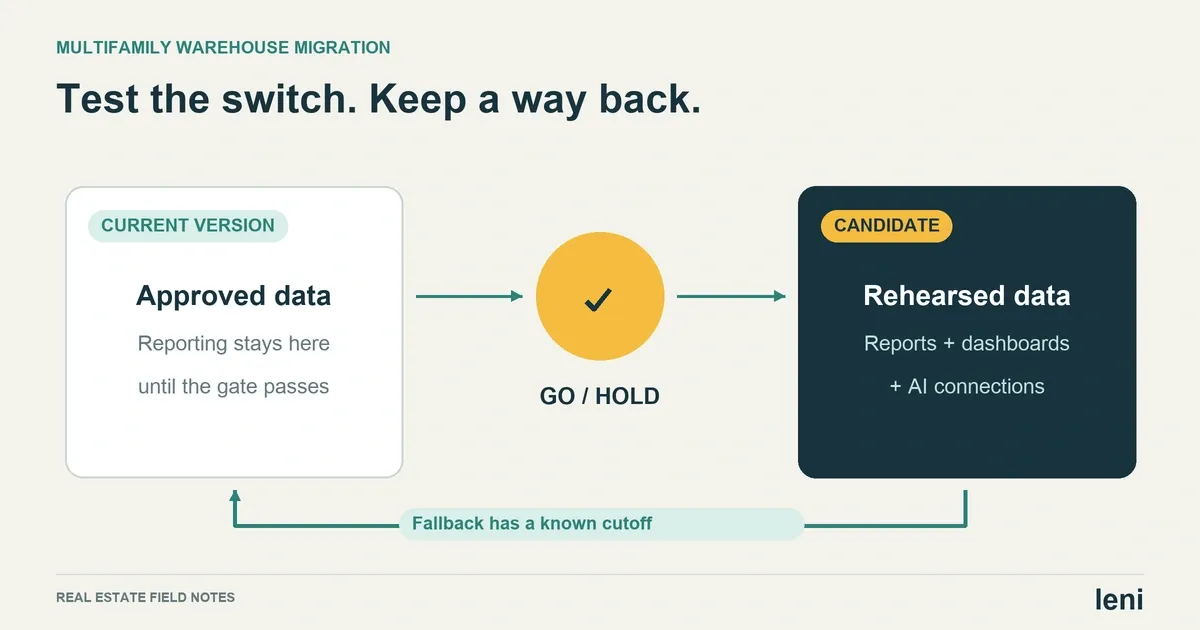
Multifamily data warehouse migration: rehearse the reporting cutover
A multifamily data warehouse migration is ready when people can use the new reporting path, explain its results and return to a known reporting state if a check fails. Moving the tables is only part of that decision. A dashboard, scheduled investor pack or AI assistant can still point to an old dataset after the new warehouse passes its data checks.
This checklist covers the reporting cutover: the point when an approved warehouse version becomes the source for those consumers. It does not replace a property management system conversion plan. Keep the accounting and property systems authoritative, and agree their separate operating changes with the responsible teams.
Choose one reporting path for the rehearsal
Start with one property, one closed period and one recurring output. List every step from the authorized source export to the report or AI answer. Include the data load, property and unit identifiers, mapping version, business definitions, access rules and the connection used by the reader.
Choose a case that crosses the planned change. If a property changes manager or PMS code, use that property. If a lease document supplies a field, include the document reference and permission check. The manager handover checklist covers the records to collect; this rehearsal tests how consumers switch to the accepted data.
Keep an explicit release record
Before testing, save the approved source snapshot, issued report and mapping version. Record the extraction time, included properties, period, filters and control totals. Preserve access to the evidence under the agreed retention and access rules.
Give the candidate reporting dataset its own version. Keep it separate from the version currently serving users. A release record should identify the candidate, the current version, the downstream connections to change and the person who can authorize the switch. It should also state how current the fallback data will be if it is used.
Decision | Evidence to record | Owner |
|---|---|---|
Is the scope complete? | Property list, source coverage, period and known exclusions | Data owner |
Do the figures reconcile? | Comparison to approved source totals and explained differences | Finance reviewer |
Do readers see the correct scope? | Allowed-property and denied-property test results | Access owner |
Will each consumer switch? | Dashboard, report job and AI connection inventory | Reporting owner |
Can the team recover? | Rehearsed fallback steps, data freshness and recovery time | Technical owner |
May the release proceed? | Named approval tied to the tested version and open issues | Decision owner |
Worked example: a report passes, but one reader stays behind
Consider an illustrative property called Cedar Court. Its old source code is CEDAR2 and its new code is NORTH7. Both must resolve to the same internal property identifier. The team loads a closed month into the candidate warehouse and reconciles its rent ledger and unit counts. These names and codes are examples, not a customer result.
The dashboard uses the candidate version and returns the approved totals. A scheduled report still uses the old connection. An AI assistant also uses an older reporting view. A dashboard-only test would miss both dependencies.
Record a separate test for each consumer. Ask the same question for the same property and period, and capture the dataset version, refresh time, permissions and source evidence used. Do not label the migration complete while a required consumer still points to the previous reporting path.
Test the change window and the first refresh
Agree which source records belong in the final migration load and which belong in the first regular refresh. Where old and new feeds overlap, define how the warehouse identifies the same transaction across them. Do not add overlapping totals together without a reviewed rule.
Test a repeated delivery of the same input. The result should follow the agreed duplicate-handling rule. Then test a late source correction and a missing file. The output should make its reporting basis and incomplete scope visible. The late-posting example shows why issued reports and current views need separate treatment.
Set pass conditions before the rehearsal. They can include an agreed tolerance for financial differences, a rule for unresolved identifiers, a refresh deadline and a requirement that restricted properties remain inaccessible. Select the conditions with the owners of the outputs; there is no universal tolerance or parallel-run duration for every portfolio.
Rehearse a fallback that states its limits
Define the failure that stops the release, who makes that decision and the steps to restore the previous reporting connection. Include scheduled jobs, saved exports and AI connections in the recovery plan. Check that the team can still access the approved version and its source evidence.
Returning readers to an older warehouse version does not undo transactions already entered in the PMS. It can also make the report stale. In the rehearsal, show the fallback's cutoff time, identify records that arrived afterward and explain how the team will reconcile them before another release attempt. Hold affected distributions if the available data cannot support the requested report.
AWS cutover guidance distinguishes rollback before data changes from rollback after new data arrives. Its infrastructure examples need adaptation to the actual reporting architecture. The practical question here is whether the fallback preserves an understandable data state, including changes made during the switch.
Approve the tested version, then check normal operation
Record a go, hold or fallback decision against the exact candidate version. Attach the test results, unresolved exceptions, approver and time. If a material mapping or permission changes after review, repeat the affected checks before using the earlier approval.
After the switch, verify the first scheduled load and each required consumer. Compare the output with the agreed source and confirm that users can see its period and refresh time. Keep the previous evidence available through the agreed observation window. Retire old connections only after the responsible owners accept the new reporting path and its recovery process.
Scope the data foundation with Leni
Leni's real estate data warehouse service brings supported property and finance records together with links to document evidence. Teams can use Leni's prebuilt warehouse or connect an existing platform, with agreed definitions and property-level permissions.
Bring one migration decision to the scoping conversation: which property and closed period to test, which reports or AI consumers must switch, and who approves the result. Confirm the source access, history, refresh schedule and ongoing support for that specific scope. Owning your AI starts with data your team can identify, check and use through a change of system.

Zain Nathoo
Co-founder & COO at Leni, writing about the systems, data, and AI behind better investment decisions.

Curious About AI?
Join the largest AI community for real estate online. Get bite-sized, real-world use case videos, plus practical tips and proven strategies from top industry experts on adopting AI effectively.
MEET LENI
AI SuperAgent Purpose Built for Investors and Operators.
Experience how professionals and teams in your domain are getting the edge using AI.