Real Estate AI Agent Runtime, APIs & MCP | Leni
Real Estate AI Agent Runtime, APIs & MCP | Leni
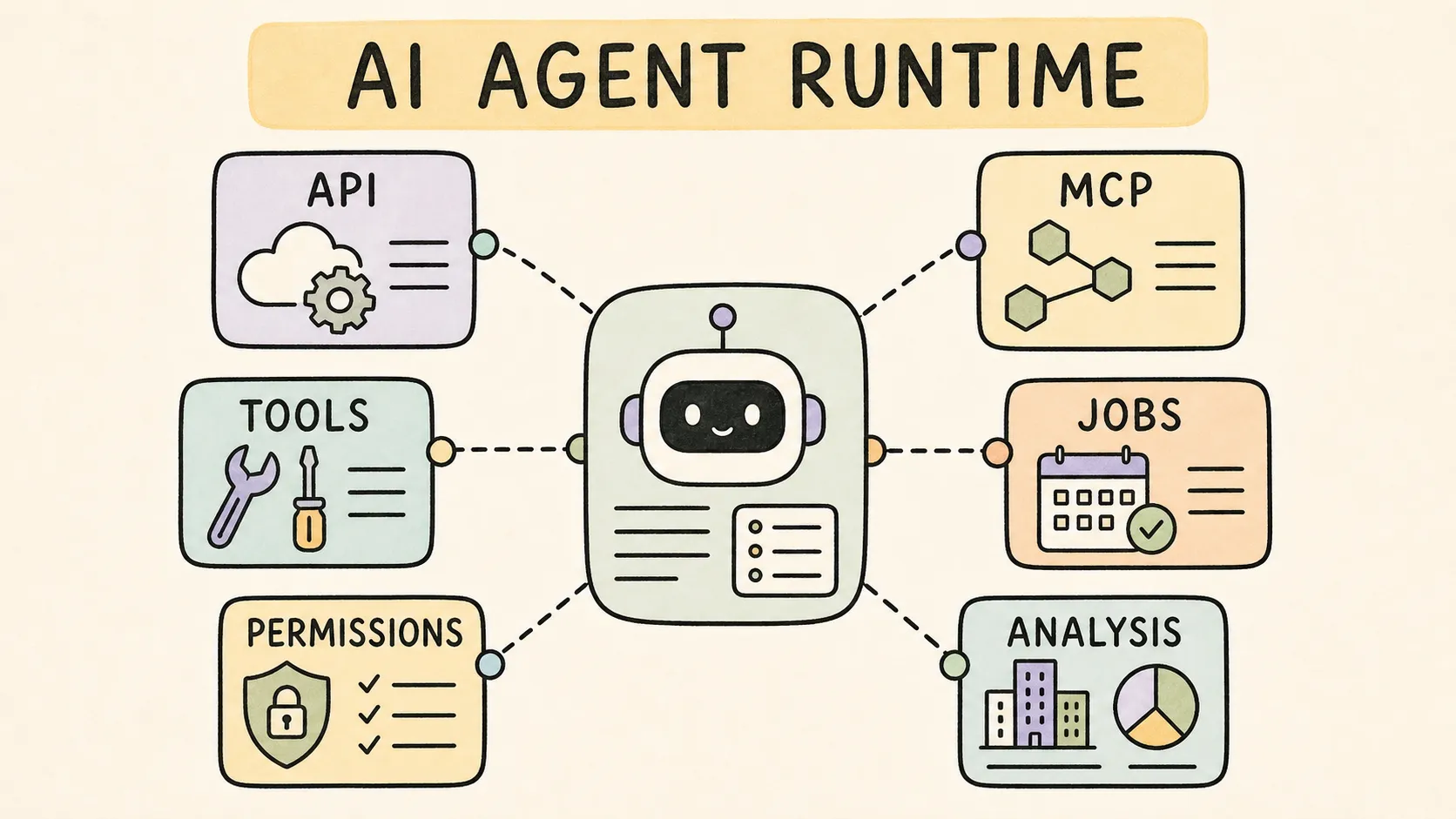
Chatbots can generate answers. Production real-estate workflows are more demanding. They need identity, approved data, business definitions, context, tools, and a reliable way to finish work that takes longer than a single response. Leni provides that operating layer through an HTTP API for server applications and remote MCP for compatible AI assistants.
More than a prompt interface
General-purpose models are powerful engines for reasoning and drafting. Production real-estate workflows also need data access, business definitions, permissions, durable execution, context, and a clear boundary around what the agent is allowed to do.
Leni supplies that system around the model. Developers can build server-to-server applications with the HTTP API. Compatible assistants can connect through Leni’s remote MCP runtime. Both paths use Leni’s governed data and context services, subject to their own authentication method, permissions, plan, and usage rules.
What the runtime coordinates
Authorized real-estate data
Approved workflows can use permitted portfolio data through Leni’s semantic layer. Direct public MCP portfolio tools are read-only, and Leni enforces organization and property scope.
Universal Data Model and semantics
The runtime works with Leni’s normalized data foundation and governed business definitions so agents can reason about supported real-estate concepts consistently.
Personal and organizational context
A workflow can consult relevant personal context and, when the user’s plan and permissions allow, organization context. Context remains tied to the authenticated user and active organization.
Analysis and research
Leni supports real-estate analysis and market-research workflows through the governed runtime. Exact capabilities, inputs, and output contracts are defined in the current developer documentation.
Durable memory
Memory is available as an explicit capability. Durable memory is created, changed, or deleted only when the user asks and the authorization permits the action.
Durable execution
Longer analyses can be accepted asynchronously. A server-to-server client may receive HTTP 202 with stable run, message, and session identifiers, then poll for the result instead of resubmitting the work.
Two ways to build
HTTP API for server-to-server applications
Use the HTTP API when your application, backend, or internal service needs programmatic Leni access.
Authenticate with a Leni project API key
Keep the key on the server
Follow the current request, upload, limit, usage, and polling contracts
Use stable run and session identifiers for asynchronous work
Do not place a project API key in an AI assistant or client-side application
The authoritative reference is the Leni developer documentation.
Remote MCP for compatible AI assistants
Use remote MCP when a compatible host needs to discover and call permitted Leni tools.
MCP endpoint: https://mcp.leni.co/mcp
Transport: remote Streamable HTTP
Authentication: Leni OAuth sign-in and consent
Scope: tied to the authenticated Leni user, active organization, plan, and permissions
For Claude, follow the current connector instructions in the Leni developer documentation. ChatGPT and other hosts can differ by product, plan, admin setting, and connector workflow; use the current documentation for each host rather than copying an old setup path.
Build a first analysis workflow with Leni’s API
Use Leni’s HTTP API when you want your own application to request analysis, track its progress and retrieve the result. This is a runtime interface—not a promise of raw Entrata, Yardi or other property-management CRUD endpoints.
The following walkthrough follows our HTTP API quickstart. Run it only with an account, environment and data scope your team has approved. Starting an analysis can consume plan usage or funded API credits.
Keep authentication on your server
Manage your project key in Leni’s API workspace and store it in a server-side secret manager. Authenticate requests with the documented API-key header. Never place the key in browser code, a public repository, a URL, or a ChatGPT or Claude conversation.
Your account determines the environments you can use. Use the authentication documentation and quickstart for the current connection check.
Submit the question once
The quickstart sends an analysis request to POST /users/run-models on https://api.prod.ca-central-1.leni.co. Its example asks for a portfolio occupancy summary with wait: false.
Use the current request body in the quickstart rather than guessing model names or copying an old payload. The data available to the analysis depends on the account’s approved connections and permissions.
Treat acceptance and completion as different states
If Leni returns HTTP 202, it has accepted the work; the answer is not ready yet. Save runId, messageId and sessionId separately, exactly as returned. They identify different parts of the workflow.
Your interface should show that the analysis is in progress and retain those identifiers so it can resume checking the same work. Do not start another analysis just because a user refreshes the screen.
Poll, then retrieve the result
Use GET /users/me/chat-messages/:messageId to check the submitted message. After completion, use the documented result retrieval flow, including POST /users/me/chat-sessions/message-responses with the matching session and message identifiers.
Display the completed result for human review. Preserve relevant supporting output and make it clear when a run fails instead of substituting a generic answer.
Handle timeouts without duplicating work
A network timeout after submission does not prove the analysis failed to start. Leni does not currently document an Idempotency-Key contract, so do not automatically repeat an ambiguous analysis POST.
Where possible, reconcile existing message or session state first. Retry safe reads with bounded backoff, and respect Retry-After when the service returns HTTP 429. See the reliability guide for the current retry contract.
Before expanding the workflow, measure the full cost of a pilot—including setup, usage and human review—against an agreed baseline. Our real estate AI pilot ROI guide provides a practical evaluation framework.
When should I use MCP instead?
Use remote MCP when a compatible assistant such as ChatGPT or Claude should call Leni on behalf of a signed-in user. MCP uses Leni OAuth, not a project key.
For a direct data question, the assistant can discover the available models, inspect their measures and run a bounded read-only query. For longer analysis, it uses the analysis tools and checks the existing analysis status rather than submitting a duplicate.
Does this API connect a new property-management system automatically?
No. Source-data authorization and implementation come first. The runtime works with the data and capabilities available to the authenticated account. An API key does not grant new source-system rights or unrestricted access to property-management records.
Model-agnostic by design
Leni should not be framed as a replacement for Claude, ChatGPT, Gemini, or another model. The model is one part of the system. Leni provides the governed real-estate data, context, workflow, and delivery layer around the intelligence selected for the task.
That separation lets a team evolve its model choices without redefining every property connection, business rule, permission, and recurring workflow.
Clear capability boundaries
The public runtime should not be presented as an unrestricted operator of source systems. Current public boundaries do not support general claims of:
Money movement
Invoice payment
Trading
Regulated advice
Mutation of property-management records
Access outside the authenticated organization or authorized properties
Raw SQL supplied by an MCP client
These constraints are part of making the runtime dependable for high-stakes work.
What teams can build
A portfolio analysis assistant grounded in authorized property data
A month-end reporting workflow that runs asynchronously
A real-estate research application with source-linked outputs
An internal assistant that applies governed definitions and organization context
A developer product that uses Leni as its real-estate intelligence backend
A Claude workflow that calls permitted Leni tools through remote MCP
Availability depends on implementation, plan, connected data, and user permissions.
Frequently asked questions
When do I need an agent runtime instead of only an LLM API?
An LLM API gives you model output. A production real-estate workflow also needs identity, permissions, tools, governed data, context, memory controls, and reliable execution. Leni brings those pieces together so your team does not have to rebuild the operating layer around every model or use case.
Is Leni an AI model?
Leni is the governed infrastructure around the model: real-estate data, context, analysis, tools, and runtime. We can use the appropriate model intelligence for a workflow without making your data and business logic depend on one model provider.
Should our developers use the Leni API or MCP?
Use the HTTP API for server-to-server products, back-end services, uploads, sessions, and asynchronous analysis. Use remote MCP when a compatible assistant needs to call Leni tools on behalf of a signed-in user. The developer documentation explains the current setup for each path.
Can I connect Leni to ChatGPT or Claude?
Yes, when your ChatGPT or Claude environment supports a remote MCP connection. Each user signs in with Leni OAuth, reviews the requested access, and works within their authorized organization and property scope.
Will Leni lock us into one model?
No. We designed Leni as model-agnostic infrastructure so the data, context, permissions, and workflow layer can remain consistent even when the right model changes.
Can I use Leni with Gemini?
Leni is model-agnostic, but we do not publish a direct Gemini connector unless both products support and document that path. If Gemini is part of your architecture, talk with us and we’ll confirm the supported integration route for your environment.
Build real-estate AI on a governed runtime
Read the developer documentation, connect through Leni MCP, or talk to Leni about your application and data scope.

Leni
Purpose-built AI analyst for investment finance and real estate. Leni runs persistent workflows across underwriting, market research, memos, and reporting so teams can move faster with higher confidence.

Curious About AI?
Join the largest AI community for real estate online. Get bite-sized, real-world use case videos, plus practical tips and proven strategies from top industry experts on adopting AI effectively.
MEET LENI
AI SuperAgent Purpose Built for Investors and Operators.
Experience how professionals and teams in your domain are getting the edge using AI.
