Real estate data warehouse costs: compare the full quote
Real estate data warehouse costs: compare the full quote
A real estate data warehouse quote is useful only when you can see what it covers. A setup fee can omit historical records. A monthly subscription can exclude document review or charge separately for a new manager. Compare the same deliverables before comparing totals.
Use the example below to separate priced work, estimates and unanswered items. It is a fictional buying exercise, not a Leni price list or a customer result.
Give both bidders the same scope
Harbor Row wants to compare financial results across two property managers and check selected rent terms against signed amendments. Its first phase requires:
- Approved property and accounting feeds from both managers, with a named owner for source access.
- Twenty-four closed months of transaction history, mapped to approved property identifiers and account definitions.
- One hundred approved lease amendments, with rent, effective date and source reference extracted. A reviewer must resolve uncertain fields.
- Daily financial refresh, with a visible last-successful-load time, and a repeatable month-end reconciliation.
- Property-level access tests, named support responsibilities and a usable export of agreed data and definitions.
These quantities describe this example only. Set your own coverage, history, document volume and review requirements. Use the multifamily warehouse RFP scorecard to define the conditions each bidder must meet.
Find the gap behind the quoted total
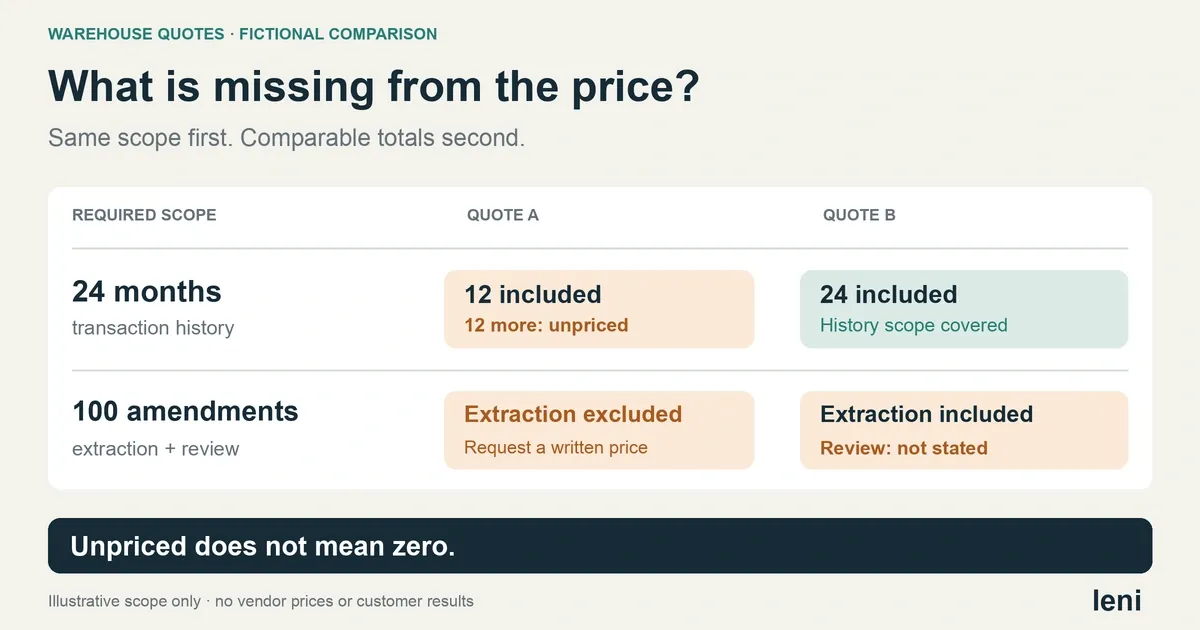
Both fictional bids claim to cover implementation. Their written scopes show a different result.
| Required work | Quote A | Quote B |
|---|---|---|
| Both managers' feeds | Included | Included |
| 24 months of history | 12 months included; extra 12 unpriced | 24 months included |
| 100 lease amendments | Extraction excluded | Extraction included; human review not stated |
| Daily refresh | Included | Included |
| Cloud usage | Estimate with stated workload | Monthly allowance; overage rate not stated |
| Export at exit | Format and fee not stated | Agreed export included |
Neither total is ready for a direct comparison. Ask Quote A to price the missing history, document extraction and export. Ask Quote B to define the review work and overage terms. Keep unresolved items marked unpriced; an empty cell does not mean zero.
A quote can include extraction software without including the person who checks an ambiguous amendment. Record who supplies that review and count internal effort separately from supplier invoices.
Build a first-year cost worksheet
Use one row for each cost and the same planning period for every option. Record the amount, currency, billing unit, included quantity, payment start, owner and quote reference. Mark the amount as fixed, estimated or unpriced.
- Launch: discovery, access setup, mapping, historical loading, document processing, access tests, reconciliation and training.
- Run: subscription, storage, compute, document or AI usage, monitoring, support and internal review.
- Change: the agreed scenario for adding one manager, one source or a new report after launch.
- Exit: export, documentation and transition work, shown as a separate scenario if it will not occur in the first year.
For the base first-year estimate, add launch charges, recurring charges for the months they apply, estimated usage and internal effort. Avoid double counting a cloud allowance already included in a subscription. Keep taxes, contingency and optional changes visible. A fixed subtotal plus unpriced items is not a complete project budget.
Ask what changes the usage estimate
Request the assumptions behind consumption charges: stored volume, query workload, refresh frequency, document pages, AI use and retention. For example, BigQuery separates compute and storage pricing and offers different compute billing models. A platform unit price alone does not establish the cost of your workflow.
Ask who monitors usage, what happens when an allowance is exceeded, and whether a limit stops processing or only sends an alert. Have each bidder price the same change scenario and identify the assumptions that would require a revised quote.
Close the unanswered items before selection
Keep each gap with its owner, written answer and decision date. Compare confirmed scope and the remaining uncertainty alongside the price. For responsibilities after launch, use the build-versus-buy operating worksheet.
Leni's real estate data warehouse service can use its prebuilt model or connect an existing warehouse. Scope approved property and finance records together with the document fields and evidence your reporting and AI workflows need. Start with one portfolio question, then agree on sources, history, refresh, review work and ongoing support before requesting a proposal.

Zain Nathoo
Co-founder & COO at Leni, writing about the systems, data, and AI behind better investment decisions.

Curious About AI?
Join the largest AI community for real estate online. Get bite-sized, real-world use case videos, plus practical tips and proven strategies from top industry experts on adopting AI effectively.
MEET LENI
AI SuperAgent Purpose Built for Investors and Operators.
Experience how professionals and teams in your domain are getting the edge using AI.