Real Estate Investment Decision-Making: A Practical Framework for 2026
.webp&w=1920&q=75)
Real Estate Investment Decision-Making: A Practical Framework for 2026
Building an Excel model is still usually a typical decision in commercial real estate investing, one that involves an analyst pulling comparables from various sources and turning those findings into an investment memo. It is a familiar and flexible process, but it can also be time-consuming, time that could otherwise go toward questioning assumptions before presenting a proposal to the investment committee.
A production system with a solid architecture does more than produce a model. It gives the team enough time and reliable information to decide whether an opportunity fits their strategy, what issues might affect it, and which assumptions matter most. In this article, we will look at how to structure that process and where current tools can step in effectively.
What investment decision-making actually involves
In this industry, investment decision-making is rarely a simple calculation of variables. It is better understood as a sequence of analytical tasks and criteria that repeat across acquisitions, hold decisions, dispositions, and refinancing.
Gathering and verifying property-level information, including rent rolls, T12 financial statements, lease abstracts, and offering memorandums.
Building or updating a financial model with return projections and sensitivity analysis.
Assessing market conditions through comparable sales, submarket fundamentals, and demand drivers.
Evaluating factors that do not fit neatly into a spreadsheet, such as sponsor track record, tenant concentration, and capital markets timing.
Presenting a recommendation that an investment committee or LP can scrutinize and question.
When analysts spend most of their productive time entering data and formatting models, they have less time left to stress-test assumptions, investigate unusual results, or compare scenarios. The final recommendation depends on how much priority is given to each step.

Three ways to structure the process
Manually
This is the most conventional workflow. Each analyst pulls information from PDFs, property management system exports, spreadsheets, and even image files. A model is built for each property, and comparable transactions are researched through sources like CoStar.
This approach gives the team direct control over every assumption, but it becomes heavy, especially when documents arrive in inconsistent or multiple formats, or when the model has to be rebuilt for every new opportunity.
That is where the process stalls. Between manually reviewing these documents and gathering and rebuilding the data, all while trying not to make mistakes along the way, very little time is left for the analyst to get to what matters: turning raw documents into a decision-ready analysis and pressure-testing assumptions.
Dashboard and BI assisted
Business intelligence tools like Power BI and Tableau are useful for organizing and visualizing data a company already has. While they are good at revealing portfolio trends and making recurring reporting more consistent, their role is more limited for a new acquisition.
A dashboard typically does not extract lease terms from documents, does not build a new underwriting model, and does not gather external market evidence. The underlying data still has to be prepared and takes time before the output is useful.
AI assisted
There are AI tools built for this purpose. Depending on the model, they can help extract and organize information from the range of document types mentioned above, such as PDFs, property management system exports, spreadsheets, image files, and others.
They can also generate offering memorandums and rent rolls, populate underwriting models, organize comparable property research, prepare an investment memo, offer suggestions, and even flag errors and missing data.
These capabilities cut down on repetitive work. Automation does not remove the need for review, but it does reduce hours of manual work. In other words, the value of these tools lies in giving the team more time for decision-making and for correcting assumptions.
Comparing the three approaches
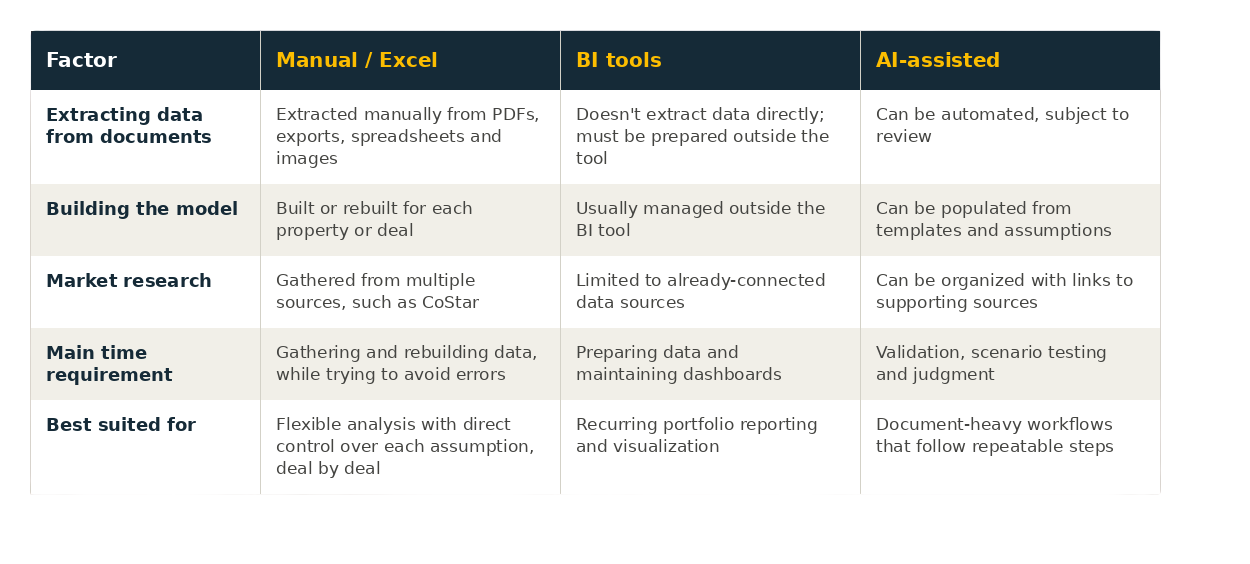
A decision framework by portfolio stage
Early stage, fewer than 10 properties
Even when deal volume is low and the team has time to examine each opportunity in depth, the need for additional tools tends to show up when underwriting delays cause the firm to lose out on opportunities, or when analysts have to manually rebuild the same reports over and over with small updates.
Growth stage, 10 to 100 properties
At this stage, the decision to move to standardized workflows starts to matter. There may be several opportunities under review at the same time, while the team is also monitoring existing assets and preparing investor reporting.
Adopting them becomes essential because the volume and complexity of the work tend to grow faster than the team does.
Institutional portfolios, more than 100 properties
Portfolios of this size need, almost as a requirement, consistent methods for extracting, modeling, monitoring, and tracking information.
The goal is no longer simply processing more data. It is making sure decision makers can verify and trace where each relevant figure came from, and understand how and where it shaped the recommendation.
While portfolio size is just one reference point for the stage a firm is at, deal frequency, asset complexity, reporting requirements, and the quality of existing data are likely just as relevant.
A practical example
Picture an asset management team evaluating a 250-unit multifamily property four days before an investment committee meeting.
If the team rushes to review the offering memorandum, enter the rent roll, update its cash flow model, research comparable properties, and at the same time draft the memo and the presentation, that is a manual workflow.
Preparing that data eats up most of the time available for the overall evaluation and for presenting the full analysis. Sensitivity testing would only start right before the meeting.
Preparing an initial extraction, populating a model, organizing comparable property research, and generating a first draft of the memo can be handled within an AI-assisted workflow.
From there, the analyst's work becomes key in verifying the extracted figures against the source documents, adjusting assumptions, and examining the scenarios that could change the recommendation.
The relevant difference is not a fixed number of hours. It is how the team uses the time available. A useful system should leave analysts with more time to ask questions like:
How sensitive are returns to the exit cap rate and to rent growth?
Which assumptions rely on incomplete or outdated evidence?
What happens if the business plan slips?
Which risks are material enough to change the recommendation?

Checklist: evaluate your current process
Before changing how your team makes investment decisions, ask yourself:
How long does it take to go from an offering memorandum to a recommendation ready for the investment committee?
How much of that time goes to data entry and formatting instead of analysis?
Can reviewers trace every material figure back to a source document?
Which assumptions get less scrutiny because the team is short on time?
How many opportunities get passed over because the team cannot underwrite them in time?
Does portfolio monitoring depend on someone catching an anomaly, or are material exceptions flagged consistently?
Where would automation improve the process, and where is human review essential?
Where Leni Fits
Leni is the AI Intelligence Layer for investing and real estate.
Built for the enterprise, Leni connects your data, documents, systems, and institutional knowledge into a single AI architecture that understands how your organization operates. Instead of relying on a single language model, it orchestrates specialized AI models, business logic, and deterministic workflows to produce accurate, source-grounded results, every answer traceable back to its source.
Your organization defines the workflows, decision criteria, and institutional knowledge. Leni applies them consistently across underwriting, market research, IC memos, document review, portfolio reporting, lease analysis, and any workflow you choose to automate. It also connects with systems like Yardi, RealPage, Entrata, and AppFolio, and over time preserves the assumptions and reasoning behind past decisions, giving future teams a clearer view of how earlier acquisitions were assessed.
Want to see more workflows in action?
Join AI in RE, our community for CRE and PE professionals putting AI to work in real workflows, sharing wins, lessons, and what's actually working on the ground.

Johanna Gruber
Johanna has spent the last 8 years helping marketing teams connect with audiences through content. Specializing in B2B SaaS and real estate.

Curious About AI?
Join the largest AI community for real estate online. Get bite-sized, real-world use case videos, plus practical tips and proven strategies from top industry experts on adopting AI effectively.
MEET LENI
AI SuperAgent Purpose Built for Investors and Operators.
Experience how professionals and teams in your domain are getting the edge using AI.
