Asset Management in 2025: Trends, Technology & Investment Outlook

Asset Management in 2025: Trends, Technology & Investment Outlook
Asset management in 2025 still depends on the same fundamentals: protect value, improve performance, and make disciplined decisions across the portfolio. What has changed is the speed and volume of information asset managers need to interpret. For CRE teams, the advantage now comes from turning fragmented operating data, market signals, and portfolio metrics into clear next steps before small issues become expensive problems.
In 2025, artificial intelligence, data analytics, and automation are changing how properties are managed and optimized. The goal is to use better information to improve returns, reduce manual work, and make operating decisions with more confidence.
In this article, we’ll break down trends in asset management in 2025, explore how digital transformation is reshaping decision-making, and highlight the best asset management platform features that can give asset managers an edge.
Before looking at specific tools and trends, it helps to name the practical shift: asset management is moving away from periodic review cycles and toward continuous, technology-assisted decision support. That changes how teams handle risk, reporting, and operating execution.
The investment outlook for 2025: what’s shaping the market?
The 2025 investment outlook is mixed for multifamily asset managers. Technology gives teams better visibility into performance, but market conditions still require careful strategy. Interest rates may be stabilizing after their historic climb, yet the effects continue to influence property valuations and investment decisions.
That tension defines much of the current market. Managers have better tools, but underwriting discipline, execution speed, and capital allocation decisions all matter more than they did in lower-volatility periods.

Risk management in an uncertain economy
Economic uncertainty is nothing new, but the investment outlook for 2025 points to a challenging year ahead. Multifamily asset managers will be up against fluctuating interest rates, inflationary pressures, and shifting tenant demand. Hedging against volatility remains a core part of the job.
Portfolio diversification is at the heart of risk mitigation strategies. Asset managers are balancing stabilized, cash-flowing properties with opportunistic investments in emerging markets. Additionally, maintaining liquidity reserves is becoming a standard practice to weather economic downturns without being forced into fire sales.
Today’s multifamily asset managers are using a more detailed approach to risk management. Instead of relying only on traditional metrics, many teams use predictive analytics to anticipate market shifts and patterns in tenant behavior.
Risk management in 2025 is less about reacting to market conditions and more about anticipating them. Current tools allow teams to model scenarios with more detail and better timing.
This is one of the clearest differences between traditional and modern asset management workflows. In the past, teams often identified risk after it showed up in occupancy, delinquency, or budget variance. In 2025, the stronger teams are using forward-looking signals to act before those issues become visible in monthly reporting.
A shift toward long-term value creation
Speculative, short-term investment plays are losing ground as asset managers prioritize sustainable, long-term value creation. This is evident in the increasing focus on adaptive reuse projects, which repurpose older buildings into multifamily properties to meet housing demand while keeping acquisition costs in check.
Institutional investors are also shifting their capital allocations toward stable, income-producing assets with strong fundamentals. As cap rates adjust and rent growth moderates, multifamily asset managers who embrace resilience-focused strategies will be better positioned to thrive.
That long-term orientation also changes how teams evaluate operating decisions. CapEx timing, maintenance strategy, lease tradeoffs, and resident experience investments all need to be assessed through the lens of durable NOI rather than short-term optics.
The role of technology in the future of asset management
Gut-feel decision-making is becoming harder to justify. Emerging technologies, particularly AI and BI for asset managers, give teams faster access to real-time portfolio insights. Technology is changing what asset managers can measure, monitor, and act on.
The important distinction is that technology is no longer only a reporting layer. The best systems influence the workflow itself by automating data gathering, accelerating analysis, and reducing the lag between a question and a usable answer.
AI and predictive analytics in asset management
Today, predictive analytics tools can identify underperforming assets before traditional financial models detect issues, allowing asset managers to make informed, proactive decisions.
Meanwhile, BI for asset managers has evolved from simple reporting tools to sophisticated predictive platforms. Modern BI (business intelligence) tools can now:
Predict maintenance needs before equipment fails
Optimize rental pricing in real-time based on market conditions
Identify patterns in tenant behavior that influence retention
Calculate the optimal timing to make various property improvements
Machine learning models are also playing a larger role in rent forecasting, market trend analysis, and asset valuation. Asset managers who integrate AI into their workflows can identify potential issues earlier and respond with better context.
The value of these systems is broader than better forecasting. They connect operational, financial, and market data into one analytical chain, which makes the output useful for real portfolio decisions instead of only visually impressive.
.png)
A push for the best asset management platform in 2025
Demand for the best asset management platform is rising as multifamily managers look for more efficient ways to oversee operations. Juggling multiple disconnected systems is becoming less practical, and platform consolidation is becoming a priority.
When evaluating asset management platforms in 2025, asset managers should prioritize:
Integration capabilities: A strong platform should connect with existing tools, from financial software to lease management systems.
AI & automation: Look for platforms that incorporate AI-driven analytics, predictive maintenance, and automated reporting to streamline decision-making.
A user-friendly interface: A well-designed dashboard should provide intuitive navigation, real-time insights, and customizable reporting.
Scalability: The platform should grow with your portfolio, accommodating additional assets and users without performance issues.
Security & compliance: Given increasing regulatory scrutiny, robust cybersecurity and compliance tracking features are must-haves.
Asset management trends in 2025
2025 asset management trends are largely driven by regulatory changes, economic shifts, and evolving tenant expectations. Asset managers need to track these changes closely to protect portfolio performance and investor confidence.
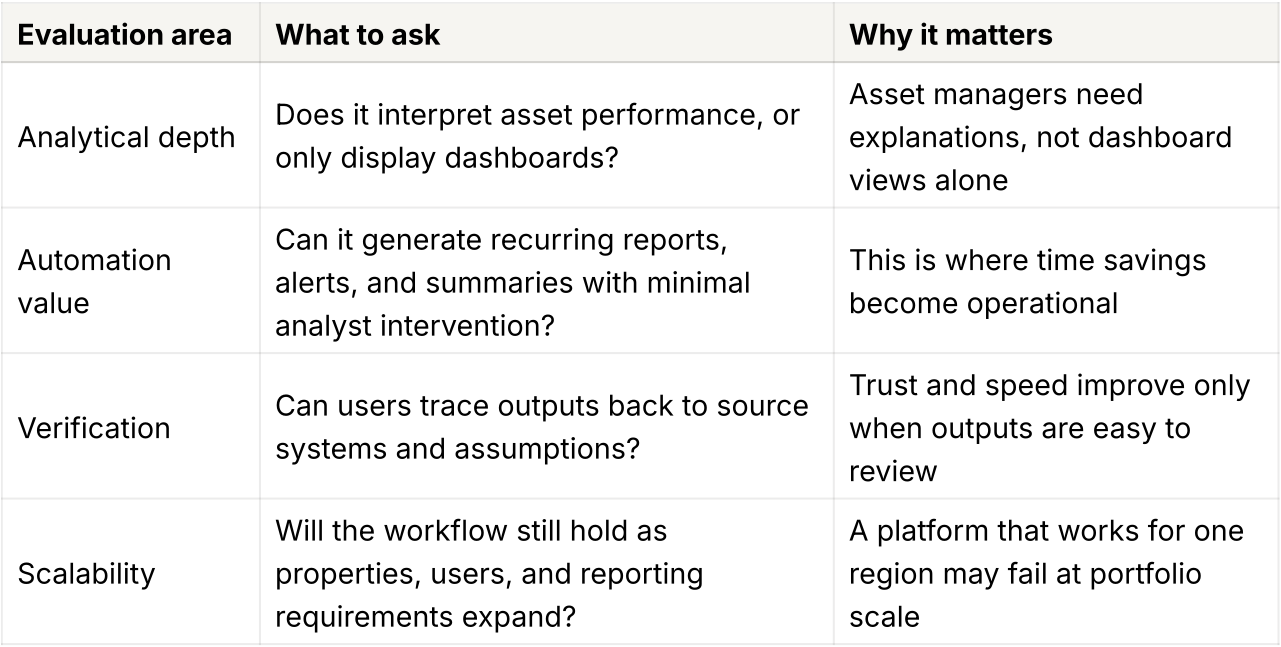
A practical way to evaluate those criteria is to ask whether the platform reduces manual handoffs in your team’s most common workflows. If analysts still need to export, reformat, and rebuild outputs in separate tools, the efficiency gains may be smaller than they appear in a demo.
A practical framework for evaluating asset management technology
Asset managers need a decision framework that goes beyond a feature list. That framework should test whether the platform improves day-to-day execution across reporting, monitoring, and decision support.
Many of these trends reinforce one another. Tighter capital markets, higher reporting expectations, and resident demand for better service all point to the same conclusion: operational discipline now has a more direct relationship to investment performance.
ESG is more than a compliance checkbox
Sustainability is no longer only a branding issue. Asset management in 2025 and beyond will be shaped by ESG (Environmental, Social, and Governance) initiatives that affect financing options, operating costs, and tenant retention.
Institutional investors are demanding greater transparency in ESG performance, and regulatory bodies are tightening compliance requirements.
Multifamily asset managers will attract more capital and long-term tenants by proactively adopting:
Green building practices
Energy-efficient upgrades
Community-focused initiatives
For many operators, the practical shift is that ESG is moving from narrative reporting into operating execution. Energy use, resident well-being, vendor accountability, and governance standards are becoming performance topics instead of disclosure topics alone.
.png)
Evolving tenant expectations
Multifamily residents expect smarter buildings that respond to their needs. AI-driven leasing, automated maintenance requests, and real-time occupancy analytics are becoming standard tools for asset managers. These capabilities can improve operating efficiency, strengthen the resident experience, and support higher retention.
That expectation creates a double requirement for asset managers: improve the resident experience while still maintaining cost discipline. The properties that perform best are likely to use technology to remove friction instead of adding features for their own sake.
The push toward operational efficiency and cost optimization
In today’s market, operational efficiency has become a critical differentiator. Strong asset managers know that real efficiency requires more than blanket cost-cutting. It requires targeted optimization that improves the bottom line while protecting resident satisfaction.
Advanced analytics platforms are changing how multifamily properties manage operating expenses. Machine learning models can analyze historical maintenance data alongside real-time building sensors to predict equipment failures before they occur, typically reducing emergency maintenance costs by 15-20% while improving resident satisfaction.
Leading asset managers are leveraging data analytics across key operational areas:
Energy management:
Smart building systems that automatically adjust HVAC based on occupancy and weather
Real-time utility monitoring with automated alerts for unusual patterns
Maintenance optimization:
Predictive maintenance scheduling based on equipment usage patterns
Mobile-first maintenance systems that improve response times and first-time fix rates
Vacancy management:
AI-driven marketing systems that optimize advertising spend
Predictive analytics for lease renewals and automated showing systems
This trend stands out because cost optimization is becoming more granular. Instead of broad cuts across categories, technology allows teams to identify exactly where spending creates value, where it creates risk, and where it should be reduced.
Proptech consolidation and the rise of all-in-one solutions
Fragmented technology stacks are quickly becoming a liability. Trends indicate that asset managers are gravitating toward integrated, end-to-end platforms that simplify portfolio oversight.
Instead of cobbling together multiple tools for different aspects of asset management, many teams are moving toward unified solutions that integrate core workflows. These platforms reduce friction in data management, improve automation, and increase reporting accuracy. All three factors matter for optimizing asset performance in 2025.
The key question is whether consolidation reduces work or simply relocates it. A true all-in-one solution should remove manual reconciliation, shorten review cycles, and preserve context across tasks. If it does not, the portfolio may still suffer from the same operational drag under a cleaner interface.
How leading asset management teams are responding in 2025
Strong teams are not trying to transform everything at once. They identify the highest-friction workflows and improve those first.
1. Start with recurring reporting workflows
Monthly portfolio reporting, variance commentary, and asset-level performance reviews are often the easiest places to create immediate value. These tasks are repetitive, time-consuming, and highly dependent on cross-system data.
2. Build verification standards early
As automation increases, teams need clear standards for what must be checked before reports, alerts, or recommendations are circulated. Source traceability, assumption clarity, and approval processes matter as much as speed.
3. Expand into predictive and scenario-based workflows
Once baseline reporting is stable, the next step is using AI and analytics to support scenario testing, operational forecasting, and capital allocation decisions across the portfolio.
4. Measure whether the new process actually reduces friction
Teams should track reporting hours saved, turnaround time to first draft, response time to portfolio issues, and how often analysts still need to rebuild outputs manually. That is how technology adoption becomes measurable rather than aspirational.
Security and governance considerations
Trust should be part of any asset management technology review. These workflows often involve financial statements, investor materials, leasing data, and internal business plans. The more automation a team adopts, the more important it becomes to preserve auditability and control.
Role-based access so sensitive portfolio and investor information is restricted appropriately
Audit trails that show what was generated, reviewed, and approved
Clear standards for how source data is ingested, stored, and refreshed
Governance protocols for exceptions, anomalies, and manual overrides
Security matters here because trust in the workflow determines adoption. If teams can verify outputs quickly and understand how conclusions were reached, they are far more likely to rely on the system in live decision-making.
Preparing for the next era of asset management
Asset managers face a challenging 2025, but the opportunity is real for teams that can improve execution. Multifamily asset managers who understand current trends, invest in practical technology, and adapt to changing economic conditions will be better positioned for long-term success.
As AI and BI improve decision-making, and ESG becomes a central part of investment strategy, asset managers need a practical plan for adoption. Choosing the right asset management platform, using predictive analytics, and building stronger reporting workflows will help teams compete.
Asset management in 2025 is becoming less about isolated tools and more about connected execution. Teams gain an edge when they can move from data to verified action quickly, consistently, and across the full portfolio. For firms exploring that direction, Leni helps investors and operators automate reporting, analyze portfolio performance, and turn fragmented data into decision-ready outputs.
Discover the power of analytics to maximize returns on your investments. Get a free demo of Leni.

Johanna Gruber
Johanna has spent the last 8 years helping marketing teams connect with audiences through content. Specializing in B2B SaaS and real estate.

Curious About AI?
Join the largest AI community for real estate online. Get bite-sized, real-world use case videos, plus practical tips and proven strategies from top industry experts on adopting AI effectively.
MEET LENI
AI SuperAgent Purpose Built for Investors and Operators.
Experience how professionals and teams in your domain are getting the edge using AI.
