Investor reporting in real estate: a metric evidence pack
Investor reporting in real estate: a metric evidence pack
Investor reporting in real estate needs a clear path from a reported number to the records behind it. When you buy a real estate data warehouse, ask the provider to demonstrate that path for one metric. A dashboard total alone is not enough.
Use this fictional example to build a small evidence pack for monthly net operating income (NOI). All names, identifiers and amounts are invented test data in USD. The exercise tests traceability; it does not set your accounting policy or determine a distribution.
Start with the number the investor sees
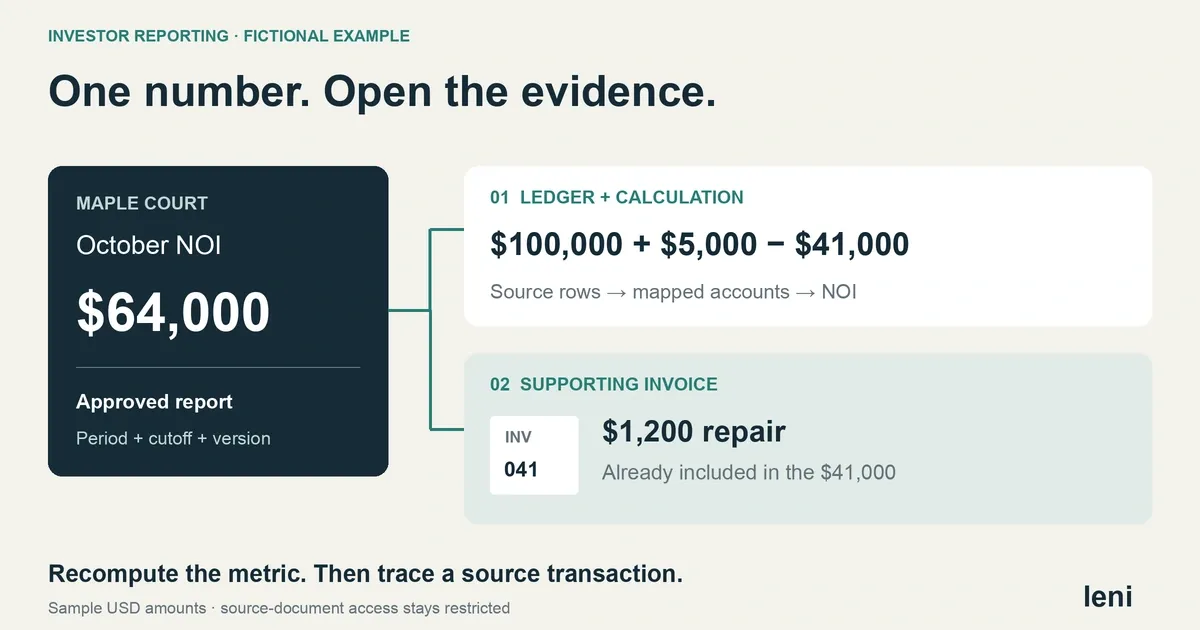
The sample report shows Maple Court, October 2026 NOI: $64,000. Its evidence pack must identify the property, reporting period, accounting basis, currency, included accounts and approved data cutoff. Give the report and its underlying data version separate identifiers so a reviewer can find the exact inputs used.
For this exercise, the reporting owner has approved an accrual-basis definition: rental revenue plus other operating revenue, less the included property operating expenses. Debt service, capital expenditures and depreciation are outside this example's calculation. Your finance team must approve the definition and account mapping for a real report.
Recompute the metric from structured records
Report component | Approved source amount | Evidence reference |
|---|---|---|
Rental revenue | $100,000 | Ledger export GL-1026-v1; mapped rental-revenue accounts |
Other operating revenue | $5,000 | Same export; mapped other-revenue accounts |
Included operating expenses | $41,000 | Same export; mapped expense accounts |
NOI | $64,000 | Calculation NOI-v1: $100,000 + $5,000 − $41,000 |
Retain the source rows, property and account mappings, calculation version and any approved adjustments. A reviewer should be able to run the same calculation against the retained inputs and get $64,000. A spreadsheet that contains only the final number cannot show how it was produced.
Open a document that supports one source row
Now trace a $1,200 repair expense within the $41,000 total. The warehouse row points to source transaction AP-041. That transaction points to invoice INV-041, version 1, page 1. The document reference must let an authorized reviewer open the correct invoice and check the amount, property and service description.
The $1,200 is already included in expenses. Do not add it to the calculation again. The invoice supports one transaction; it does not prove that the entire $41,000 expense total is complete or correctly classified. Reconcile the full account set separately.
This is where structured and unstructured data meet. The ledger rows support calculation. The document supports review of a specific transaction. Keep the link between them, plus the document version and review status. A PDF in a shared folder is not enough if the metric cannot identify which record it supports.
Keep a compact evidence record
Item | What the reviewer needs |
|---|---|
Report | Report ID, issue date, metric label, property and period |
Inputs | Source export ID, retained rows, cutoff time and time zone |
Rules | Approved definition, account mapping and calculation version |
Document | Transaction ID, document ID, version, page and permitted source location |
Review | Named owner, reviewer, decision time and unresolved exceptions |
Release | Approved report copy and the audience permitted to receive it |
Assign one owner to resolve missing references. A broken link or an unavailable invoice needs an explicit exception, rather than a claim that the figure is fully supported. Agree how documents remain retrievable when folders, source systems or permissions change.
Use three questions in the vendor demonstration
Can another reviewer reproduce $64,000? Start from the report, open the retained source rows and calculation, and reproduce the result without relying on the original preparer's memory.
Can the reviewer explain the $1,200 expense? Follow the transaction reference to the correct invoice version. Confirm that the amount is a component of expenses, not another adjustment.
What can an investor actually see? Demonstrate separate staff and investor access. Permission to view a report must not automatically expose internal invoices, tenant details or another property's records.
Record the observed result and any manual steps. Ask the provider to repeat the test with a missing document and with a user who lacks source-document access. If AI drafts an explanation, its source references and summary must follow the same access rules.
For later corrections, retain the issued report and use a labeled, approved revision. Our late-posting test covers that version-control exercise. Our warehouse validation example checks whether matching totals hide incorrect property allocations.
Scope the data foundation with Leni
Owning your AI starts with your data. Leni's real estate data warehouse service brings approved property and finance records together with selected document fields and source references. Use Leni's prebuilt warehouse or connect your existing warehouse.
Bring one investor-reporting metric, one closed period and the supporting records. Agree which data and documents are in scope, who approves definitions, who can open the evidence and how exceptions will be handled. Use the evidence pack as a concrete acceptance test before expanding the work.

Zain Nathoo
Co-founder & COO at Leni, writing about the systems, data, and AI behind better investment decisions.

Curious About AI?
Join the largest AI community for real estate online. Get bite-sized, real-world use case videos, plus practical tips and proven strategies from top industry experts on adopting AI effectively.
MEET LENI
AI SuperAgent Purpose Built for Investors and Operators.
Experience how professionals and teams in your domain are getting the edge using AI.