Why NOI Can Fall Even When Occupancy Improves
Why NOI Can Fall Even When Occupancy Improves
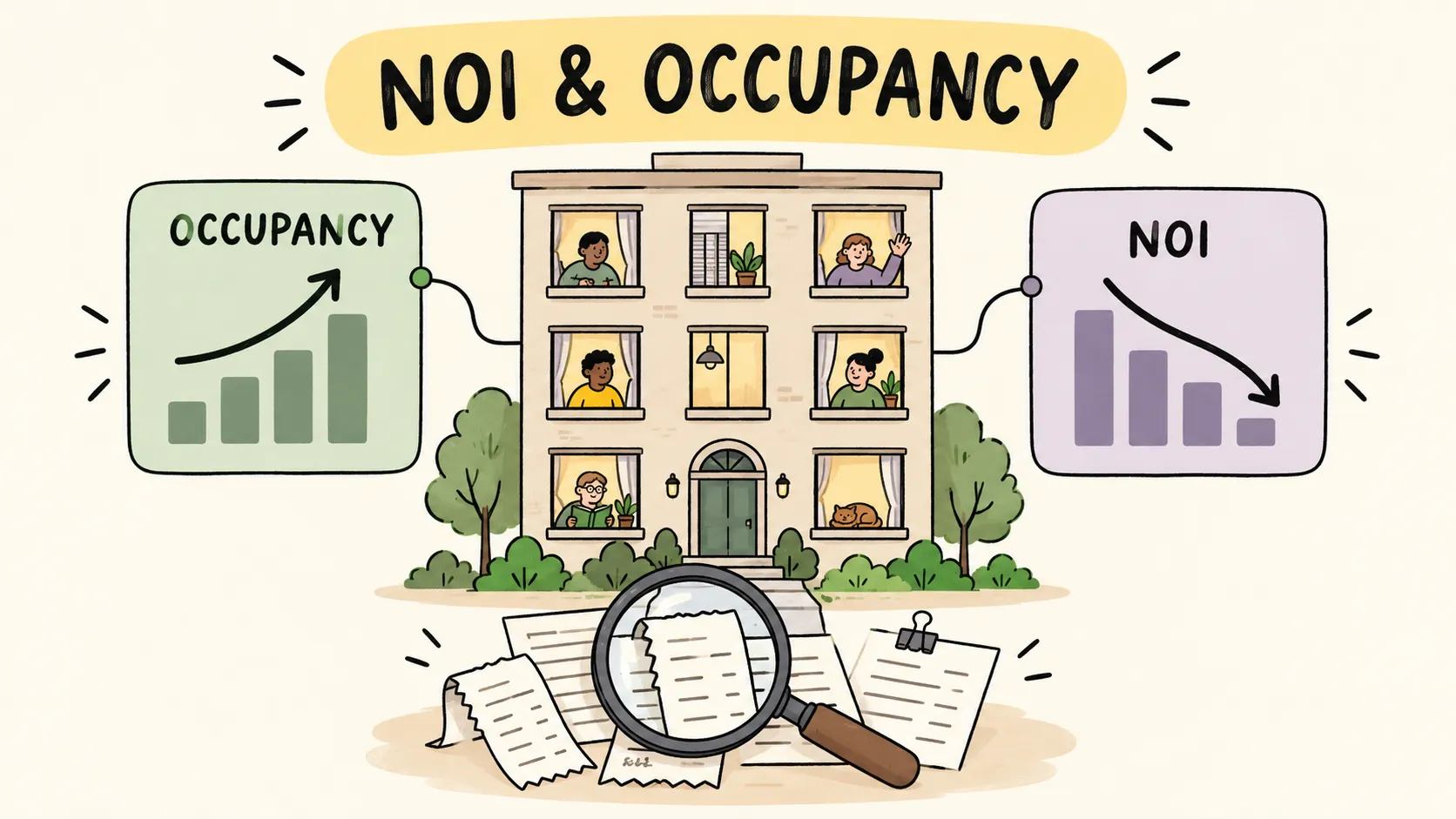
NOI can fall while occupancy improves because filling more units does not guarantee higher net income. Concessions can reduce rent earned, collections can lag, other income can weaken, or operating expenses can grow faster than revenue. Before changing the leasing strategy, reconcile the income statement and check that the occupancy and financial figures describe the same period.
A fuller building and a weaker operating result can both be accurate. The useful question is what changed between the two.
Start with the income statement, not the occupancy headline
Net operating income is effective gross income minus operating expenses. Fannie Mae uses this relationship in its multifamily analysis-of-operations definitions. Debt service is a separate part of cash-flow analysis, so a higher mortgage payment does not, by itself, explain lower NOI.
Physical occupancy measures the units occupied. It does not tell you the rent each unit contributes, the concessions attached to that lease, or the costs of operating the property.
There is also a timing trap. A month-end occupancy snapshot may reflect move-ins that contributed only a few days of rent. Compare average occupancy or occupied unit-days when the question concerns income earned throughout a month.
A simple example: occupancy rises, NOI falls
The figures below describe a fictional 100-unit property. They illustrate the arithmetic, not a Leni customer result or an industry benchmark.
Measure | Prior month | Current month | Change |
|---|---|---|---|
Month-end occupied units | 92 | 95 | +3 |
Effective gross income | USD 180,000 | USD 184,000 | +4,000 |
Operating expenses | USD 80,000 | USD 86,000 | +6,000 |
NOI | USD 100,000 | USD 98,000 | −2,000 |
Income increased, but expenses increased more. The occupancy improvement is real; it simply did not offset the additional cost in this period.
This table identifies the size of the problem. It does not establish the cause. To explain the change, the reviewer still needs the underlying revenue accounts, invoices, accruals, and lease information.
Build the explanation in four passes
1. Reconcile rental income
Start with scheduled rent and work through the adjustments used in your reporting policy. Separate changes in occupied units from lease rates, move-in timing, concessions, and bad debt.
Do not mix cash collected with accrued revenue. A resident paying late can affect cash before the accounting treatment affects NOI. Confirm the accounting basis before describing collections as the cause.
2. Check other income
Review parking, storage, reimbursements, and other material income lines. A prior-month one-off receipt can make the current month look weak even when the recurring business is stable.
Keep the comparison honest: recurring income should be compared with recurring income, with unusual items shown separately.
3. Isolate expense drivers
Break the expense change into categories before attributing it to “higher costs.” Was there a utility-rate change, a catch-up accrual, more unit turns, a repair invoice, or a payroll allocation change?
For each material movement, distinguish a confirmed cause from an explanation that still needs evidence. “Insurance increased by USD 4,000” is a measured change. “The renewal caused the increase” requires the policy or invoice.
4. Check the comparison itself
Confirm the same property set, reporting period, accounting basis, and account mappings. Reclassifications can move amounts between categories without changing total NOI. A newly acquired property can change portfolio totals even if the existing properties are performing consistently.
Turn the analysis into an operating decision
A useful explanation has three parts: the amount, the supported cause, and the next check.
For the fictional example, an initial note could read:
NOI declined by USD 2,000. Effective gross income improved by USD 4,000, while operating expenses rose by USD 6,000. Month-end occupancy increased from 92 to 95 units. Review the expense detail and move-in dates before deciding whether this is a recurring margin issue or a timing effect.
That is more useful than saying “occupancy is up, but profitability is down.” It tells the team what is known and what still needs investigation.
Use Leni to organize the review
With the relevant authorized data available, Leni can support portfolio analysis and variance review using the Universal Data Model and your reporting context.
Try a specific request:
Compare this property’s NOI with the previous closed month. Separate revenue and expense changes. Show the reporting periods and definitions used, identify missing evidence, and do not infer causes that the source data does not support.
Keep a reviewer responsible for confirming the explanation before it enters an investor report. Available data and analysis depend on your connected systems, permissions, and implementation.
Questions asset managers ask
Should we reduce rents if occupancy rises but NOI falls?
Not from those two figures alone. First determine whether the decline comes from rent economics, operating costs, or accounting timing. A leasing decision should address the verified driver, not just the occupancy percentage.
Can Leni explain this across several property managers?
We can support cross-system analysis when the sources and mappings are in scope. Your team still needs consistent NOI definitions and reporting periods; a shared model does not make unlike periods comparable.
Where should we start?
Choose one closed month and one property with a material NOI movement. Reconcile that example before applying the process to the whole portfolio. Talk to Leni about your reporting workflow.

Leni
Purpose-built AI analyst for investment finance and real estate. Leni runs persistent workflows across underwriting, market research, memos, and reporting so teams can move faster with higher confidence.

Curious About AI?
Join the largest AI community for real estate online. Get bite-sized, real-world use case videos, plus practical tips and proven strategies from top industry experts on adopting AI effectively.
MEET LENI
AI SuperAgent Purpose Built for Investors and Operators.
Experience how professionals and teams in your domain are getting the edge using AI.
