How to Write a Real Estate Budget Variance Explanation
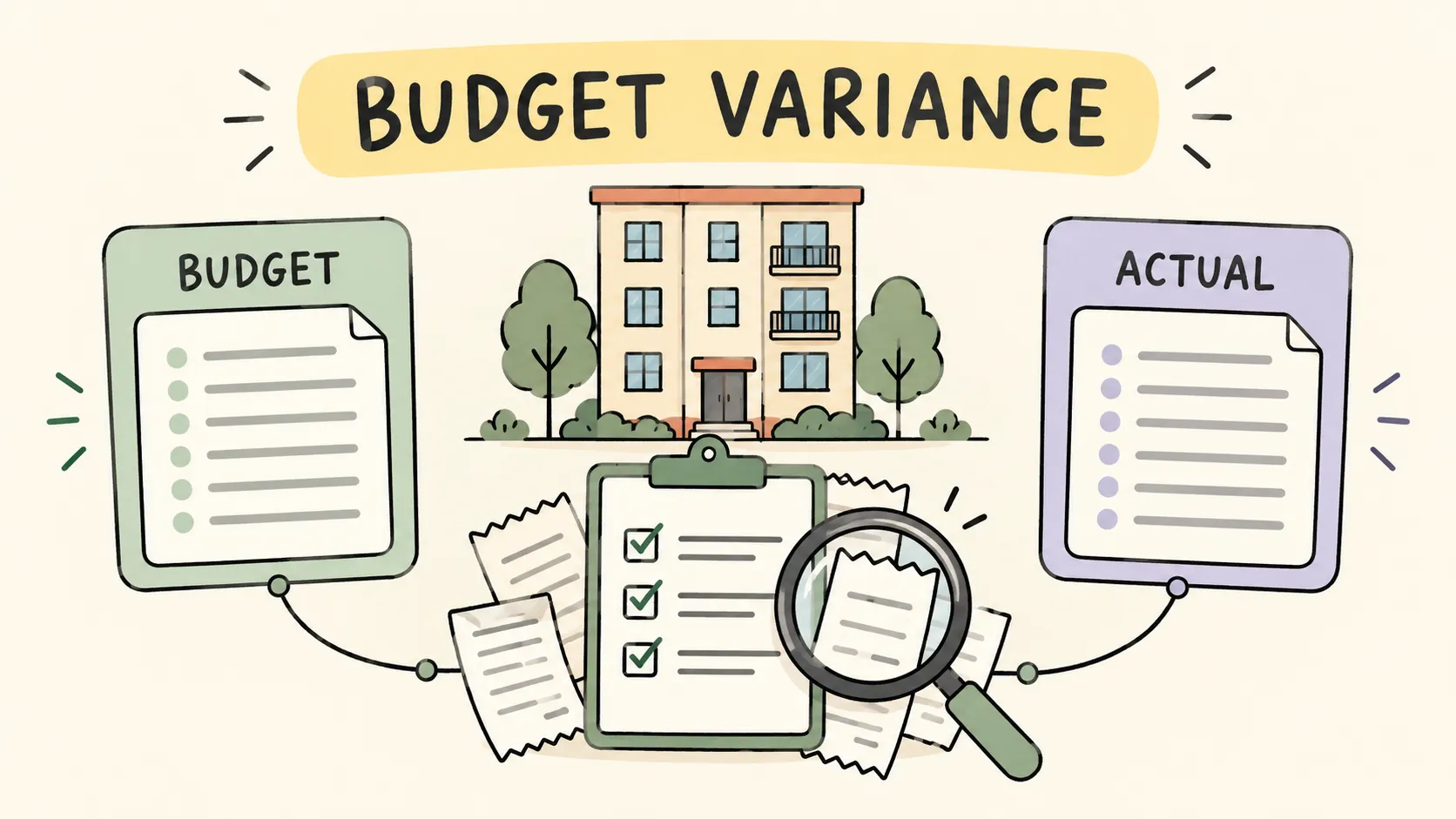
How to Write a Real Estate Budget Variance Explanation
A useful real estate budget variance explanation states what changed, how much it affected NOI, what evidence explains the change, and what the team will do next. It should distinguish confirmed causes from open questions rather than turning every difference into a confident narrative.
The aim is not to describe every account. It is to help an asset manager or investor understand the material movements without reopening the entire workbook.
Start with one sign convention
For this guide, variance means actual minus budget. Under that convention, revenue above budget is generally favorable and expenses above budget are generally unfavorable.
Label favorable or unfavorable explicitly. A positive number alone does not tell the reader whether the result is good.
For percentages, divide the difference by the absolute budget amount and state the convention. If the budget is zero, report the dollar amount and mark the percentage as not meaningful. Do not manufacture an infinite or 100% variance.
Reconcile the NOI movement first
Here is a fictional monthly report. All amounts are in USD.
Measure | Budget | Actual | Actual minus budget |
|---|---|---|---|
Effective gross income | 250,000 | 244,000 | −6,000 |
Operating expenses | 150,000 | 156,000 | +6,000 |
NOI | 100,000 | 88,000 | −12,000 |
The NOI shortfall is USD 12,000: USD 6,000 from lower income plus USD 6,000 from higher expenses. Explaining only the largest expense account would leave half the movement unexplained.
Reconcile the totals to the approved reporting source before writing the commentary. Confirm that the budget version, property set, and reporting period match.
Give each material variance a short evidence record
For every material line, capture:
Budget, actual, dollar variance, and the reporting period.
The transaction, schedule, invoice, or operating measure supporting the explanation.
Whether the difference is timing-related, one-off, or expected to continue.
The action owner and next review date.
Anything the team has not yet confirmed.
Set materiality with the people who use the report. A percentage threshold alone can overemphasize tiny accounts; a dollar threshold alone can miss meaningful changes at smaller properties.
Write the explanation in four sentences
Use this sequence: result, evidence, outlook, action.
For the fictional report, suppose the supporting records confirm an additional USD 6,000 in concessions, USD 4,000 in utility costs, and USD 2,000 in repairs. A draft might read:
NOI was USD 12,000 below budget. The ledger and leasing schedule reconcile the shortfall to USD 6,000 in additional concessions and USD 6,000 in higher utilities and repairs. The team has not yet confirmed how much of the expense increase will recur. The property manager will review the relevant invoices and concession commitments before the next forecast update.
The numbers are illustrative. The final sentence deliberately avoids promising a recovery that has not been supported.
Compare that with “NOI underperformed because of market conditions.” The shorter sentence sounds complete but gives the reader no evidence and no next step.
Keep timing differences visible
An annual invoice posted in one month can create a large monthly variance. A late accrual can do the same. Explain the reporting treatment without hiding the item or changing the approved accounts.
Show both the monthly and year-to-date view when useful. If an expense is expected to recur, carry that question into the forecast. A budget explains the original plan; a forecast reflects the latest supported expectations. See our multifamily budget forecasting guide for that distinction.
Ask Leni for a first draft with evidence gaps
Where the relevant sources are available, Leni can support variance and portfolio review. Give it the reporting context, not just the two totals:
Compare actuals with the approved budget for these properties and this closed month. Reconcile the NOI difference. Draft explanations for material items, separate evidence from hypotheses, and list the missing invoices or operating data needed to confirm the causes.
Review the result before distribution. If the source only proves that an account increased, the narrative should not claim to know why.
Questions reporting teams ask
Can Leni write the commentary in our reporting style?
We can use the reporting instructions and relevant context available to the workflow. Define the audience, sign convention, materiality rules, and preferred level of detail. Availability depends on your plan, permissions, and implementation.
Should every variance have an explanation?
Prioritize material items and unusual patterns. Small recurring differences can be grouped when that does not hide an important issue.
Is this the same as a zoning variance?
No. This guide concerns financial differences between budget and actual results. A zoning variance is a separate land-use concept.
Talk to Leni about making your variance review easier to repeat.

Leni
Purpose-built AI analyst for investment finance and real estate. Leni runs persistent workflows across underwriting, market research, memos, and reporting so teams can move faster with higher confidence.

Curious About AI?
Join the largest AI community for real estate online. Get bite-sized, real-world use case videos, plus practical tips and proven strategies from top industry experts on adopting AI effectively.
MEET LENI
AI SuperAgent Purpose Built for Investors and Operators.
Experience how professionals and teams in your domain are getting the edge using AI.
