Real estate data dictionary: separate zero from missing
Real estate data dictionary: separate zero from missing
A real estate data dictionary for property management must explain what a blank means. A confirmed zero, a missing amount and a charge that does not apply are different facts. If a warehouse converts all three to zero, a report or AI answer can look complete while evidence is missing.
Start with one field and a small test file. The example below shows the definition, evidence and reporting rules a buyer can ask an implementation team to deliver. The field names, unit identifiers and amounts are fictional. They are not vendor fields or a Leni API contract.
Write a definition that a reviewer can test
Use a monthly parking charge as the example. Define the amount separately from its evidence status. An empty amount must not carry several meanings that only the analyst remembers.
Dictionary item | Example definition |
|---|---|
Business meaning | Recurring contractual parking charge assigned to a unit for the selected month. Excludes one-time fees and payments received. |
Record scope | One property, unit and reporting month. Preserve source identifiers and the approved mapping. |
Amount and unit | A decimal amount in USD per month for this test. Keep currency and frequency explicit; do not combine other currencies or annual amounts without an approved conversion. |
Status | Confirmed, missing or not applicable. Store the reason separately from the numeric amount. |
Evidence | Source record, effective period and supporting document reference where required. Record who reviewed an exception. |
Owner and version | A named operations owner approves the meaning and allowed statuses. Record the definition version and its effective date. |
A data dictionary describes a field's meaning and rules. A data model describes how records relate. Our Universal Data Model guide explains the broader structure. Standards can also provide naming patterns: RESO's Data Dictionary organizes listing data into resources, fields and lookup values. Check the fit before applying a standard to an operational charge.
Keep three states separate
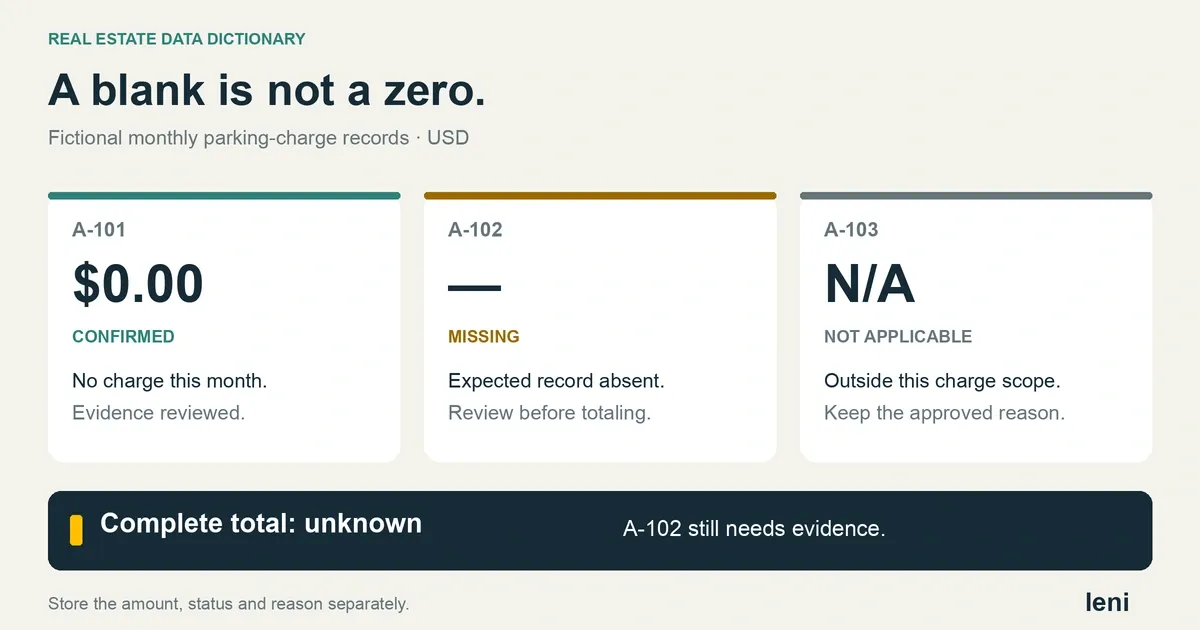
These are invented test records under the definition above. A reviewer has confirmed the first and third states. The second record still needs evidence.
Unit | Amount | Status | Meaning and report behavior |
|---|---|---|---|
A-101 | 0.00 USD | Confirmed | The record confirms no recurring parking charge for this month. Display $0.00. |
A-102 | No value | Missing | The expected charge record was not supplied. Display “Missing” and route it for review. Do not assume no charge. |
A-103 | No value | Not applicable | The approved scope says this charge concept does not apply to this unit. Display “N/A” with its reason. |
For this test, the known applicable amount is $0.00, but the complete applicable total is unknown because A-102 is unresolved. A report can show a partial amount if it labels the missing record. It must not present that amount as a complete total. “Not applicable” does not mean “not supplied.”
Do not put “N/A” into a numeric column or use an unexplained negative sentinel value. Keep the amount, status and reason as separate fields. A validation rule should reject a confirmed record without an amount and flag a not-applicable record that also has a charge.
Test the warehouse, report and AI answer
Ask the implementation team to load the three records into a test copy and show the result at each stage. Confirm that an import default, spreadsheet formula or report setting does not replace the missing value with zero.
Then ask the AI: “Show this month's parking charges for my authorized units. Separate confirmed zero, missing and not applicable. State whether the total is complete and identify the evidence needed for unresolved records.” The answer should preserve the three states and the user's permitted property scope.
Finally, supply a fictional approved charge of $125.00 for A-102. The current complete applicable total should become $125.00. Confirm that the old missing record is resolved, rather than added as a second charge. Preserve the prior report, the new evidence and the correction time so a reviewer can explain the change.
Resolve the cause before changing the value
A missing source record, a failed extraction, an unsupported field and a permission limit need different follow-up actions. Preserve those reasons. A restricted value must not be converted to zero or exposed to a user who cannot access it.
When a lease or amendment supplies evidence, keep its reference and effective date beside the reviewed field. Do not let an extracted number silently overwrite an approved record. Our lease-document connection guide covers that review path.
Leni's real estate data warehouse service brings approved property records and document evidence into reporting and AI workflows. Your team approves definitions and exceptions. Start the implementation discussion with a completed field definition, these three test states and the expected report behavior.

Zain Nathoo
Co-founder & COO at Leni, writing about the systems, data, and AI behind better investment decisions.

Curious About AI?
Join the largest AI community for real estate online. Get bite-sized, real-world use case videos, plus practical tips and proven strategies from top industry experts on adopting AI effectively.
MEET LENI
AI SuperAgent Purpose Built for Investors and Operators.
Experience how professionals and teams in your domain are getting the edge using AI.