Anthropic⇄OpenAI
Your workflows stay
Independence.
Work in your preferred AI. Choose models for each task while keeping your data foundation, company knowledge and controls.
Keep your options open ↓Use your portfolio data in Claude or ChatGPT, or build a custom app for your business. Bring what you’ve already built. Leni can run the infrastructure behind it.
Grow income. Reduce the cost of work. Keep what makes you different.

Start with Leni’s prebuilt real estate data warehouse or connect the warehouse you already have. Connect your assistant through MCP, or build an app on the same data through the API. Both use your definitions and permissions.
Start with the sources your workflow needs.
Built on the Universal Data Model.
Ask which properties are over budget, or put the same figures in your asset managers’ dashboard.
Start with one portfolio or workflow. We confirm the sources, history, refresh schedule and access your team needs.
See the data foundation ↓Independence. Automation. Ownership. One foundation for the way your business works.
Work in your preferred AI. Choose models for each task while keeping your data foundation, company knowledge and controls.
Keep your options open ↓Move from prompts to repeatable work. Connect sources, run checks and deliver reports and apps, with people approving what matters.
See the work move ↓Keep approved agent traces, decisions and corrections. Build a record of how your business works, ready for future model training.
See the long game ↓The model gets the right evidence and business rules for the task. Approved work becomes knowledge you can reuse.
Start with one project. The apps, rules and decisions you build around it can serve the next one.
Ask a question in your usual AI, build a new app or bring a prototype. Start with the same approved property data.
Save the sources, checks and corrections behind each approved decision. Reuse them the next time the same question comes up.
Test a specialist model on work your team has approved. Move to private cloud or your own compute when the results justify it.
Compare work-order dates with rent-ready dates. Check the source records before deciding where to intervene.
Show the same units, the next task and who owns it. Track days to rent-ready to see whether the process improves.
Company-reported results. Your rollout and savings depend on the work.
You retain your source data and agreed exports of company context, approved outputs and decision records. The build defines ownership and access for custom apps, workflows, training datasets and any models trained for you.
An agent trace records the sources used, tool calls, results, checks and human decisions. It can include explanations deliberately recorded by the workflow. It does not assume access to a model provider’s hidden internal reasoning.
Personal context stays separate from approved company knowledge. Only authorized, reviewed work enters a training set. The agreement defines reuse restrictions, retention and export formats.
The numbers, answers and reports your team needs, ready for review.
See what changed. Prioritize the income at stake.
A morning brief in Teams. An inbox with owners and drill-down.

“How did the portfolio do against budget, and why?” Ask in plain language and trace the answer to the close.
Teams, Slack, Claude or ChatGPT. One governed foundation.

Accounting and manager data become your recurring pack.
Your formats. Your review rules. Less manual assembly.
Accounting and manager data arrive.
Tied to the ledger. Exceptions go to review.
Your brand. The right view for each audience.
Draft privately. Review with your team. Publish to approved users.

Ask which leases roll below market, compare clauses or test a model assumption alongside the financial data.
SharePoint knowledge becomes part of the work.
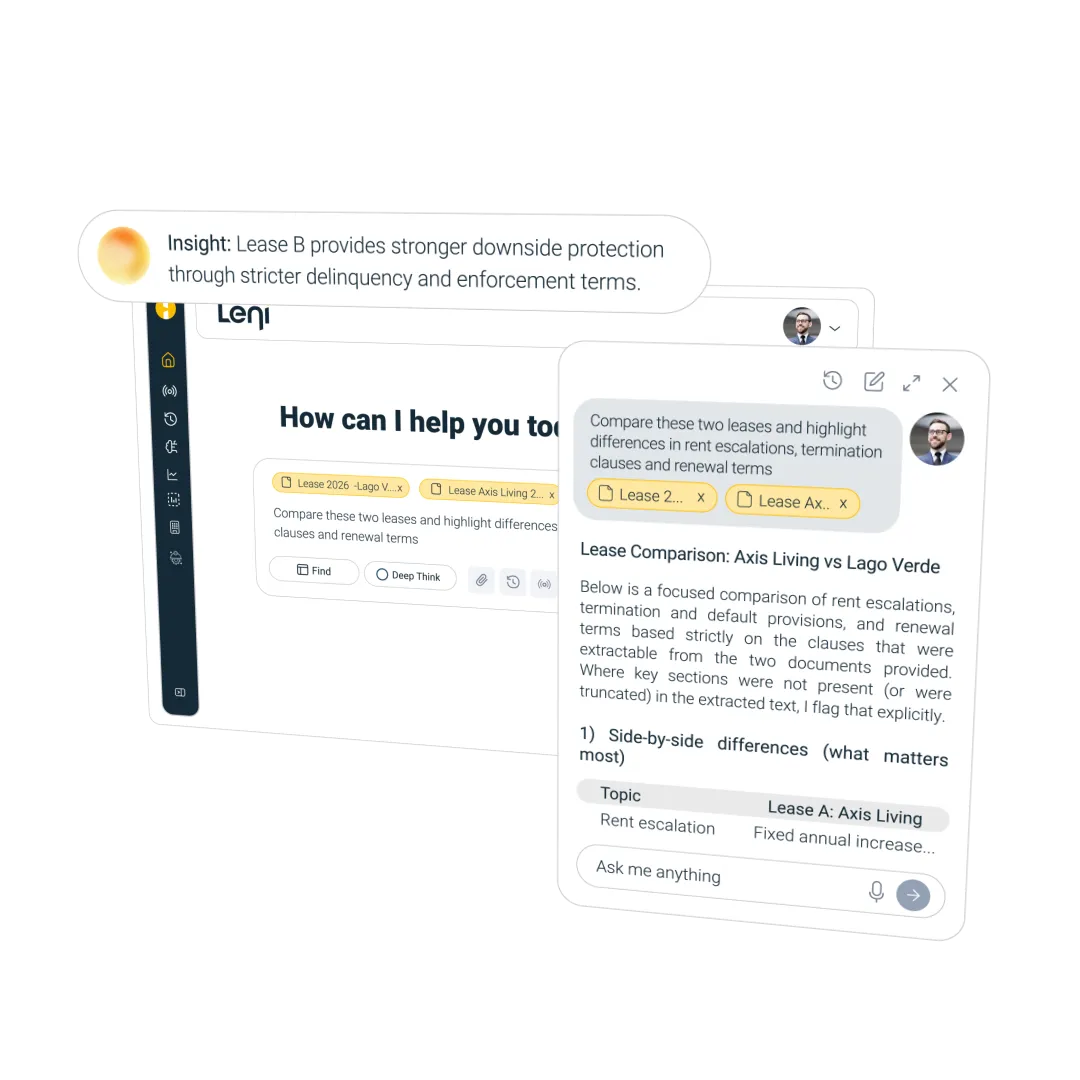
Example working day built around existing Leni capabilities. Connections, schedules and approval rules are configured for your organization.
Product walkthroughs using Leni’s existing interface. Availability and configuration depend on your organization.
Keep the investment logic and operating decisions that make your business different.
Sources · actions · recorded reasoning · review
Only reviewed, authorized work becomes reusable company knowledge.
Your company’s memory. Connected to the source.
Your definitions and decisions guide each task. Evidence comes from the source, with the user’s permissions.
Company-reported internal evaluation against a chunk-and-vector baseline, with the base model held constant. Results describe the evaluated workload.
Your prebuilt real estate data warehouse.
Leni brings supported source data into one real estate model. Use consistent numbers across managers and systems, then access them from your AI, reports or apps.
Company-reported platform figures. Specific systems, objects and permissions are confirmed for your implementation.
Portfolio data, history and your definitions, organized by Leni.
Connect a compatible assistant through MCP or give your custom app access through the HTTP API.
MCP stands for Model Context Protocol. It lets a compatible AI assistant call Leni’s tools for the data and analysis a task needs. Each user signs in to Leni and approves access within their organization and permissions.
The warehouse holds the shared data foundation. MCP is the connection to it through Leni’s tools. Source coverage, history and refresh cadence are scoped with your team.
Reconcile supported ERP structures into one model.
Flag inconsistent data before analysis.
Trace transformed numbers back to their sources.
Scope historical imports and maintain mappings as sources evolve.
Deterministic checks and a separate observation step sit around the model.
100,000+ decision traces across 30,000+ interactions inform Leni’s specialized models. Company-reported evaluations show 99.6%+ task accuracy and about 65% lower cost to reach the evaluated result. Results depend on the workload and baseline.
Your approved work can become a private training set. Model training and deployment follow the scope, rights and evaluations agreed with your team.
Yardi, third-party managers, Microsoft 365, SharePoint, Snowflake, models and market data connect into the same governed foundation. The existing connector estate includes 1,500+ managed connections; confirm the specific sources in discovery.
A semantic layer gives metrics their business meaning. The runtime coordinates permitted tools, context and checks. Developers connect through the HTTP API; compatible assistants connect through MCP with Leni OAuth and the user's approved scope.
Teams, Slack, Outlook, Excel, Claude, ChatGPT, Copilot and company apps use the appropriate supported integration. The UDM and RKG are two patent-pending mechanisms within this wider system.
Independent examination. Report scope and period available for review.
Agree the environment, residency and sandbox boundaries with IT.
Access follows the user’s permissions in supported connections.
Define private training, derived-data use and retention in your contract.
Trace sources, changes, decisions and agent actions.
Keep company context useful as models and systems evolve.
Leni has completed a SOC 2 Type II examination. The public report reference period is February 7 to May 7, 2024. Request the latest issued report for its scope and period. Data is encrypted in transit and at rest.
Agree private-cloud or customer-environment deployment, residency, source access, retention, model providers and operational responsibilities. Source permissions and isolation must be tested in the selected connections and deployment.
Leni’s current published terms permit some de-identified and derived data use for training and other purposes. A separate customer agreement defines any additional restrictions for your ownership plan.
Bring an idea, a spreadsheet workflow or a working prototype. We review it with your team, keep what works and agree what it needs to go live.
Pilot with one team. Leni can maintain the connections, resolve failures and ship agreed changes as more properties come on.
Agree the first workflow, data readiness and delivery milestones together. Track time to a trusted output, the cost per approved result and the income opportunities acted on.
Use approved agent traces to test and improve specialist models. Expand only after the workflow meets your team's quality, security and ownership requirements.
Marcio Sahade brings 14 years at Hines and Tishman Speyer across asset management, acquisitions and capital raising.
The data model, company knowledge graph and agent runtime. Two patent-pending foundations, with specialized models trained on real decision traces.
From scoping to adoption, alongside your sponsor, data owners and IT team. An existing platform serving 30+ organizations.
Company-reported platform scale from the supplied reference materials.
Your build starts with an existing platform. Connection, approval and app scope are agreed for your organization.
A shared roadmap connects the executive pilot to a wider rollout.
Connect the first assets. Put an executive app and recurring report into use.
Move approved reporting workflows, connect documents and models, and extend daily insights.
Expand team agents and investor views. Keep approved decisions and traces in your company context.
Timing follows scope and readiness. Business owners guide decisions; IT reviews access; Leni builds alongside your team.
One set of reconciled numbers across reports, apps and answers. Less report assembly. Earlier action on income and operating issues. Fewer overlapping tools where consolidation makes sense. Company context and training data that remain usable as models or property systems change.
Model and source-system changes still need compatibility checks and mapping updates. A stable company data and context layer reduces the work of rebuilding applications around each change.
Choose the workflow with a clear owner and a measurable business return.
Use your own data in real meetings before deciding on the wider investment.
Agree the scope and select an initial 5–10 buildings. Map the data and reconciliation rules.
Draft the apps. Your business and IT owners check the numbers, access and outputs.
Leaders use the apps in real meetings. Review adoption, reconciled numbers and reporting time saved.
Bring a portfolio question or an app you’ve started. Agree what to pilot, who will run it and how you’ll measure the result.