Leni vs ChatGPT Real Estate: The Right AI for Your Work

Leni vs ChatGPT Real Estate: The Right AI for Your Work
The conversation around leni vs chatgpt real estate has intensified as investment professionals seek clarity on which AI tool genuinely solves their daily challenges. ChatGPT revolutionized public awareness of artificial intelligence, offering fast responses and impressive versatility across countless use cases. Yet real estate and investment finance professionals face a different question: when does a general-purpose chatbot serve you well, and when do you need a purpose-built, accuracy-verified system designed specifically for financial workflows? The answer reshapes how we think about AI categories entirely.
Understanding the Core Difference: General AI vs Finance-Grade Systems
ChatGPT is a general-purpose language model designed to handle conversations across every imaginable topic. It excels at brainstorming, drafting emails, summarizing documents, and generating creative content. OpenAI built it to be broadly useful, not deeply specialized.
Leni represents a fundamentally different category. This is a purpose-built AI analyst system designed explicitly for investment and asset management workflows. Rather than maximizing conversational breadth, Leni delivers accuracy-focused performance across commercial real estate, private equity, and adjacent investment sectors.
The Architecture Behind Each System
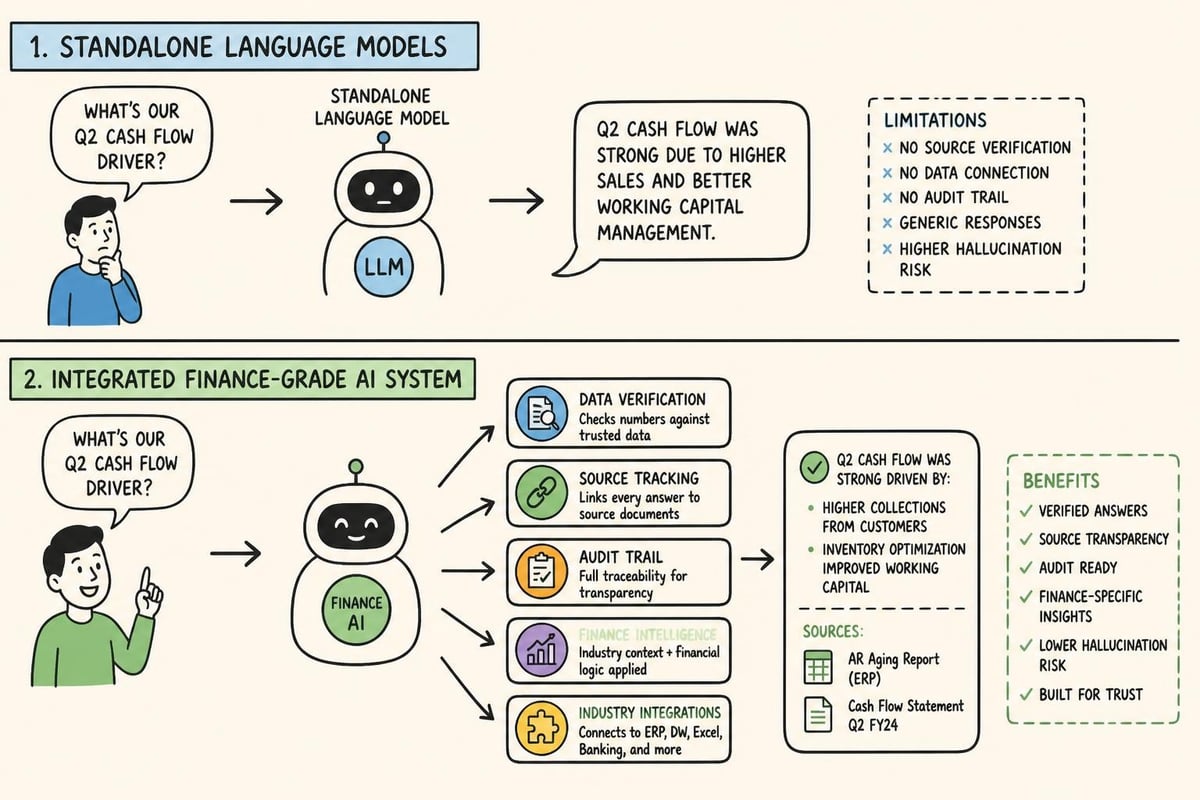
When examining leni vs chatgpt real estate applications, understanding the underlying architecture matters:
ChatGPT operates as:
A standalone language model trained on broad internet text
A response generator that prioritizes fluency and coherence
A system without native data verification or source tracking
A tool requiring users to fact-check all outputs independently
Leni functions as:
A model-agnostic platform that can run GPT or other LLMs inside a governed framework
An accuracy-checked system with source-traceable outputs
A finance-native reasoning engine trained on investment workflows
An integrated platform connecting core systems like Yardi and RealPage
The distinction is not GPT versus something else. Leni can use GPT as one component. The real question is whether you need a raw language model or a complete finance-grade workflow system. According to independent AI benchmarks, purpose-built systems demonstrate measurably superior performance on domain-specific tasks.
Where ChatGPT Excels in Real Estate Work
ChatGPT deserves honest recognition for what it does well. For real estate professionals, it provides genuine value in specific scenarios that do not require verified accuracy or financial-grade precision.
Rapid Ideation and Content Creation
ChatGPT handles these tasks effectively:
Drafting property marketing descriptions
Generating email templates for investor communications
Brainstorming negotiation strategies
Creating initial outlines for investment memoranda
Summarizing lengthy lease agreements for quick review
These applications share a common thread: they benefit from speed and creativity, and humans review the output before it matters. A property description can be edited. A brainstorming session generates ideas you will verify anyway.
Document Summarization and Research Assistance
When you need to process large volumes of text quickly, ChatGPT performs admirably:

The pattern is clear: ChatGPT excels when you need a fast first draft that you will verify independently. It does not connect to your actual deal pipeline, property management systems, or financial models.
Where Leni Serves Investment Finance Professionals
The leni vs chatgpt real estate comparison shifts dramatically when accuracy becomes non-negotiable. Investment decisions, asset management reporting, and financial underwriting require verified outputs with traceable sources.
Enterprise-Grade Accuracy and Source Verification
Leni topped four major AI benchmarks, outperforming systems from OpenAI, Anthropic, Google, and Perplexity on tasks relevant to commercial real estate and investment finance. This performance difference reflects fundamental architectural choices.
Source-traceable outputs mean:
Every calculation links back to its originating data point
Financial projections show their methodology transparently
Market analysis cites specific comparable properties
Assumptions are documented and auditable
This matters when your output informs a $50 million acquisition decision or quarterly investor reporting. You cannot afford hallucinated rent rolls or invented cap rate assumptions.
Native Integration with Core Systems
Solo professionals upload their own documents without requiring integrations or AI expertise. Enterprise teams connect Yardi, RealPage, and other core systems for governed reporting at scale.
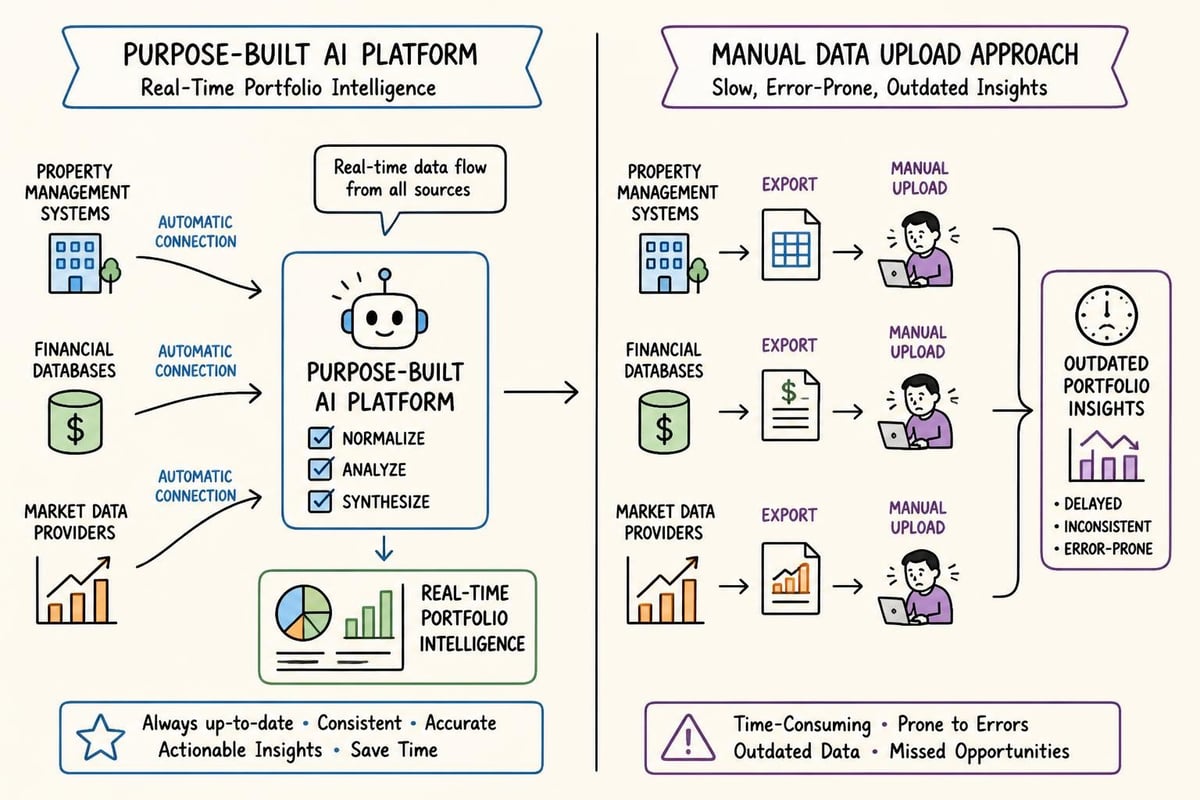
The integration capability transforms how leni vs chatgpt real estate workflows actually function:
ChatGPT: Requires manual copy-paste of data, disconnected from live systems
Leni: Pulls directly from property management platforms, financial databases, and market data providers
This is not a minor convenience feature. It is the difference between asking an AI to draft something based on what you tell it versus querying an AI that already has verified access to your entire portfolio.
The Solo Professional vs Enterprise Team Equation
Different user profiles find value in different places when evaluating leni vs chatgpt real estate solutions.
Solo Practitioners and Small Teams
A single real estate agent or small investment shop may find ChatGPT's versatility appealing. You can:
Use it for dozens of different tasks across your business
Access it immediately without specialized setup
Pay a simple monthly subscription
Handle the fact-checking burden yourself
Yet even solo professionals working on AI for real estate investment face moments when accuracy cannot be compromised. Underwriting a new acquisition, modeling cash flows, or analyzing portfolio performance demand verified calculations.
Leni serves solo professionals who upload their own documents. No integrations required. No AI expertise needed. You get finance-grade accuracy on the tasks where it actually matters, without building technical infrastructure.
Enterprise Organizations and Investment Firms
For organizations managing substantial portfolios, the leni vs chatgpt real estate decision becomes clearer. Enterprise needs include:
Governed reporting that meets audit and compliance standards
Consistent methodology across analyst teams
Real-time data access from integrated core systems
Version control and workflow management
Security protocols appropriate for sensitive financial data
ChatGPT cannot meet these requirements. It lacks enterprise-specific context, seamless industry data integrations, and the audit trail that regulated investment work demands. Commercial real estate technology in 2026 must deliver more than conversational AI.
Workflow-Specific Comparisons
Breaking down leni vs chatgpt real estate by specific workflow reveals where each tool genuinely adds value.
Deal Underwriting and Financial Modeling
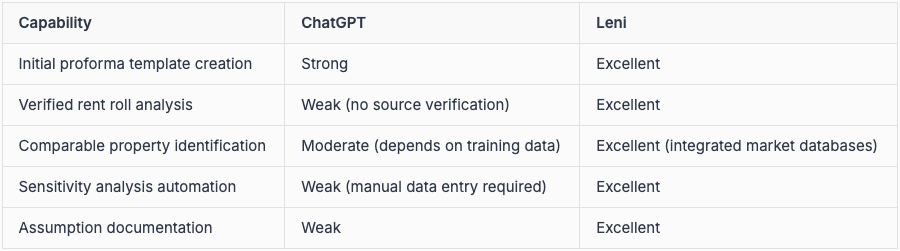
AI underwriting in real estate requires more than generating a spreadsheet template. It demands verified market data, transparent methodology, and traceable calculations. This is where how AI integration enhances real estate analytics becomes critical.
Portfolio Reporting and Asset Management
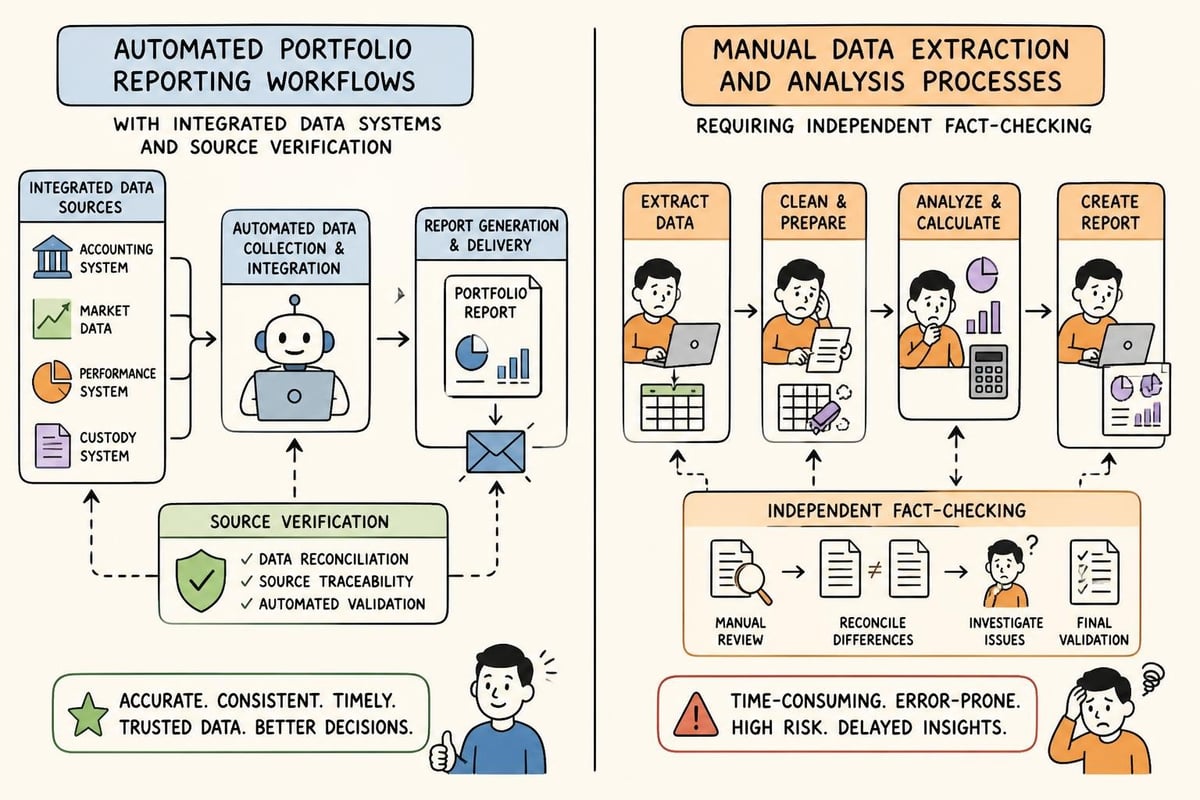
Monthly and quarterly reporting exemplifies why accuracy trumps conversational fluency. Consider the workflow:
With ChatGPT:
Export data from property management system
Manually format for ChatGPT
Request analysis or summary
Independently verify all numbers
Manually format output for stakeholders
Repeat monthly with no workflow memory
With Leni:
System automatically pulls current data from integrated platforms
Analysis runs with verified calculations
Output includes source attribution
Format templates maintain consistency
Workflow repeats automatically with audit trail
The time savings matter. The error reduction matters more. When you are reporting to investors on asset performance, you cannot afford a hallucinated occupancy rate or invented NOI figure.
Market Research and Competitive Analysis
Both tools offer value here, but differently:
ChatGPT serves well when:
Synthesizing publicly available market reports
Generating hypotheses about market trends
Creating initial research frameworks
Brainstorming competitive positioning strategies
Leni excels when:
Analyzing actual transaction comparables from verified databases
Tracking portfolio performance against market benchmarks
Identifying investment opportunities through systematic screening
Generating source-attributed market intelligence reports
The distinction returns to verification. If you are exploring ideas, ChatGPT works fine. If you are making capital allocation decisions based on market analysis, you need real estate market analysis backed by verified data sources.
The Model-Agnostic Advantage
One critical aspect of leni vs chatgpt real estate often gets overlooked: Leni is model-agnostic. The platform can run GPT as one component within a larger, governed system.
This architecture means:
You get the language capabilities of leading LLMs
Plus the accuracy verification layer
Plus the finance-native reasoning
Plus the integrated data access
Plus the audit trail and governance
You are not choosing between GPT and something inferior. You are choosing between a raw model and that same model integrated into a finance-grade workflow system. The comparison is not ChatGPT versus a competitor chatbot. It is standalone conversational AI versus purpose-built investment intelligence.
Security, Governance, and Compliance Considerations
Enterprise adoption of AI in investment finance faces regulatory and security hurdles that consumer chatbots were never designed to address.
Data Security Requirements
ChatGPT: Inputs may be used to train future models unless you opt for enterprise plans
Leni: Built from inception with enterprise-grade security protocols appropriate for sensitive financial data
Audit Trails and Compliance
Investment firms operate under regulatory frameworks requiring documented decision-making processes:
Source attribution for all data points
Methodology transparency for calculations
Version control for reports and analyses
User access logging
Data retention policies
ChatGPT offers none of these capabilities natively. Purpose-built platforms like Leni for asset management include them as fundamental features because they understand the regulatory environment investment professionals navigate.
Complementary Tools, Not Direct Competitors
Reframing leni vs chatgpt real estate as an either-or question misses the actual use case reality. Many professionals use both tools, applying each where it genuinely fits.
Use ChatGPT for:
Email drafting and communications
Creative brainstorming sessions
General research and learning
Content creation that you will edit
Quick summarization of public documents
Use Leni for:
Financial underwriting and modeling
Portfolio performance analysis
Investment monitoring and reporting
Market research requiring verified data
Any output that informs capital decisions
The real question is not which tool to choose. It is understanding when you need conversational AI for ideation and when you need finance-grade accuracy for decision-making. Real estate AI tools serve different purposes across your workflow.
The 2026 Investment Professional's AI Stack
Forward-thinking investment teams recognize that AI adoption is not about picking a single tool. It is about assembling the right capabilities for each workflow component.
The Emerging Pattern
Tier 1 - Ideation and Communication:
General-purpose AI for drafting, brainstorming, summarizing
ChatGPT, Claude, or similar conversational AI
Fast, creative, requires human verification
Tier 2 - Financial Intelligence:
Purpose-built AI for analysis, modeling, reporting
Finance-native platforms like Leni
Accurate, verified, source-traceable
Tier 3 - Core Systems:
Property management, accounting, market data
Existing enterprise infrastructure
Source of truth for operational data
The leni vs chatgpt real estate conversation evolves into understanding how these tiers work together. ChatGPT sits at Tier 1. Leni operates at Tier 2, often incorporating GPT's language capabilities within a governed framework while connecting to Tier 3 systems.
Which Tool Actually Serves You?
The honest assessment of leni vs chatgpt real estate comes down to matching tool capabilities with your actual needs.
Choose ChatGPT when:
You need versatile assistance across many domains
Speed matters more than verified accuracy
You have time and expertise to fact-check outputs
Your use cases are primarily creative or communicative
You work outside regulated investment workflows
Choose Leni when:
Financial accuracy is non-negotiable
You need source-traceable outputs for audit compliance
Your work involves portfolio management or investment underwriting
Integration with core financial systems adds value
You operate within regulated investment frameworks
Choose both when:
Different workflows have different accuracy requirements
You separate ideation from analysis
You want conversational AI for some tasks and finance-grade intelligence for others
Your team handles both creative work and quantitative analysis
The platforms serve fundamentally different purposes. Understanding AI agents in real estate clarifies that specialized systems deliver superior performance on domain-specific tasks while general-purpose models maintain broader versatility.
Cost-Benefit Analysis for Investment Teams
Budget considerations factor into any technology decision. The leni vs chatgpt real estate cost equation extends beyond subscription prices.
Direct Costs

Hidden Costs and ROI
The total cost equation includes:
Time spent manually verifying AI outputs
Risk of errors in financial calculations
Efficiency losses from disconnected systems
Compliance costs from inadequate audit trails
Opportunity cost of analyst time on low-value tasks
Leni's positioning addresses "time-intensive tasks that add limited value to businesses." Automating verified portfolio reporting, standardizing underwriting analysis, and integrating data sources creates measurable ROI beyond the subscription cost.
ChatGPT's lower price point reflects its general-purpose design. You pay less because you get a conversation tool, not an integrated financial intelligence platform. The question is not which costs less, but which delivers appropriate value for your specific workflow.
Future Trajectories and Market Evolution
The AI landscape in investment finance continues evolving rapidly. The leni vs chatgpt real estate comparison in 2026 will differ from 2027 and beyond.
General AI Improvements
OpenAI and competitors continue advancing language model capabilities:
More sophisticated reasoning
Better factual accuracy
Longer context windows
Multimodal capabilities
These improvements benefit everyone, including platforms like Leni that can incorporate advanced models within their governed frameworks.
Specialized Platform Development
Purpose-built platforms increasingly demonstrate transformative effects of AI in real estate through:
Deeper industry integrations
More sophisticated financial modeling
Enhanced verification mechanisms
Broader workflow coverage
The trajectory is not general AI replacing specialized systems. It is specialized systems incorporating better general AI components while maintaining their accuracy, verification, and integration advantages.
The leni vs chatgpt real estate decision clarifies when you understand that these tools serve different professional needs rather than competing directly. ChatGPT excels at creative ideation and rapid drafting; Leni delivers verified financial intelligence integrated with your core investment systems. Investment professionals increasingly recognize that the right approach combines fast conversational AI for appropriate tasks with purpose-built, accuracy-focused platforms for financial workflows where precision determines outcomes. Leni offers purpose-built AI designed specifically for the investment and asset management work that demands verified accuracy and source-traceable outputs, serving both solo professionals uploading their own documents and enterprise teams integrating core systems for governed reporting at scale.

Johanna Gruber
Johanna has spent the last 8 years helping marketing teams connect with audiences through content. Specializing in B2B SaaS and real estate.

Curious About AI?
Join the largest AI community for real estate online. Get bite-sized, real-world use case videos, plus practical tips and proven strategies from top industry experts on adopting AI effectively.
MEET LENI
AI SuperAgent Purpose Built for Investors and Operators.
Experience how professionals and teams in your domain are getting the edge using AI.
