AI Document Processing for Real Estate Teams: A Practical Guide
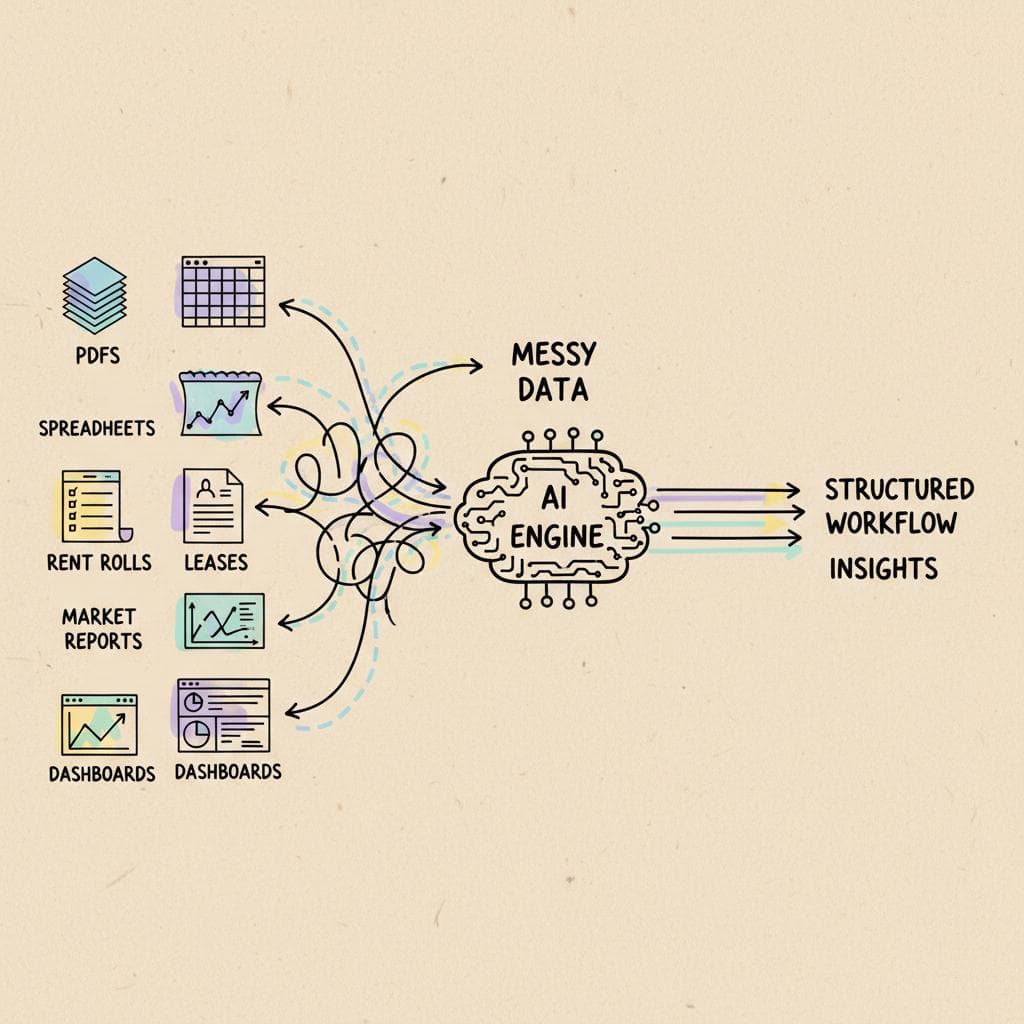
AI Document Processing for Real Estate Teams: A Practical Guide
AI document processing is the use of machine learning and language models to read documents such as leases, rent rolls, operating statements, offering memorandums and loan agreements, classify them, extract the fields that matter, validate those fields, and send the results to the systems where decisions are made. For a real estate firm, the value is not the extraction itself. It is that lease terms, financials and investor materials become structured data the firm owns and can reuse across reporting, underwriting and asset management.
This guide explains how automated document processing works, which real estate workflows it suits, what results to plan for and how to measure them, what drives cost, and how to implement it with data protection and human review in place.
TL;DR
AI document processing can classify documents, extract fields, validate them and route the output. Test unfamiliar layouts and review the results before relying on them.
The strongest real estate uses are lease abstraction, rent roll and operating statement extraction, portfolio reporting, underwriting inputs and investor communications.
Set targets per workflow and measure them against a before-and-after baseline. Separate hours released from cash actually saved.
Keep tenant-private data under clear controls, review all AI output, and consider Fair Housing Act risk in any workflow touching residents.
Total cost depends mainly on document variety, volume, integrations and the amount of human review, not on the extraction model alone.
What AI document processing is, and how it differs from OCR
Optical character recognition (OCR) converts an image of text into machine-readable characters. It does not know whether a number is a base rent, a CAM reconciliation or a page number. Traditional automated document processing adds rules and templates on top: the system looks for a label in a fixed position and captures what follows.
Rules and templates work well for standardized documents. Intelligent document processing adds machine learning and language models to classify documents and extract information from more varied layouts. The exact capabilities depend on the system and its configuration. See IBM's overview of intelligent document processing.
The difference matters in real estate because documents vary. Two leases for the same property type may place the same economic terms in different sections, under different headings, with different amendment structures. A fixed template may need adjustment for the second lease. A language model can use context to identify the term, but its answer still needs validation against the source.
Capability | OCR alone | Rules and templates | AI document workflow |
|---|---|---|---|
Read text from scans | Yes | Usually uses OCR | Uses OCR or visual models |
Find a business field | Needs additional logic | Uses labels, patterns or positions | Can use context, with validation |
Handle unfamiliar layouts | Can read text, but does not map business fields | May need template changes | May adapt, but needs testing |
Classify document types | Needs additional logic | Uses configured rules | Can use trained models or prompts |
Flag uncertain output | Some engines provide text confidence | Can flag rule failures | Needs configured checks and review criteria |
How automated document processing works, step by step
Most production systems follow the same sequence, whatever the vendor or the document type.
Ingestion. Documents arrive from email, data rooms, shared drives, property management systems or uploads. Scanned files pass through OCR first.
Classification. The system identifies each file: lease, amendment, estoppel, rent roll, T-12, appraisal, loan agreement. Packages containing several documents are split.
Extraction. The model pulls defined fields: tenant name, suite, commencement and expiration dates, base rent schedule, escalations, renewal options, security deposit, recovery structure.
Validation. Extracted values are checked against rules and against each other. Do the rent schedule and the stated annual rent reconcile? Is the expiration date after the commencement date? Does the unit exist in the property record?
Human review. Low-confidence fields and failed validations go to a reviewer, who confirms or corrects them.
Routing. Approved data flows into the reporting model, the underwriting file, the property management system or the document repository.
Human review can also supply examples for improving a workflow. The DICR contract-review research describes a trainable system that extracts information for human validation and downstream applications. Corrections improve a production workflow only when someone records them, updates its rules or models, and tests the change. Improvement is not automatic.
Real estate workflows where it pays off
Not every document workflow deserves automation. The best candidates share three traits: high volume, a repeating set of fields, and a downstream process that waits on the data.
Lease abstraction and lease data
Abstracting leases by hand takes time, particularly when a firm onboards a portfolio with hundreds of leases. AI can help extract candidate terms for review. Measure the time saved on your own lease set, including amendments and exceptions. Our guide to lease data automation for multifamily covers the fields and exceptions that matter.
Rent rolls, operating statements and portfolio reporting
Every property manager sends financials in a slightly different format. Extraction converts those files into a consistent schema, which means the monthly or quarterly portfolio report is assembled from structured data rather than rebuilt in spreadsheets. See our notes on AI reporting automation and on reporting for real estate portfolios.
Underwriting and deal analysis
During a deal cycle, analysts receive offering memorandums, rent rolls, T-12 statements and market reports within a short window. Pulling those inputs into a model is repetitive work that delays the actual analysis. Reading about automated underwriting in commercial real estate and about how AI accelerates deal cycles shows where the time is recovered.
Investor communications and memos
Investor updates and investment committee memos draw on the same source documents: operating results, leasing activity, budgets and market data. When those documents are already structured, drafting becomes a matter of selecting and checking, not retyping.
Asset management
Capturing lease expirations, covenant dates, capital plans and vendor contracts in structured form lets asset managers see risks earlier. Our overview of AI asset management strategies describes how that data supports hold and sell decisions.
How to use AI to process documentation in your firm
A workable first project is narrow. The following sequence suits most real estate teams.
Pick one document type and one downstream use. For example, rent rolls feeding the quarterly portfolio report, or leases feeding an expiration schedule.
Define the fields and the schema. List the exact fields, their formats and the validation rules. Decide in advance how amendments override base lease terms.
Assemble a test set. Use 30 to 50 real documents that include the awkward ones: scanned, amended, non-standard.
Record the baseline. Time the manual process and log its error rate before any automation.
Run in parallel. Have the AI output and a human reviewer both process the set, then compare field by field.
Set review thresholds. Decide which fields always receive human review, such as rent amounts and dates, and which can pass on high confidence.
Connect the output. Extracted data that lands in a spreadsheet nobody maintains has limited value. Route it into the reporting, underwriting or property management system.
Expand by document type. Add the next document only after the first is stable.
A general-purpose chatbot can help summarize a single lease. A repeatable portfolio workflow also needs a defined schema, validation rules, an audit trail and connections to the systems that use the data. Those capabilities depend on the product and how it is configured. Our article on using AI for real estate insights discusses practical uses and limitations.
What results to expect and how to measure them
Set targets using your own document sample and current process. Measure the manual baseline, run the proposed workflow on comparable documents, and include review and correction time. Report results by document type and field so easy cases do not hide errors in more difficult ones.
Track benefits at the process level. A faster extraction step matters when it shortens the work that follows, such as preparing a portfolio report or completing a first review of a deal.
Hours saved and cash saved are different measures. Record what the team does with released time. Count a cash saving only when spending actually falls, and subtract the cost of the tool, integration, review and ongoing maintenance.
A practical measurement set for a document workflow:
Field-level accuracy: correct fields divided by total fields, sampled by a reviewer.
Exception rate: share of documents needing manual correction.
Turnaround time: from document receipt to approved data.
Cycle time of the downstream deliverable: days to close the quarterly report or to complete first-pass underwriting.
Reallocated hours: what the released time was assigned to, in writing.
What affects the cost
Published prices for document processing vary widely because the work varies widely, so a single figure would mislead. The factors that move the total are consistent:
Document variety. One standardized form costs far less to automate than dozens of lease formats and amendment structures.
Volume and pattern. Steady monthly volume and one-time backlog conversions are priced and planned differently.
Integrations. Connecting to a property management system, accounting platform or data warehouse is often a larger part of the work than extraction.
Review burden. Higher accuracy requirements mean more human review time, which is a labor cost on your side.
Customization. Firm-specific fields, business logic and reporting formats require configuration.
Pricing model. Some tools charge per page or per document, others by subscription, and the two behave differently as volume grows.
When comparing options, ask for a pilot on your own documents and calculate cost per approved document, including review time, not cost per page alone.
Protecting data and keeping humans in the loop
Real estate documents carry tenant names, income details, identification numbers and financial terms. Guidance for the sector is direct on this point: the National Association of Realtors advises that property managers should keep sensitive or tenant-private data out of AI use, review all AI output, and consider Fair Housing Act risks.
Translate that into policy before rollout:
Decide which document classes may enter an AI workflow and which may not. Keep applicant screening files and resident identification out unless counsel has approved the controls.
Confirm where data is stored, whether it is used to train third-party models, and who can access it.
Require human approval for any output that reaches a tenant, an investor or a lender.
Keep an audit trail linking each extracted value to its source page.
Do not use AI output to make or support decisions about applicants or residents without review by qualified staff, and consult your fair housing counsel on those workflows.
For property management companies, AI for property managers outlines where these controls apply day to day.
Our perspective on owning the extracted data
Most document tools treat extraction as the product. We see it as the first step. A firm that extracts lease terms into a vendor's closed system has solved today's task and left its knowledge somewhere it cannot use freely. The more durable approach is for the firm to own the structured data, connect it to its systems and documents, and build AI workflows around its own business logic.
This is how we design Leni. The data extracted from a lease should serve the portfolio report, the underwriting model, the investor update and the asset plan from the same source, with the firm choosing which AI models to apply and how its workflows run. Generic tools cannot know how your team defines net effective rent, treats free rent periods or reports to a particular investor. Firm-specific logic is what turns extraction into decisions.
We also hold that human review is a feature, not a concession. Each correction a reviewer makes encodes how the firm reads its own documents. Captured properly, that becomes team knowledge that survives staff turnover. Over time, the company's accumulated knowledge becomes an asset that supports long-term value, not a set of files on a shared drive.
Putting it to work with Leni
Leni is an AI operating system for real estate businesses. It connects your systems and documents, lets you keep ownership of your data, and automates workflows around your own logic, from document extraction to portfolio reporting and investor communications.
If your first project is pulling structured data from leases, rent rolls and financial statements, start with our document extraction page. If the larger goal is faster, more consistent portfolio reporting, see reporting and asset management.
If your team needs additional analytical capacity while you build, our analyst offering adds specialists who work inside your AI workflows. To see the full platform, visit Leni.
FAQ
How can I use AI to process documentation?
Start with one document type, such as rent rolls or leases, and define the exact fields you need. Test the system on a set of real documents against a manual baseline, set review thresholds, and connect the approved output to the system that uses it. Expand to further document types once results are stable.
How much does AI document processing cost?
Cost depends on document variety, volume, integrations, review requirements and the pricing model. Ask for a pilot on your own documents and compare cost per approved document, including staff review time. For a Leni project, contact the team to scope your documents, outputs and controls.
Can I use ChatGPT to review a document?
A chatbot can summarize or answer questions about a document, but a reliable recurring workflow also needs consistent fields, source references, validation and review. Check which capabilities your chosen product supports. Keep confidential and tenant-private data out of tools that your organization has not approved, and check each answer against its source.
What is the difference between automated and intelligent document processing?
Automated processing typically relies on OCR and fixed rules, which suit standardized documents. Intelligent processing adds AI that can classify documents and extract fields from layouts it has not seen before, with less reconfiguration.
Which documents should a real estate firm automate first?
Choose those with high volume, repeating fields and a downstream process waiting on the data. Rent rolls, operating statements and leases usually qualify, because they feed reporting, underwriting and asset management directly.
Sources
Recommended

Leni
Purpose-built AI analyst for investment finance and real estate. Leni runs persistent workflows across underwriting, market research, memos, and reporting so teams can move faster with higher confidence.

Curious About AI?
Join the largest AI community for real estate online. Get bite-sized, real-world use case videos, plus practical tips and proven strategies from top industry experts on adopting AI effectively.
MEET LENI
AI SuperAgent Purpose Built for Investors and Operators.
Experience how professionals and teams in your domain are getting the edge using AI.