5 Ways to Cut Month-End Reporting Time Across Multiple Properties
5 Ways to Cut Month-End Reporting Time Across Multiple Properties
Five Practical Ways to Shorten Multi-Property Month-End Reporting
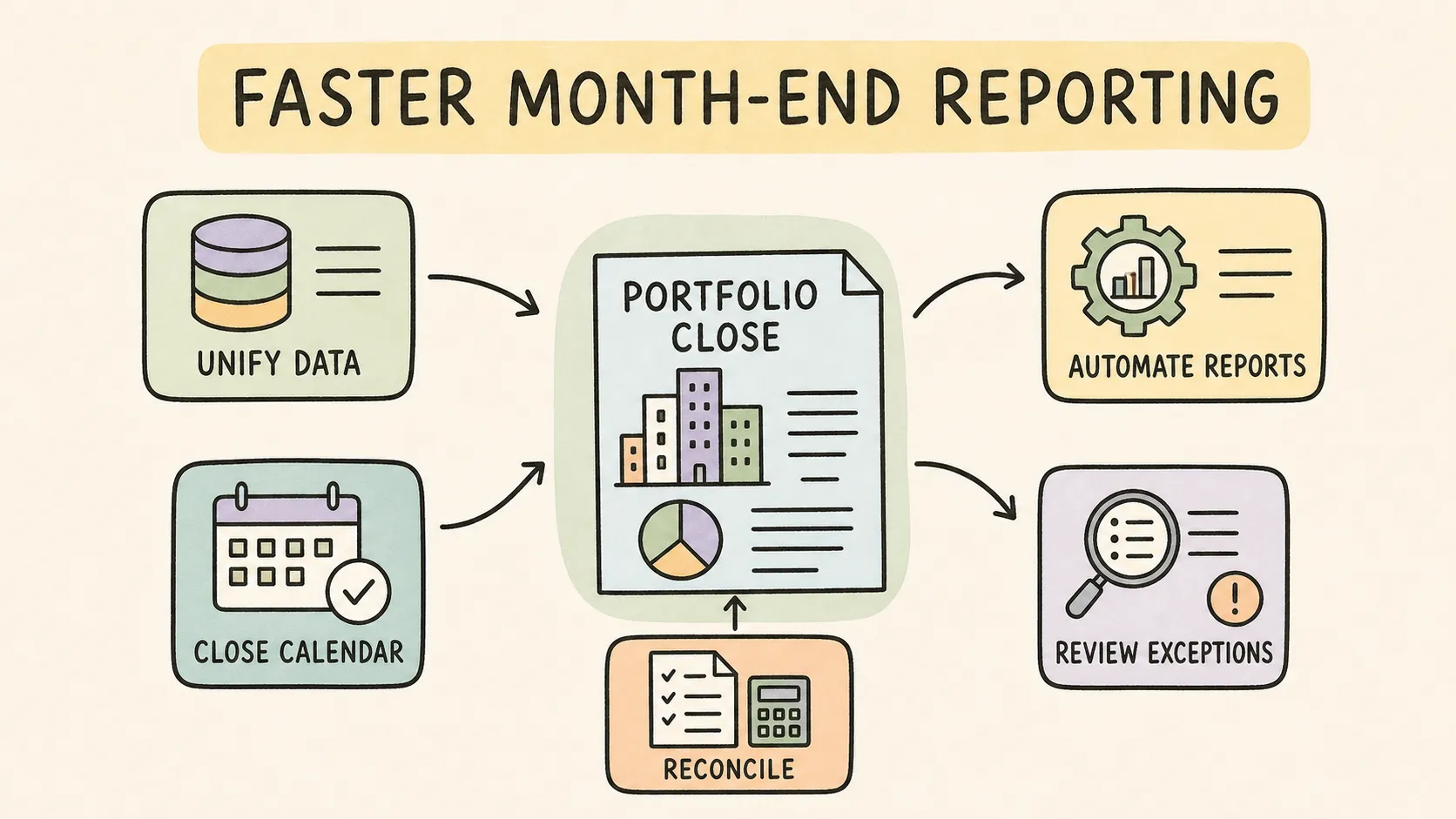
The most reliable ways to cut month-end reporting time across multiple properties are to unify source data, standardize the close process, reconcile throughout the month, automate repeatable reports, and review exceptions instead of every line item. The goal is not an arbitrary number of days. It is a controlled workflow that gives reviewers more time to investigate material changes and less time to assemble spreadsheets.
For real estate teams, the main constraint is often data fragmentation. Different properties may use Yardi, RealPage, Entrata, ResMan, or Rent Manager, while supporting schedules live in spreadsheets and shared drives. Each manual export, account mapping, and copy-and-paste step adds delay and another place for errors to enter the process.
This guide focuses on the operating model behind a faster close and explains where a universal data model, automation, and AI-assisted exception review can help.
Why Multi-Property Reporting Becomes Slow
A portfolio close repeats the same financial and operating tasks across many entities. The work becomes difficult when every property follows a slightly different process or produces data in a different format.
Data lives in separate systems. Teams sign in to multiple property management systems and download reports one at a time.
Account structures differ. Similar expenses may use different account codes or labels across entities.
Files require manual preparation. Rent rolls, general ledgers, occupancy reports, and budget files must be renamed, mapped, and combined.
Dependencies are unclear. A late bank reconciliation or missing accrual can delay portfolio-level reporting.
Review happens too late. Material variances may not be visible until the final workbook or presentation is assembled.
The practical fix is to reduce the number of manual handoffs between source systems, portfolio reports, and reviewers.
1. Consolidate Data Across Property Systems
A universal data model maps fields, account codes, property identifiers, and reporting periods from different systems into one consistent structure. It creates a shared data layer without requiring every property to use the same source application.
Consider a portfolio where one property produces a rent roll from Yardi and another produces an expense ledger from RealPage. In a manual workflow, an analyst exports both files, renames columns, maps account codes, checks the reporting period, and re-keys selected values into a portfolio workbook. In a normalized workflow, customer-authorized API feeds or ETL processes bring those records into a common model. The report then reads standardized fields instead of relying on repeated spreadsheet preparation.
Source item | Manual workflow | Normalized workflow |
|---|---|---|
Rent roll | Export, rename columns, and paste into a master workbook | Map property, unit, lease, and rent fields into a shared structure |
Expense ledger | Match local account codes to portfolio categories by hand | Apply a maintained account mapping during ingestion |
Occupancy and collections | Recalculate portfolio totals in separate spreadsheets | Roll standardized property records into the same reporting layer |
Clean, unified inputs also support more useful AI-driven multifamily portfolio analytics because every metric can be traced back to a consistent property, period, and source.
2. Standardize the Close Calendar and Chart of Accounts
Technology cannot repair an undefined close process. Use a portfolio-wide calendar that identifies what is due, who owns it, what it depends on, and who reviews it.
At minimum, document:
Task owner: the person responsible for completing each reconciliation or schedule.
Due date: the expected completion date relative to period end.
Dependency: the source task or file that must be available first.
Reviewer: the person responsible for sign-off.
Evidence: the report, reconciliation, or supporting document retained for review.
Pair the calendar with a standardized portfolio chart of accounts or a governed mapping from local accounts to portfolio categories. The mapping should have an owner, an approval process, and an effective date. When a new property or account is introduced, update the mapping once instead of improvising the classification during every close.
Before comparing properties, agree on which costs belong in operating expense ratio and which are controllable operating expenses. Consistent categories make the review easier to explain.
Make the process consistent without hiding property differences
Standardization does not mean every asset must operate identically. It means the same type of information follows the same reporting rules. Property-specific exceptions should remain visible and documented rather than being buried in spreadsheet formulas.
3. Reconcile Continuously During the Month
Waiting until period end to reconcile every balance creates an avoidable surge of work. Move repeatable checks earlier in the month and reserve the final close for genuinely period-dependent items.
Post and review routine rent, fee, and expense activity on a regular cadence.
Reconcile bank and control accounts weekly where the operating process allows it.
Investigate unusual account mappings when they first appear.
Track missing invoices, accruals, and owner approvals before the reporting deadline.
Maintain a visible exception list rather than relying on email threads.
This approach does not eliminate final review. It gives the reviewer a cleaner starting point and prevents old discrepancies from competing with current-period decisions.
4. Automate Repeatable Report Generation
Once source data is normalized and reconciled, recurring reports should use controlled templates instead of being rebuilt each month. Automation is most useful for outputs that follow a stable structure:
Actual-to-budget and prior-period variance reports.
Property and portfolio operating summaries.
Occupancy, collections, and delinquency reporting.
Owner or investor reporting packages.
Scheduled distribution to approved stakeholders.
Connect the reporting template to governed data fields, preserve the source lineage, and require review before external distribution. Leni supports automated recurring reporting across multiple properties using normalized portfolio data, so teams can spend more time explaining changes and less time updating slides.
5. Use AI for Proactive Alerts and Exception Review
AI is most valuable when it narrows the review set and shows why an item was flagged. It can surface occupancy changes, collection issues, budget variances, missing data, and unusual expense movements across the portfolio.
For example, imagine a monthly report containing 200 property-level metric lines. Instead of asking a reviewer to inspect all 200 with equal attention, an exception workflow might flag five lines whose values exceeded an approved threshold or changed materially from the comparison period. The reviewer still validates those items against the source records. The benefit is prioritization, not the removal of human judgment. The numbers in this example are illustrative; the actual review set depends on portfolio size, controls, and thresholds.
For a worked review, see why NOI can fall while occupancy improves. When a movement needs management commentary, use the budget variance explanation framework to separate the measured change from its supported cause and next check.
A useful alert should include the affected property, metric, reporting period, comparison value, source, and reason it was flagged. That context makes an AI agent for real estate auditable and actionable rather than another black-box score.
An Illustrative Before-and-After Workflow
The following comparison describes a workflow change, not a time-savings benchmark. Results will vary with portfolio complexity, source-system access, data quality, and the maturity of the close process.
Stage | Fragmented workflow | Improved workflow |
|---|---|---|
Data collection | Analysts download files from each system and maintain separate versions | Approved API or ETL feeds load source records into a governed data model |
Account mapping | Mappings are recreated or repaired in individual workbooks | A maintained mapping standardizes local accounts during ingestion |
Reconciliation | Most discrepancies are discovered at period end | Repeatable checks occur throughout the month and exceptions stay visible |
Report production | Slides and tables are updated manually | Controlled templates populate from reviewed data |
Management review | Reviewers search the full package for material changes | Exception flags direct attention to items that need investigation |
How to Evaluate the Right Tools
Different categories solve different parts of the close. Evaluate them against the actual bottleneck rather than selecting a tool solely from its category label.
Approach | Primary strength | What to verify |
|---|---|---|
Spreadsheets and task checklists | Flexible workflows for smaller teams | Version control, audit history, source lineage, and scalability |
Close-management platforms | Task orchestration, reconciliations, and sign-offs | Whether property-level operating data still requires separate preparation |
ERP and consolidation platforms | Entity-level accounting and financial consolidation | Implementation scope and access to each property management system |
Real-estate data and AI platforms | Cross-system normalization, portfolio reporting, and exception analysis | Authorized connectors, refresh cadence, mapping governance, security, and traceability |
For property-level cost comparisons, our expense benchmarking per unit guide explains how to keep the period, unit count and expense scope consistent.
Before implementation, confirm which systems and fields are supported, how data is authorized and refreshed, where transformations occur, and how users can trace a reported value to its source.
Frequently Asked Questions
What are the best ways to cut month-end reporting time across multiple properties?
Unify property-system data, standardize the close calendar and account mapping, reconcile during the month, automate stable report templates, and use exception rules to prioritize review. Measure improvements against your own baseline because portfolio complexity varies.
How can I combine Yardi, RealPage, and Entrata data into one report?
Use customer-authorized API access or ETL processes to bring the required records into a universal data model. Map each source's property identifiers, account codes, dates, and metric definitions to a governed structure, then connect the reporting layer to those standardized fields.
How do I automate a real estate month-end close?
Start with the repeatable parts: scheduled data ingestion, account mapping, reconciliation checks, controlled report templates, and approved distribution. Keep review and sign-off controls in place, and document how every reported value links back to its source.
How do I get proactive portfolio alerts on occupancy or collections issues?
Define the metric, comparison period, and materiality threshold for each alert. Run those rules against normalized portfolio data and include the property, source, value, and reason with every flag. Reviewers should be able to validate the alert before acting on it.
How long should month-end reporting take?
There is no reliable universal benchmark for every portfolio. Timing depends on the number of properties, systems, entities, approvals, reconciliations, and reporting requirements. Establish a baseline for data collection, reconciliation, report production, and review, then measure each process change against it.
Methodology and Scope
This article presents a process framework rather than a guaranteed performance benchmark. The examples are illustrative and should be adapted to each organization's accounting policies, internal controls, source-system permissions, security requirements, and review procedures.
Want to evaluate this workflow for your portfolio? Request a Leni demonstration to review your current data sources, reporting process, and exception-review requirements.

Marcio Sahade
Marcio writes about AI adoption in real estate, drawing on his work with operators, investors, and enterprise teams turning industry problems into practical workflows.

Curious About AI?
Join the largest AI community for real estate online. Get bite-sized, real-world use case videos, plus practical tips and proven strategies from top industry experts on adopting AI effectively.
MEET LENI
AI SuperAgent Purpose Built for Investors and Operators.
Experience how professionals and teams in your domain are getting the edge using AI.
